
Ukraine peace talks: Zelenskyy ready for front-line ceasefire, but what stands in the way?
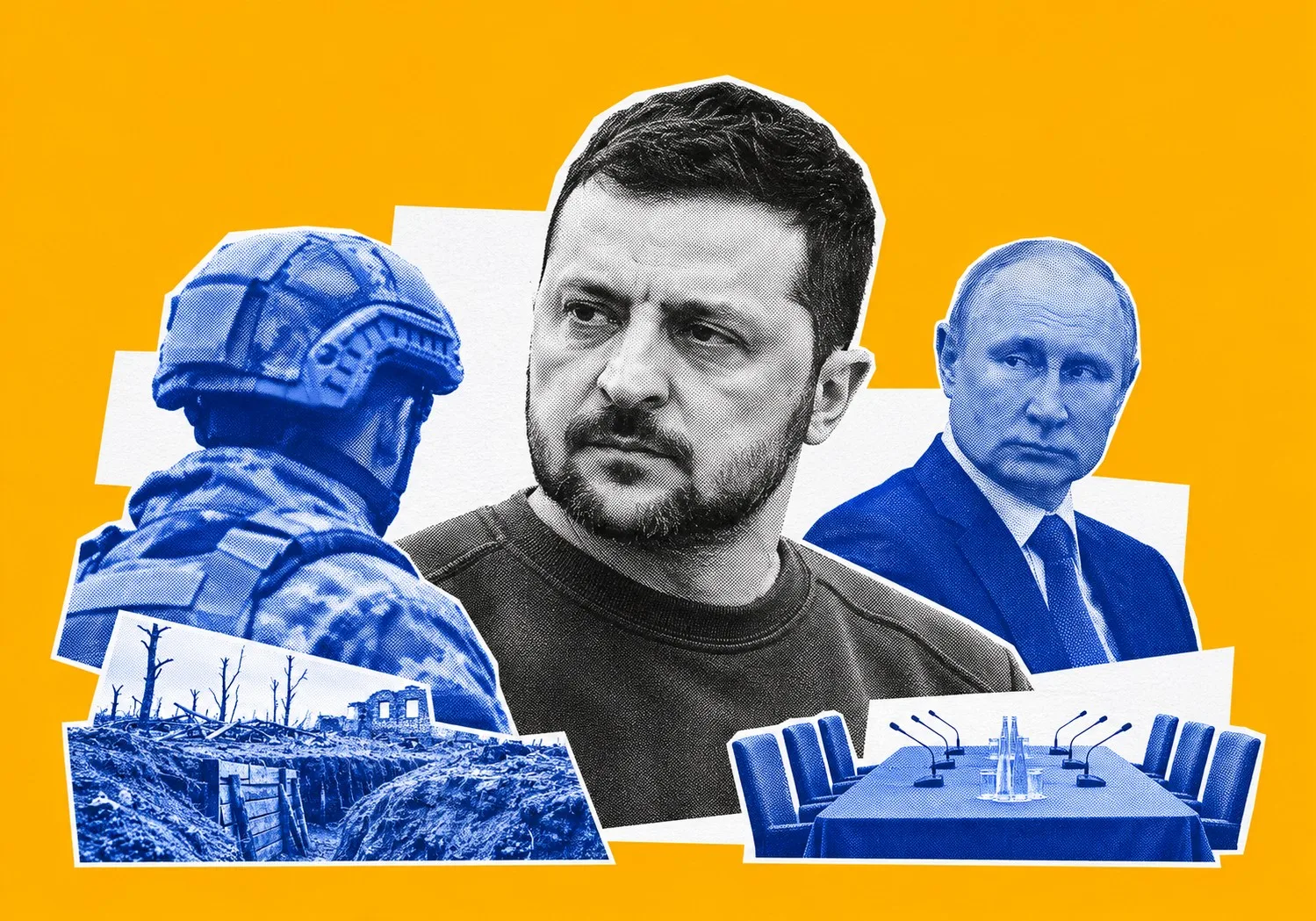
Ukraine is ready to halt fighting along the current front line, Volodymyr Zelenskyy has said, but Russia continues to demand a wider settlement before a ceasefire. US-led negotiations have yet to bridge divisions over territory and security guarantees, while European governments are seeking a direct role in shaping a deal. Speaking to Al Jazeera, the Ukrainian president described halting hostilities where the armies currently stand as a “very big compromise”. He also urged Donald Trump to keep seeking an end to the war without making Ukraine bear the cost of Russia’s invasion.

Zelenskyy’s proposal: stop fighting, then negotiate
The offer would leave Russian troops on Ukrainian soil while negotiations continued, without recognising Moscow’s sovereignty over occupied land. Kyiv would therefore accept a halt to hostilities before securing a full withdrawal, while leaving the territorial settlement for later negotiations.
Zelenskyy said territorial decisions must be taken by national leaders. He ruled out compulsory neutrality or limits on Ukraine’s armed forces and said Russia could not dictate the country’s security guarantees. He said technical groups could discuss other issues and prepare for negotiations between leaders.
In discussing the negotiations, Zelenskyy identified energy and maritime ceasefires, prisoner exchanges and preparations for a leaders’ meeting as areas where delegations could work towards results.
Zelenskyy set out the reasoning behind that position: Ukrainian resilience, unity between the United States and Europe, and the costs Russia incurs would shape Moscow’s willingness to accept a ceasefire. He warned that voluntarily abandoning the remaining Ukrainian-held parts of Donbas could encourage further Russian demands.
Russia’s response: conditions before a ceasefire
Moscow has continued participating in US-mediated negotiations while rejecting a ceasefire as the first step.
Its demands extend beyond retaining the land its forces occupy.
Moscow seeks recognition of its claims to Donetsk, Luhansk, Zaporizhzhia and Kherson, including areas outside Russian control. This goes further than Zelenskyy’s proposal to halt fighting at existing military positions while leaving sovereignty unresolved.
The wider security demands reach beyond Ukraine. Russia has revived proposals first advanced before the full-scale invasion concerning NATO expansion and the deployment of alliance forces in eastern Europe. Those demands would affect the defence arrangements of countries that are not parties to the territorial dispute.
Russia also wants the negotiations to address a broader agenda. Foreign Minister Sergei Lavrov argued that parameters for a future European security framework should be established before the specifics of the war were resolved. Kyiv and European governments have resisted making an end to hostilities dependent on such a wider negotiation. Putin has opposed the deployment of Western troops in Ukraine after a peace deal, warning that Russia would regard it as a threat.
Foreign Minister Andrii Sybiha said Ukraine had conveyed a Black Sea ceasefire proposal and was awaiting Moscow’s response. According to Sybiha, Russia had sought a suspension of Ukrainian attacks on its oil sector as part of a maritime truce. Kyiv would consider that only within a broader energy ceasefire, covering Russian attacks on Ukraine as well.
Meanwhile, military operations continued. Russian attacks on Ukrainian cities and infrastructure continued, alongside Ukrainian strikes on Russian oil facilities.
US and European efforts: where the process stands
The latest round of direct US-mediated negotiations took place in Abu Dhabi on 10–11 November. These were the first trilateral US-Ukrainian-Russian negotiations following a nine-month interruption. Washington’s envoys, Steve Witkoff and Jared Kushner, sought to restart a process that Trump has repeatedly said could deliver a broader agreement. Rustem Umerov led the Ukrainian team, while Vladimir Medinsky, an aide to Putin, headed Russia’s delegation.
European representatives were in Abu Dhabi for consultations with Ukraine and the United States, but did not take part directly in the trilateral negotiations with Russia. Before those talks, the partners issued a joint statement supporting Ukrainian sovereignty and credible security guarantees. Their presence at the venue therefore did not amount to an agreed European seat in the negotiations.
The clearest announced result was an agreement on a major release of prisoners of war. Few other concrete results were announced on ending the conflict. No agreement on territory or a general ceasefire was announced.
Ukrainian negotiator David Arakhamia said the discussions had been difficult and that Russia’s delegation arrived with strict instructions. Kushner acknowledged the absence of trust while presenting the talks as a useful beginning. Medinsky also suggested a settlement had moved closer, although he placed responsibility for further progress on Ukraine and the American position.
American mediation continued after Abu Dhabi. Witkoff and Kushner met Putin in Moscow on 12 November before travelling to Dublin to see Zelenskyy. The subsequent accounts exposed a disagreement over who would take part in the next round. After the Moscow meeting, Witkoff said European representatives would join the next negotiating round. Zelenskyy welcomed the prospect. Kremlin statements, however, did not establish the same understanding. Putin’s foreign policy aide Yuri Ushakov said Russia had not yet agreed to European participation, contradicting the American account.
Meanwhile, Ukraine, the United States and European representatives continued their own consultations. Zelenskyy reported an online meeting on 16 November involving the American envoys and representatives from France, Germany, Britain, Italy and Poland.
For European governments, participation concerns decisions they would have to implement. Security commitments, financial assistance and arrangements affecting NATO or the European Union cannot simply be negotiated on their behalf. The European Council outlined a proposed team comprising EU institutions and France, Germany, Italy, Poland and Britain. Its stated purpose was to coordinate Europe’s diplomatic contribution while consulting the wider EU membership. European leaders also linked the peace effort to continued military and financial support for Ukraine. In their joint statement, the leaders of Britain, France, Germany and Ukraine said any negotiated arrangements affecting the EU or NATO would require the consent of the relevant member states or allies. They also ruled out agreements on wider European security while Russia continued its war against Ukraine.
Alongside the dispute over participation, Ukraine’s partners have been developing proposals to protect the country after a ceasefire. In a joint statement on 19 November, the leaders of Germany, France, Britain and Ukraine said robust, legally binding guarantees should be in place when a ceasefire takes effect. The options included sustained support for Ukraine’s armed forces, participation in a proposed American-led monitoring mechanism to verify whether both sides were observing the ceasefire and a European-led multinational force backed by the United States.
They also envisaged a legally binding commitment, subject to national procedures, to take measures to restore peace and security following a future Russian armed attack. These are proposed components of a security arrangement; they are not an agreed settlement with Moscow. The statement described the guarantees as defensive and said they would be coordinated closely with Washington. It also called for an energy ceasefire lasting through the winter and a maritime truce to protect food exports.
Economic pressure remains another part of the negotiating effort. In their bilateral strategic dialogue, Britain and Ukraine said sanctions should not be eased while Russia continued its war. They committed to stronger enforcement and action against circumvention, presenting pressure on Moscow as necessary to support diplomacy.
Another round of US-mediated talks in Abu Dhabi was planned, according to Kremlin spokesman Dmitry Peskov, but no date had been set. There was no publicly announced agreement on a general ceasefire, and the terms of European participation remained disputed.
Sources : RFE/RL,Reuters, European Council, Joint statement by Germany, France, the United Kingdom and Ukraine, Ukrinform