
How Moscow Exploited the 2026 Milan Protests Ahead of the 2027 Elections

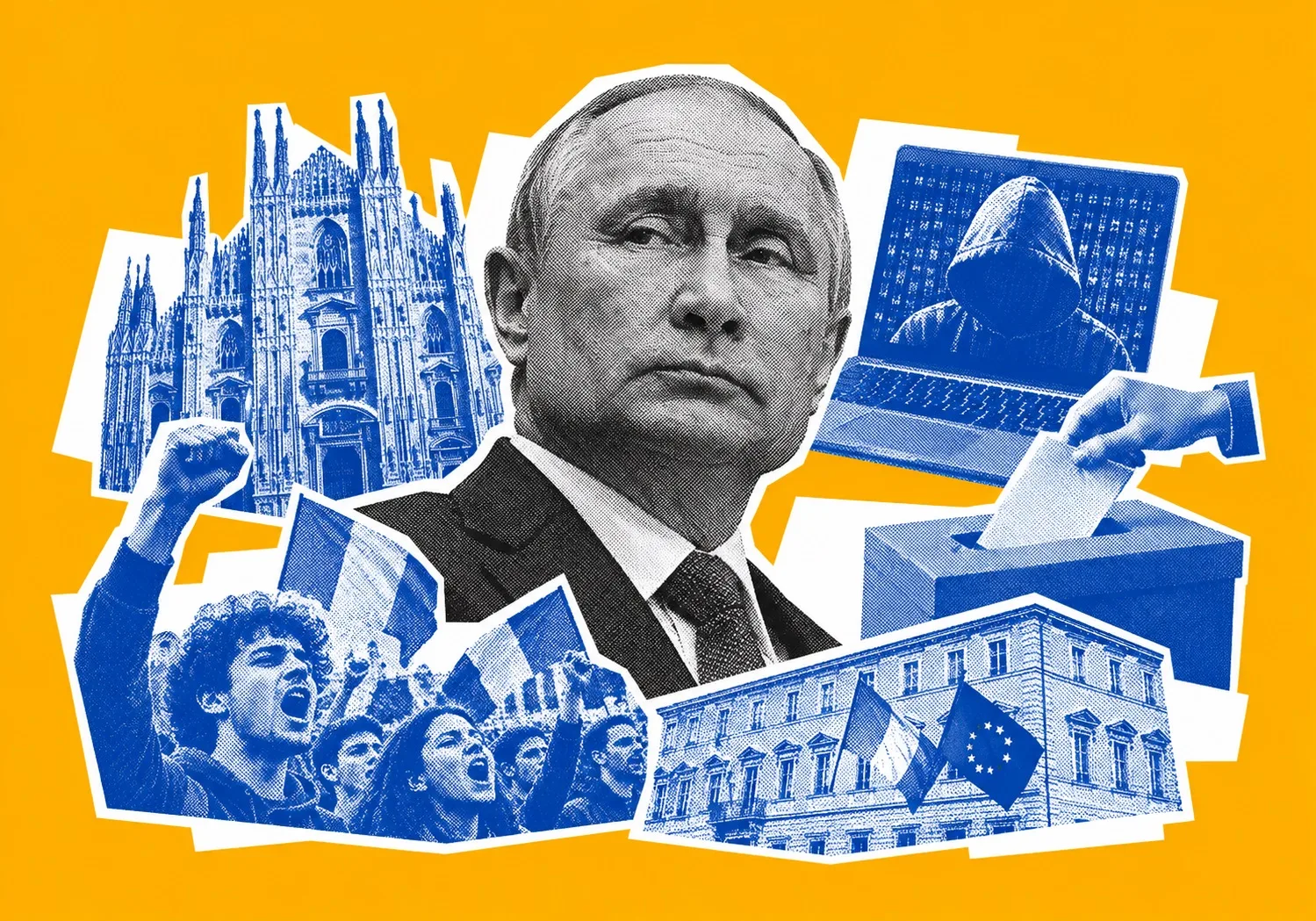
Following violent anti-government demonstrations in Milan in October 2026, pro-Kremlin networks, including the Matryoshka operation, flooded social media with AI-generated images and fake news reports. A new analysis by the European Centre for Strategies and Transformations (ECST) reveals how Russia hijacks genuine domestic grievances in Italy to erode support for Ukraine, NATO, and European institutions without organising the protests itself.
When the demonstrations in Milan descended into violence on 17 October, attention quickly turned to the possibility of foreign interference. The Italian government sought information about whether outside actors had contributed to the unrest, including through the activities of provocateurs.
The ECST report, published on 24 November, examines Italy alongside Poland and France, drawing on a wider research project investigating protest movements and sabotage across eight NATO countries between January 2024 and October 2026.
The Italian case illustrates a particularly difficult aspect of modern information warfare: foreign actors can exploit genuine political grievances without having created them.
From domestic grievances to pro-Kremlin narratives
During an expert discussion organised by ECST in November, Italian columnist and political commentator Davide Romano described how communities formed around opposition to pandemic restrictions subsequently became receptive to pro-Kremlin messaging.
Romano recalled people whose initial opposition to vaccination policies gradually developed into a broader rejection of Western institutions and, eventually, support for Russian President Vladimir Putin.
The transition took place partly within Telegram communities, where discussions about individual freedoms and government accountability increasingly incorporated geopolitical arguments.
For an influence operation, such communities offer an advantage. Their members may already distrust mainstream news organisations, political institutions or official accounts of international events. Messages questioning Western foreign policy can therefore reach audiences through communities that were originally formed around unrelated domestic concerns.

This does not mean that opposition to pandemic restrictions automatically translates into support for Russia. Nor does it establish that Moscow created or controlled these communities.
The security concern identified by Romano is how existing distrust can be redirected towards a different political objective.
A similar process can occur around economic hardship, migration, housing costs, or military spending. People may enter an online discussion because they are worried about their household finances and gradually encounter claims that European sanctions or assistance to Ukraine are responsible for their difficulties.
The original economic grievance remains genuine, even when the explanation attached to it is misleading.
Why Russia can benefit from both political extremes
Another aspect of the Italian case examined by ECST is the circulation of similar geopolitical narratives among groups with otherwise incompatible political beliefs.
Livia Ponzio, a media consultant specialising in propaganda and disinformation, described how far-left organisations were visible during street demonstrations while far-right online networks helped publicise the unrest.
The distinction is important because ideological agreement is not a prerequisite for amplification. Different political communities may circulate the same footage or accusations for entirely different reasons.
For Moscow, the potential benefit lies in the cumulative effect: growing hostility towards institutions, increasingly confrontational political debate and greater difficulty in maintaining public support for common European policies.
An audience does not necessarily have to develop a favourable view of Russia for an influence campaign to achieve results. Persistent doubts about the credibility of European governments, independent journalism or democratic institutions may be sufficient to weaken political consensus.
ECST’s discussion also highlighted the need to distinguish similarities in political rhetoric from evidence of operational cooperation. Shared criticism of Western governments cannot, by itself, establish that Russian actors are financing or directing the organisations involved.
Milan’s October protests and the fabrication of a national crisis
The events of 17 October provided a practical example of how an Italian political confrontation could be exploited by foreign information networks.
Demonstrations took place in several Italian cities, including Rome, Turin and Bologna. While most remained peaceful, the situation in Milan escalated into clashes with police.

According to Spain’s public broadcaster RTVE, 150 police officers were injured and 200 people were detained in Milan.
The violence was real. However, some of the images circulating on social media had nothing to do with the events of October 2026.
One widely shared video purportedly showing Italians rising against government policies featured crowds singing the anti-fascist song Bella Ciao. Fact-checkers established that the footage had been recorded in Florence in December 2019 during a demonstration by the Sardines political movement.
Other publications showed what appeared to be Italian soldiers deployed near Milan Cathedral. RTVE established that the images had been generated using artificial intelligence.
The misleading material created competing interpretations of the crisis. Some publications suggested that the Italian government was losing control of the country, while others portrayed Prime Minister Giorgia Meloni as having resorted to military intervention.
Neither interpretation was supported by the images used to promote it.
For European security institutions, these incidents demonstrate why monitoring demonstrations alone is insufficient. The information circulating around a protest may eventually reach a much larger audience than the event itself.
Matryoshka: impersonating trusted Italian media
The manipulation continued after the demonstrations.
An investigation by the Italian publication Linkiesta documented a coordinated campaign involving counterfeit news reports and newspaper front pages designed to resemble established media organisations.
The investigation linked the activity to Matryoshka, a pro-Russian influence operation monitored by the research collective Antibot4Navalny.
Several fabricated reports attempted to discredit the Italian government’s investigation into possible Russian interference. The campaign portrayed suspicions about Moscow as politically motivated while connecting domestic dissatisfaction to Italy’s expenditure on supporting Ukraine.
Among the media organisations impersonated were major Italian newspapers and international broadcasters.
The campaign illustrates a broader vulnerability in Europe’s information environment. Audiences accustomed to recognising reputable news organisations by their visual identity may encounter fabricated material that borrows the appearance and authority of legitimate journalism.
Identifying and correcting such publications also requires resources. Journalists must establish whether a report exists, verify statements attributed to public figures, and investigate the accounts distributing the content.
These efforts consume time that newsrooms could otherwise devote to reporting on the actual political and economic grievances behind the demonstrations.
However, Linkiesta also noted that the campaign had achieved limited organic distribution. The existence of a coordinated operation does not necessarily mean that it successfully persuaded large numbers of Italians.
The networks behind Russian information warfare
ECST’s research on Russian disinformation infrastructure, published in September 2026, provides a wider context for understanding the Italian case.
Operations such as Matryoshka, Storm-1516 and Portal Kombat form part of an information environment in which different networks distribute misleading claims, fabricated material and pro-Kremlin interpretations of international events.
Their activities demonstrate that foreign interference is not confined to overt propaganda published by Russian state media.
The challenge for Italy is that manipulated content can enter ordinary political discussions through social media accounts whose origins are not immediately apparent.
By the time a misleading claim reaches a domestic audience, it may have been repeated by people with no direct connection to its original producer. Distinguishing coordinated foreign influence from ordinary political participation consequently becomes more difficult.
Italy’s political vulnerability ahead of the 2027 elections
Italy is expected to hold parliamentary elections in 2027, unless an early election is called.
The coming months could provide further opportunities for influence campaigns seeking to exploit dissatisfaction over public spending, living standards, migration and foreign policy.
Italy’s position within NATO and the European Union makes its domestic political stability particularly significant. Rome participates in European sanctions policy, contributes to collective defence and supports Ukraine against Russian aggression.

A deterioration in public confidence could make these commitments more politically contentious, particularly during an election campaign.
The potential consequences would extend beyond Italy. Disagreements within a major EU member state can complicate negotiations over sanctions, defence expenditure and financial assistance to Ukraine.
Nevertheless, attributing future electoral developments to Russian interference would require considerably stronger evidence than identifying pro-Kremlin content circulating online.
ECST’s October research report distinguishes between discovering false information, establishing coordinated distribution, identifying the responsible actors and demonstrating an actual effect on public behaviour.
Applying this framework to Italy would help prevent political speculation from being mistaken for documented foreign interference.
Protecting Italian democracy without criminalising dissent
Italy faces two separate challenges: responding to the domestic problems that bring citizens onto the streets and identifying foreign actors attempting to manipulate the resulting political debate.
Addressing only the second would leave the original grievances unresolved. Addressing only the first would overlook an established vulnerability in Europe’s digital information environment.
Greater transparency around political funding, cooperation with social media companies and investment in independent journalism could help Italian institutions identify interference without restricting legitimate political opposition.
Public authorities also need to communicate carefully about ongoing investigations. Premature accusations risk undermining public confidence, particularly if subsequent inquiries fail to substantiate them.
As ECST emphasises, democratic protest and foreign manipulation can coexist. Evidence that Russian networks exploited a demonstration does not invalidate the reasons why Italian citizens participated in it.
For Italy, the challenge ahead of 2027 will be to preserve a political environment in which citizens can challenge their government freely, while ensuring that foreign actors cannot covertly distort those debates or manufacture the appearance of public opinion.
Sources: European Centre for Strategies and Transformations (ECST), ECST, October 2026, ECST, September 2026, Bloomberg, Linkiesta, RTVE