
How Russia Is Weaponising European Protests Ahead of the 2027 Elections

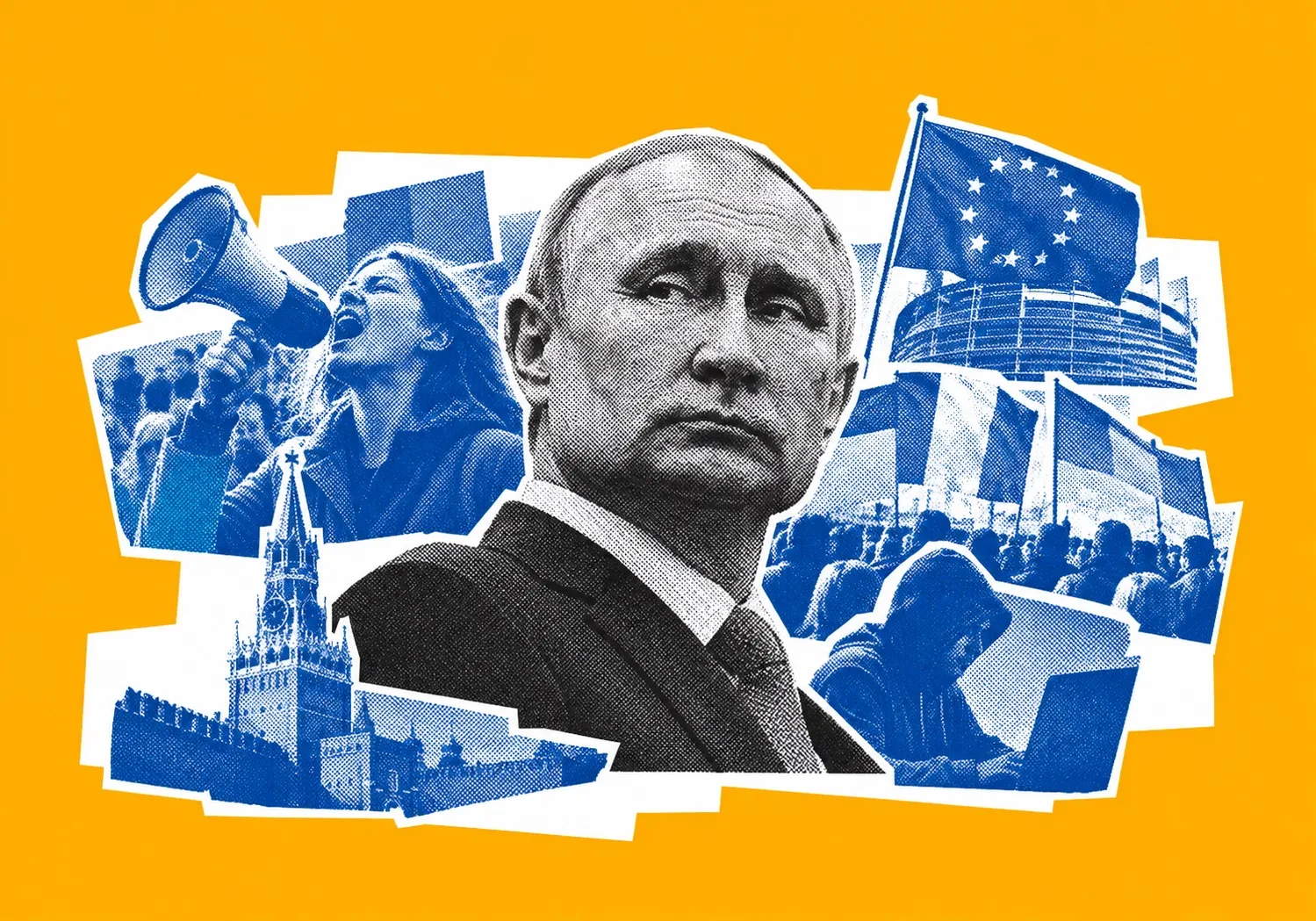
Moscow no longer needs to organise street demonstrations in Europe to destabilise democracies - it simply hijacks existing domestic unrest. A new study of 23 cases across eight NATO countries reveals how Russian disinformation and sabotage networks are exploiting protests in France, Italy and Poland ahead of the pivotal 2027 elections.
Published on 24 November by the European Centre for Strategies and Transformations (ECST), the analysis covers incidents documented between January 2024 and October 2026. The findings raise a difficult question for European governments: how can democracies counter foreign interference without undermining the freedoms they seek to protect?
Drawing on national perspectives from all three electoral battlegrounds, the report illustrates how domestic grievances can acquire geopolitical significance through external manipulation.
Economic insecurity, dissatisfaction with public institutions, historical disputes and opposition to government policies provide opportunities for foreign influence networks. The grievances themselves may be entirely legitimate. What changes is the interpretation attached to them, the way they are distributed and, in some cases, the involvement of actors seeking to turn social tensions into deliberate provocations.
ECST's findings suggest that the distinction between domestic discontent and foreign interference is essential to understanding Russian hybrid warfare.
Three countries, different grievances and overlapping strategic objectives
The Italian, Polish and French cases examined during ECST's November expert discussion reveal different vulnerabilities within European societies.
In Italy, political commentator Davide Romano described how communities initially formed around opposition to COVID-19 vaccination policies subsequently became receptive to pro-Kremlin narratives. Discussions about personal freedoms and government restrictions gradually expanded into arguments questioning the legitimacy of Western democratic institutions.
Media consultant Livia Ponzio identified another feature of the Italian information environment. While far-left organisations were prominent during street demonstrations, far-right networks helped amplify the unrest online.

These groups did not need to share political objectives or cooperate. Their activities could nevertheless contribute to the circulation of similar anti-establishment narratives.
Poland presents a different picture. Political scientist Taras Myshlyaev, Director of Research at the International Diplomatic Alliance, identified economic competition, historical disputes and attitudes towards Ukrainian refugees as particularly sensitive issues.
During the Polish agricultural protests of 2024, Russian media used images of a participant displaying a Soviet flag and a banner appealing to Vladimir Putin to portray a dispute over agricultural imports as evidence of a wider rejection of Ukraine.
The interests of Polish farmers were real. The geopolitical interpretation imposed on their protest was a separate matter.
In France, political scientist Oksana Melnychuk, co-founder of United for Ukraine, examined the potential consequences of prolonged political confrontation. Her contribution focused on how unrest can develop a political significance increasingly detached from the demands that originally brought demonstrators onto the streets.
France's disputes over living standards, public services and government policies provide opportunities for manipulation without requiring foreign actors to initiate the confrontation.
ECST's discussion identifies a common feature: Russia can pursue similar strategic objectives through very different national controversies. An agricultural dispute in Poland, anti-government mobilisation in Italy and student protests in France need not have anything in common organisationally to become useful material for foreign influence campaigns.
Cognitive warfare: when persuasion is no longer necessary
One of the most significant contributions to ECST's discussion came from cognitive scientist Dr Alex Gavriel, who examined the psychological dimension of information manipulation.
Traditional propaganda is often understood as an attempt to persuade audiences to accept a particular political position. Modern influence operations can pursue a different objective: weakening people's confidence in their ability to establish what is true.
An audience exposed to contradictory accounts of the same event may become increasingly sceptical of all available sources. Under such circumstances, a foreign actor does not necessarily need to establish a convincing alternative narrative.
The October 2026 demonstrations in Milan illustrate this problem. Alongside genuine footage of clashes, social media users encountered old recordings presented as contemporary events and AI-generated images purporting to show soldiers deployed near Milan Cathedral.
In France, the Russian-linked Operation Overload distributed fabricated reports surrounding the October unrest, including false allegations concerning migrants and warnings of imminent terrorist attacks.

Such material can generate competing perceptions of the same crisis. One audience may conclude that the government has lost control, while another believes that authorities are responding with excessive force.
Neither audience needs to develop favourable attitudes towards Russia.
The potential strategic benefit lies in the deterioration of confidence in institutions, journalism and political processes. However, the existence of fabricated content alone cannot establish that such deterioration has occurred.
Gavriel's discussion of grievance tracking also exposes a fundamental difference between democratic governance and hostile influence operations. Both may examine public dissatisfaction, but their purposes differ. Governments need to understand grievances to address them; foreign influence networks can study the same frustrations to identify opportunities for exploitation.
This creates a security dimension to domestic policymaking. Unresolved social and economic problems can provide recurring material for external manipulation, although their existence should never be treated as evidence of foreign involvement.
From manipulated narratives to paid provocations and sabotage
ECST's wider research examines protest movements alongside sabotage, placing them within the broader context of Russian hybrid influence.
The distinction between these activities is particularly important in Poland, where authorities have investigated cases involving alleged Russian financing and intelligence-directed operations.

On 29 June 2026, Poland's Internal Security Agency, known as the ABW, announced the detention of nine Ukrainian and two Belarusian nationals in connection with an alleged Russian-funded initiative involving paid demonstrations.
Ukraine's Security Service said participants had been offered between $100 and $200 per appearance.
A separate Polish investigation announced in November concerned vehicle arson attacks allegedly commissioned by Russian intelligence to inflame anti-Ukrainian sentiment. Prosecutors charged two Ukrainian nationals with espionage and sabotage. The allegations remain subject to judicial proceedings.
These cases differ fundamentally from the circulation of misleading footage surrounding an independently organised demonstration.
Former French Army officer David Piguet, speaking during ECST's expert discussion, emphasised the importance of establishing recruitment arrangements, financial transactions and operational instructions.
His contribution highlights why investigators must distinguish between people expressing political opinions, individuals unknowingly distributing manipulated content and those knowingly carrying out assignments on behalf of foreign actors.
The experts also differed over whether information manipulation should be understood as a precursor to more direct operations.
Gavriel suggested that cognitive influence could develop into recruitment and active measures. Ponzio cautioned against assuming that these activities follow a predictable sequence. Digital manipulation and traditional covert operations can take place simultaneously or independently.
That disagreement has practical implications for European security institutions.

Evidence of an information campaign does not automatically establish a connection to a subsequent act of sabotage. Conversely, an intelligence-directed operation may be accompanied by propaganda intended to exploit its consequences.
Establishing a connection requires evidence specific to the operation concerned.
Why 2027 offers a particularly sensitive political environment
France is due to hold its presidential election in 2027, while parliamentary elections are expected in Italy and Poland. Although the national campaigns will develop around different priorities, all three countries face debates over public expenditure, living standards, migration and European security.
For Moscow, the potential political value of these debates extends beyond the electoral performance of individual parties.
Russia could benefit from support for Ukraine becoming increasingly difficult for European governments to defend domestically, particularly when military assistance is presented as competing with expenditure on welfare, healthcare or energy subsidies.
Myshlyaev identified energy prices, refugee benefits and fear of war as potential pressure points in Poland during the winter of 2026–27.
His observations also have wider European relevance. Governments across the continent face the simultaneous demands of maintaining public services, strengthening military capabilities and financing international commitments.
An influence operation can exploit the tension between these responsibilities by presenting complex budgetary decisions as a straightforward choice between national prosperity and assistance to Ukraine.
The resulting political pressure could complicate European negotiations over sanctions, defence cooperation and financial support for Kyiv.
ECST's analysis does not suggest that Russia needs to secure the election of sympathetic governments to achieve such an outcome. Increasing the political cost of policies opposed by the Kremlin could itself serve Russian strategic interests.
However, demonstrating an actual impact on electoral behaviour requires evidence beyond the identification of hostile narratives or coordinated online activity.
A publication's reach is not a reliable measure of its persuasive effect.
Europe's response: the problem of speed and evidence
France's proposed foreign interference legislation offers a practical example of the institutional challenges identified by ECST.
On 20 October 2026, the French Senate approved a bill that would extend existing electoral safeguards to local elections and create an emergency judicial procedure for certain cases of foreign-backed disinformation outside election periods.
Under the proposed procedure, judges would have 48 hours to issue a ruling. The National Assembly is scheduled to examine the legislation on 8 December.
The proposal addresses a fundamental weakness in conventional responses to information manipulation. Fabricated material can circulate across several platforms before investigators establish its origin, identify the responsible actors and collect sufficient evidence for judicial intervention.
Yet accelerating the response also creates legal challenges.

Authorities must distinguish deliberately manipulated information from inaccurate reporting, political opinion and legitimate criticism. Establishing foreign involvement introduces an additional evidentiary requirement.
ECST senior research fellow Dr Iryna Kühnapfel emphasises the importance of responding to demonstrable interference while preserving independent judicial oversight.
At European level, cooperation between national authorities and digital platforms under the Digital Services Act provides another avenue for addressing coordinated manipulation. Its effectiveness will depend partly on the ability of researchers, regulators and law enforcement agencies to exchange reliable information about networks operating across national borders.
Investment in independent journalism is equally relevant. The impersonation of established media organisations by networks such as Matryoshka and Operation Overload exploits the credibility that legitimate newsrooms have accumulated over decades.
Countering such operations requires more than removing individual publications. It also requires maintaining an information environment in which citizens can independently establish whether a report, photograph or public statement is authentic.
Democratic resilience cannot be built through security measures alone
ECST's recommendations extend beyond intelligence gathering, financial transparency and the disruption of covert networks.
They also address a problem that conventional counter-interference strategies can overlook: the domestic conditions that make manipulation possible.
If farmers face genuine economic difficulties, exposing Russian propaganda does not resolve their financial problems. Identifying fabricated reports about public services does not eliminate dissatisfaction with those services. Investigating covert attempts to exploit migration debates does not remove the need for effective migration policies.

Governments that attribute domestic discontent to foreign interference without addressing its underlying causes risk damaging the very institutional trust they are attempting to preserve.
At the same time, the legitimacy of a grievance cannot exempt those involved in covert financing, deliberate provocations or intelligence-directed operations from investigation.
ECST's research therefore points towards a response operating on two parallel levels: effective democratic governance and evidence-based protection against foreign interference.
The distinction will become increasingly important as Europe's 2027 election campaigns approach. Political competition will inevitably expose disagreements over security, economic priorities and the continent's relationship with Ukraine. Those disagreements are a normal part of democratic life.
Europe's resilience will depend on its ability to prevent external actors from covertly manipulating that debate while ensuring that citizens remain free to challenge their governments, demand accountability and influence national policy.
Sources: European Centre for Strategies and Transformations (ECST), European Centre for Strategies and Transformations (ECST), Nexus Europa (Poland), Nexus Europa (Italy), Nexus Europa (France)