
Donbas Withdrawal for Nato Membership? Zelensky Says US Raised the Sdea

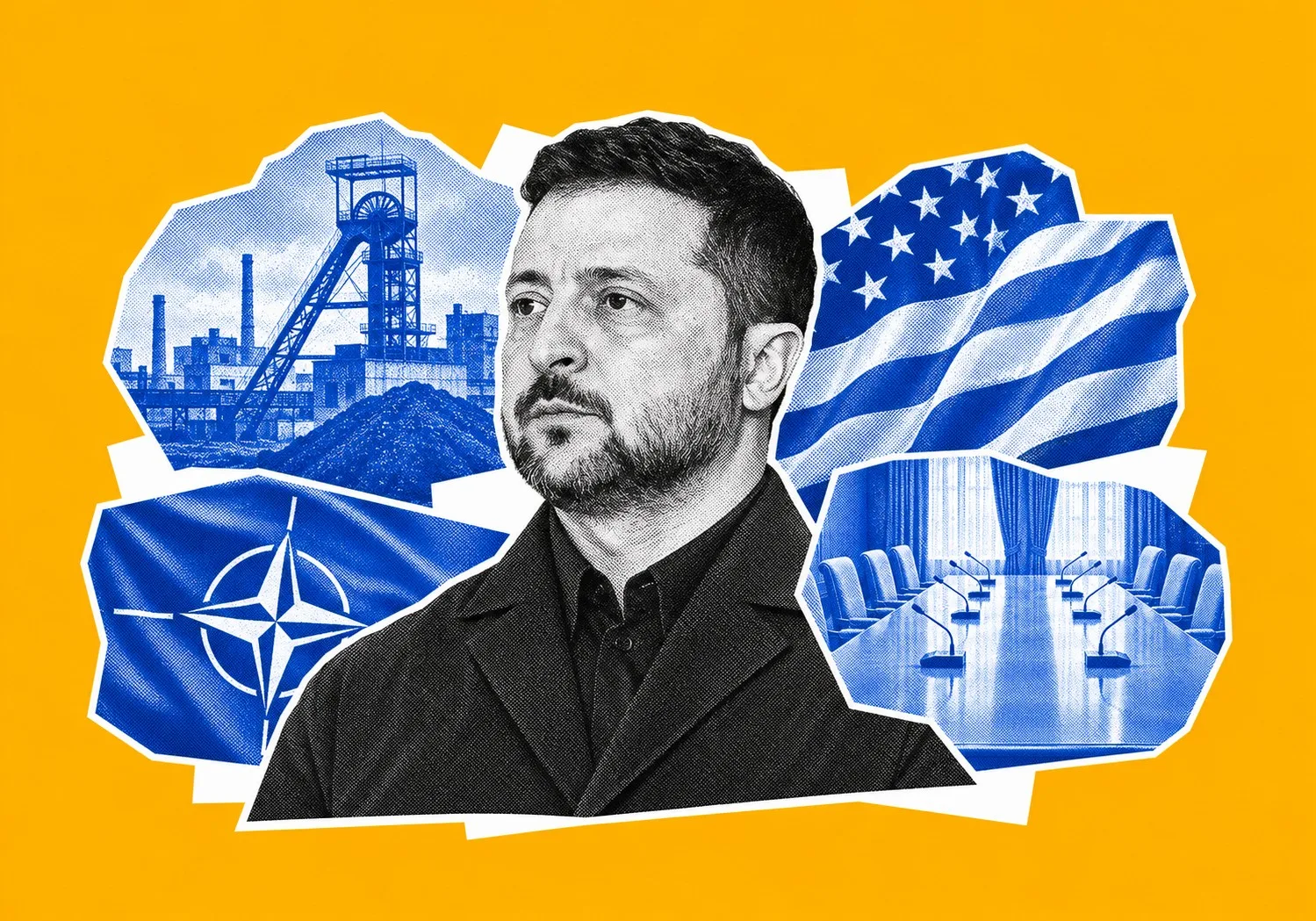
US negotiators have asked Kyiv whether it would pull its troops out of the Ukrainian-held Donbas if Ukraine were admitted to Nato, President of Ukraine Volodymyr Zelensky has said. It was the first time US negotiators had raised the idea, he said. He would put a deal to a referendum if it secured firm guarantees against another attack, long-term military support and funding for reconstruction.

Zelensky spoke to reporters on Friday evening in remarks released on Saturday, 14 November, after US envoys Steve Witkoff and Jared Kushner met Vladimir Putin in Moscow and then flew to Dublin to brief him.
“What if Ukraine joins NATO? Would Ukraine withdraw from Donbas?” Zelensky said the Americans had asked.
He reiterated that Kyiv was unwilling to give up its territory. The Donbas, the focus of Moscow’s territorial demands, spans the eastern regions of Donetsk and Luhansk. Russia wants Ukrainian troops to leave the areas they still hold, including a chain of cities that has anchored Kyiv’s defences in Donetsk for years.
What Kyiv and Moscow want from the talks
In February 2025, US Defence Secretary Pete Hegseth called Ukrainian Nato membership an unrealistic outcome of a negotiated settlement. Zelensky now believes membership is “back on the agenda”. Under Article 10 of the North Atlantic Treaty, an invitation requires the consent of every Nato member. The White House, the US embassy in Kyiv and Nato did not immediately respond to the Financial Times’s requests for comment.
For Kyiv, the attraction is Article 5, which obliges allies to assist a member that comes under armed attack, with each government deciding what action it considers necessary. Western governments have also discussed a separate agreement modelled on that commitment. For Ukraine, two questions would be when that protection took effect and what territory it covered. Zelensky said he would first need to see what Washington and the other allies were prepared to guarantee.
Kyiv says limits on its army would leave it more vulnerable to another invasion.
There is also a difference in who would be bound by the two arrangements.
Nato membership would bring Ukraine under the treaty that governs the alliance. A separate guarantee would depend on the countries that signed it and the obligations they accepted. Zelensky said the package under discussion could include commitments from both Nato and the European Union. He also wanted a commitment to financial support for a specified period.
Moscow has previously demanded Ukrainian neutrality, limits on the size of its armed forces and territorial concessions. Putin also told US envoys in Moscow that Russia opposed the deployment of European troops to Ukraine after a ceasefire. Zelensky said a ceasefire should come first, followed by an end to the war and guarantees for Ukraine.
After the US-mediated talks in Abu Dhabi, Kushner said in Dublin that Europeans would need a seat at the table to conclude a deal. The Kremlin said it would consider European participation if those involved showed a willingness to contribute. Zelensky said the talks had yielded agreement to exchange more than 1,000 prisoners on each side, with the final numbers still under discussion. Kyiv was still seeking a halt to attacks on energy infrastructure ahead of winter.

The front on 14 November
Ukraine’s General Staff reported 273 clashes across the front in its Saturday morning briefing.
It recorded 47 Russian attacks in the Pokrovsk sector, the highest total of any sector, alongside 15 in the Lyman sector, 11 around Kostiantynivka and six on the Sloviansk front. Further south, the General Staff recorded 11 attacks in the Huliaipole sector and eight in the Orikhiv sector, both in Zaporizhzhia. In its 13 November assessment, the Institute for the Study of War (ISW) reported two days of Russian attacks in and around Kostiantynivka and found no evidence of a Russian advance there.
In Moscow, Putin proposed a civilian evacuation from Kostiantynivka along the lines of the operation in Russian-occupied Oleshky. A local ceasefire brokered by US first lady Melania Trump began there on 29 October, allowing aid to enter and civilians to leave. The White House said about 800 people were evacuated. ISW disputed his earlier claim that Russia controlled the city, citing evidence of at least 41 Ukrainian positions in and around Kostiantynivka since 1 September. Ukraine’s human rights ombudsman, Dmytro Lubinets, said on Friday that arrangements for a mission had yet to be discussed. Across the Donetsk region, 6,370 residents left or were evacuated in the first ten days of November, according to the regional administration. About 4,500 of them left the Kramatorsk community.
Ukraine’s Third Army Corps says it retook 277 sq km around Lyman during Operation Vivaldi, a counter-offensive made public this autumn. Andrii Kupriianov, a Ukrainian battalion commander who took part in the operation, told Hromadske that it had disrupted Russian plans to advance towards Sloviansk and Kramatorsk. ISW separately reported that Ukraine had recovered positions on the western bank of the Zherebets river and assessed that the operation had thwarted Russia’s campaign plan for the fortified cities. On 12 November, it reported a recent Russian advance north-east of Lyman while assessing that Ukraine still held the operational initiative in that area. ISW had earlier reported Ukrainian counter-attacks north-east and south-east of Lyman on 9 and 10 November.
How the Donbas was divided and why Russia wants it
The war in the Donbas began in spring 2014, after Russia occupied and annexed Crimea.
Russian-backed armed groups seized towns and government buildings in Donetsk and Luhansk and proclaimed two separatist republics. The European Court of Human Rights found that Russia exercised effective control over separatist-held areas from 11 May 2014. Ukrainian forces retook Sloviansk and Kramatorsk that summer. The cities of Donetsk and Luhansk remained under separatist control, and ceasefire agreements reached in Minsk in 2014 and 2015 failed to end the fighting.
Russia recognised the two separatist entities in February 2022, days before launching its full-scale invasion.
It captured Mariupol that spring after a siege and took Lyman in May. Ukraine recaptured Lyman in October, one day after Putin proclaimed the annexation of Donetsk, Luhansk, Kherson and Zaporizhzhia. Lyman had served as a transport and supply hub for Russian troops. The UN General Assembly condemned the attempted annexations and called on states to withhold recognition, in a resolution adopted by 143 votes to five.
Moscow laid claim to the full administrative territory of all four regions, including districts it had never captured. Freezing the front would leave Kyiv in control of the towns it still holds. A withdrawal would require it to pull troops out of those towns. Zelensky has ruled out recognising Russian sovereignty over occupied Ukrainian territory.
Sloviansk and Kramatorsk have served as Ukrainian military hubs since 2014.
Together with Kostiantynivka, they form part of a defensive belt that Ukraine has reinforced with trenches, bunkers and anti-tank obstacles. A negotiated withdrawal would give Moscow control of those positions without having to capture them in battle. Ukraine would have to establish a new line farther west. Kyiv fears Russia could use a ceasefire to rearm and later push further west. Putin’s demands have also included a buffer zone in areas beyond those Russia formally claims.
The Donbas takes its name from the Donetsk coal basin. Before the war, Donetsk accounted for more than half of Ukraine’s output in several coal and steel categories, according to Reuters. Years of fighting have destroyed mines and industrial plants.
Mariupol’s port, under Russian occupation since 2022, sits on the Sea of Azov corridor linking Russia by land to Crimea, which Moscow seized in 2014.
The Kremlin has invoked the region’s Russian-speaking population to justify its intervention. Taking the rest of the Donbas would allow Putin to claim that Russia had secured all of Donetsk and Luhansk, two of the regions he declared Russian in 2022.
Putin presses for a Nato rollback
Republican senator Tom Cotton, who chairs the US Senate Intelligence Committee, called Moscow’s demand for Nato to pull its forces back to their 1997 positions preposterous. “Further talks are a farce at this point,” he wrote on X. Cotton argued that Putin would agree to end the war only once he realised he could not win.
“We need to help Ukraine prove that point,” he added.
Cotton was responding to a 13 November report in The New York Times on a paper that Russian officials circulated at the Abu Dhabi talks. Moscow called for Nato to rule out further enlargement and halt military activity in Ukraine, Eastern Europe, the South Caucasus and Central Asia. It also sought the withdrawal of troops and removal of bases from countries that joined the alliance after 1997.
The paper called for an end to Western arms supplies to Ukraine and said Moscow would accept Ukrainian membership of the EU only if Kyiv stayed out of the bloc’s common defence policy. It also asked Britain and France to rule out using their nuclear weapons to defend other European countries, going beyond Russia’s December 2021 demands.
ISW assessed that Moscow was using the Abu Dhabi talks to revive its 2021 demands and shift the negotiations towards a wider overhaul of European security.
On 10 November, Russian foreign minister Sergei Lavrov argued that Europe’s security arrangements should be discussed before a settlement in Ukraine. An unnamed source in the Russian delegation said that day that ending the war was only one item in a discussion whose main purpose was to reshape European security.
Sources: Reuters, Financial Times, US Department of Defense, Associated Press, Ukrainska Pravda, ISW, Tom Cotton statement on X