
How Russia Targets Poland: Farmers, Paid Protests and Sabotage

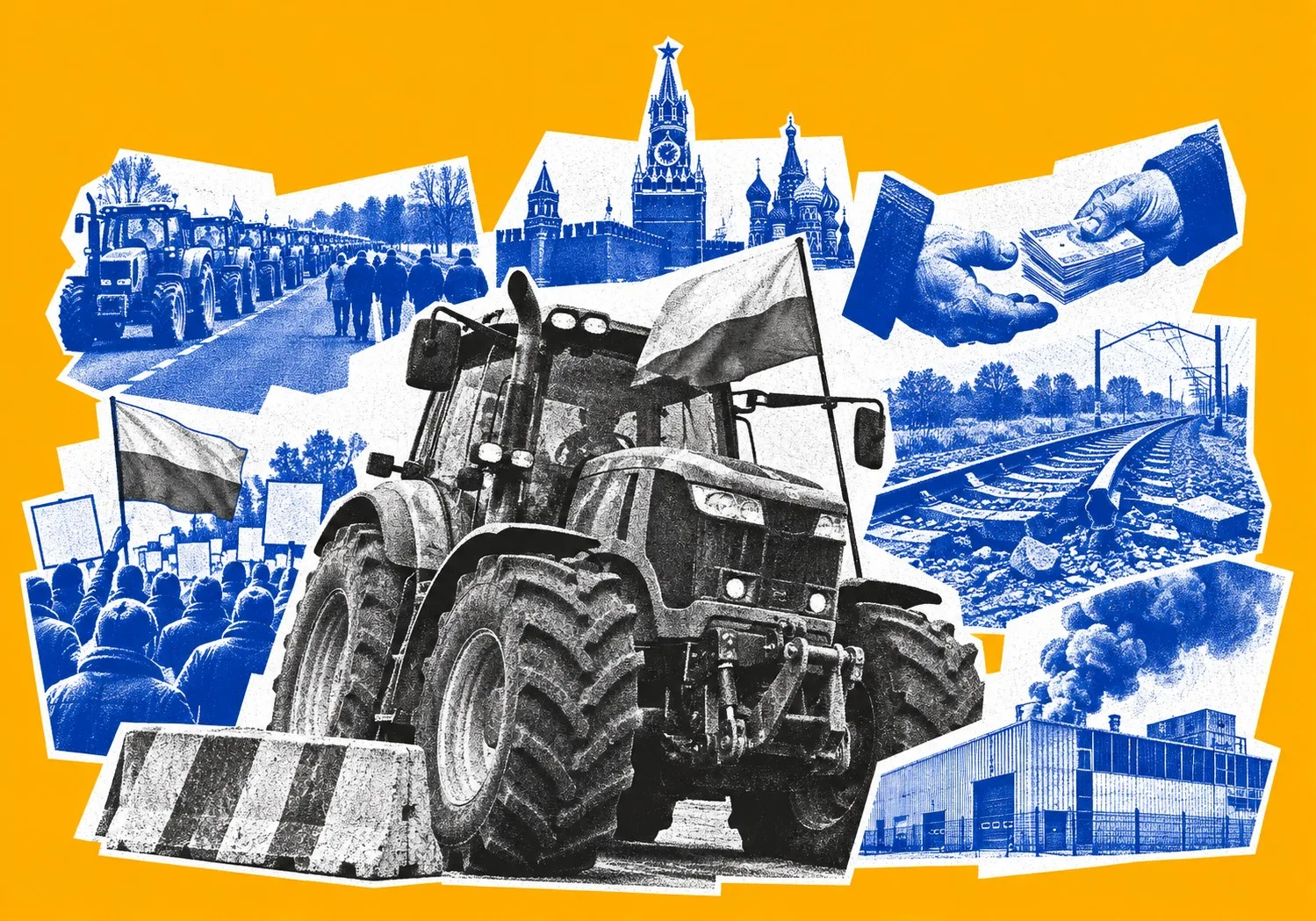
Poland’s Internal Security Agency says Russia financed paid demonstrations among Ukrainian refugees. In a separate investigation, prosecutors allege that Russian intelligence commissioned vehicle arson attacks to fuel anti-Ukrainian sentiment. An analysis published on 24 November by the European Centre for Strategies and Transformations (ECST) examines how Moscow also exploits genuine farmers’ grievances and historical disputes to undermine Polish support for Kyiv. ECST’s wider research examined 23 documented cases across eight NATO countries between January 2024 and October 2026. It found stronger evidence of Russia amplifying existing protest narratives than initiating demonstrations. According to ECST, protest manipulation and sabotage share strategic objectives, including pressure on public trust and support for Ukraine.
Poland’s agricultural protests in 2024 began with specific economic demands. Farmers blocked roads and border crossings over competition from cheaper Ukrainian imports and EU environmental policies, which they said threatened their livelihoods. During one demonstration, a participant displayed a Soviet flag and a banner appealing to Vladimir Putin to intervene against Ukraine, Brussels and Poland’s government. Police detained him and he was charged with inciting hatred based on nationality.
The foreign ministry warned that extreme groups, possibly influenced by Russian agents, were attempting to take over the movement. Farmers’ union leader Sławomir Izdebski condemned the incident and said the unions had not authorised it.

Political scientist Taras Myshlyaev, director of research at the International Diplomatic Alliance, explained how a protest rooted in domestic concerns can acquire a different message when Russian outlets select and recirculate its most inflammatory images.
Russian outlets used the image to suggest that Polish farmers as a whole were turning against Ukraine, according to ECST.
The analysis describes this coverage as an attempt to portray an agricultural trade dispute as a breakdown in Polish-Ukrainian relations. Myshlyaev described similar attempts to connect arguments over refugee benefits and history with the claim that helping Ukraine harms Polish citizens.
Polish agricultural publications reported this month that Copa-Cogeca, which represents European farmers and agricultural cooperatives, planned a demonstration in Brussels on 26 November over proposed changes to the EU agricultural budget. The organisation warned that funding could fall by more than 20 per cent in most member states, including Poland.
The government’s November monitoring recorded a dispute over jobs and the future of the Bogdanka coal mine, alongside a warning strike over pay and working conditions at transport company Adampol.
Cash for Demonstrators
On 29 June, the Internal Security Agency, known as the ABW, announced the detention of nine Ukrainian and two Belarusian nationals for immediate expulsion. The detentions took place in Warsaw, Wrocław, Kraków, Zakopane and Bydgoszcz.
The agency said they had recruited and paid participants since autumn 2025, using issues including Ukrainian corruption scandals to mobilise opposition to the authorities in Kyiv. It attributed the initiative and funding to Russia.
Ukraine’s Security Service said the investigation concerned five staged events in Warsaw and Wrocław. Participants were offered between $100 and $200 per appearance, while organisers distributed campaign materials and paid them in cash under instructions from Moscow-based coordinators.
The agency said all 11 organisers had been deported.
Turning History into Provocation
A separate investigation published by Belarusian outlet MOST on 10 November uncovered an offer of $500 for provocative graffiti in Poznań. A journalist answered an advertisement in a Białystok Telegram group and was instructed to spray “Glory to the UPA” on monuments and attach QR codes. The recruiter offered travel expenses and supplied a photograph showing monuments to Adam Mickiewicz and the Poznań workers’ uprising of June 1956.
The proposed slogan referred to the Ukrainian Insurgent Army, known as the UPA. MOST said it retained the correspondence but could identify neither the recruiter nor the person behind the assignment.
The Polish Institute of International Affairs, or PISM, has documented how Russian propaganda exploits such historical disputes. Researchers Filip Bryjka and Aleksandra Wójtowicz described messaging that equates contemporary Ukraine with wartime nationalist formations and portrays it as inherently hostile to Poland. Their August analysis identified a falsified document presented as a Polish intelligence report and selective publication of Soviet security archives as methods of deepening the division.
PISM also reported a sharp rise in Polish-language social media posts containing extremely hateful terms directed at Ukrainians: 364,000 between 26 May and 13 July, an increase of 171 per cent in the analysis it cited.
Sabotage Suspects and Hate-Crime Arrests
In the vehicle-arson case announced on 10 November, prosecutors said two Ukrainian men fitted vehicles with number plates resembling those used by Ukraine’s military before setting them alight. Investigators alleged that Russian intelligence commissioned the operation to inflame anti-Ukrainian sentiment.

The ABW detained the suspects in Mińsk Mazowiecki on 3 November. Prosecutors charged them the following day with espionage and sabotage for Russian intelligence, alleging that they also gathered information about military facilities and critical infrastructure and received payment, including cryptocurrency. Both were remanded in custody for three months.
A separate operation announced on 5 November involved five Polish citizens and a Russian woman. Authorities alleged that their group supplied Russia with components used in ammunition and weapons systems. Four faced espionage charges and were remanded; two remained outside custody under other restrictions.
Reporting on that announcement, Polish public radio quoted intelligence coordinator Tomasz Siemoniak as saying that around 100 people had been suspected of espionage and sabotage since the beginning of 2024.
Data supplied to Poland’s human rights commissioner in 2026 recorded 176 detentions in 2025 under provisions covering discriminatory violence or threats, incitement and prohibited propaganda, and public insults or attacks. The comparable figure for 2024 was 113.
Sources: ECST, Polish National Prosecutor’s Office, Top Agrar Polska, MOST, PISM, Polskie Radio, Polish police