
Is Russia’s Ice-Skating Robot Real? What We Know About the Video

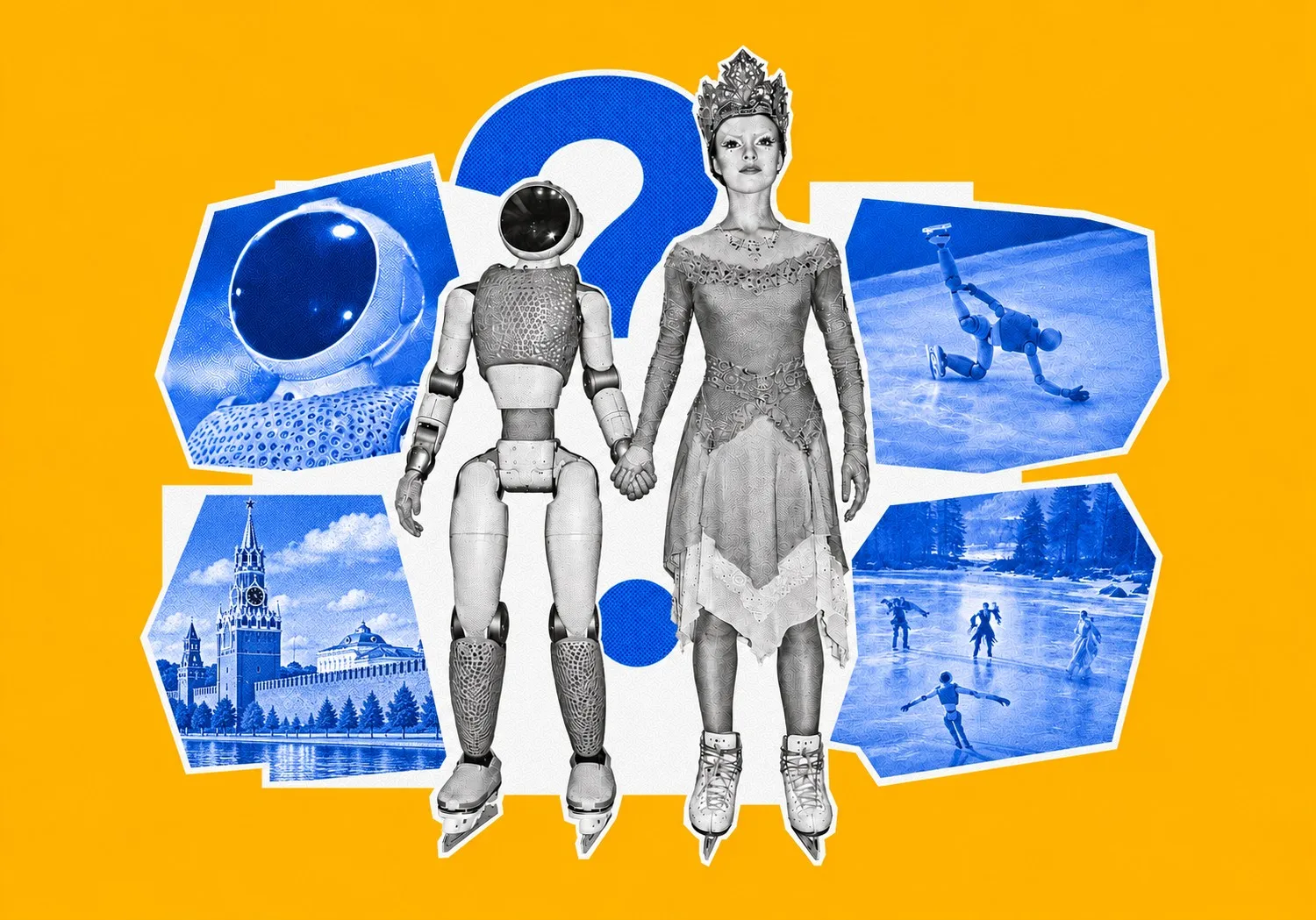
Russia’s state-controlled banking and technology group Sber says its humanoid robot Yuni has performed on ice alongside Olympic champion Anna Shcherbakova. The presentation was publicised after years of restrictions on Russian figure skaters and ice hockey teams following Russia’s full-scale invasion of Ukraine.
Reports published on 26 November 2026 describe a production at the AI Journey conference based on the Russian fairy tale The Frog Princess. Ilya Averbukh directed the staging, with music by Pyotr Dranga. Sber linked the production to its 185th anniversary and described it as the first humanoid robot appearance in an ice show.
The claim of a world first comes from the company.

Sber is the group built around Sberbank, whose controlling shareholder is the Russian state, represented by the finance ministry.
Alongside banking, the group develops artificial intelligence, robotics and digital services. Its financial statements identify the government as its ultimate controlling party.
Shcherbakova won the women’s Olympic title in Beijing in 2022 and the world championship in 2021. The International Skating Union’s records list her Olympic personal best of 255.95 points, including 175.75 for the free skate. Her role in Sber’s production was as a performer in a staged show alongside the machine.
What the published material establishes
The sources identify Yuni by name, describe Sber’s robotics programme and attribute the ice production to Sber’s robotics centre and named artistic contributors.
The technical account comes principally from Sber; Kommersant’s report also attributes its description to the company.
The announcements describe the movements performed but do not specify whether remote instructions were used during the ice routine or provide a component-by-component account of the hardware’s origin.
No independent test results are included in those announcements. The stated aims are those given publicly by Sber: developing movement control, creating performances with human partners and preparing a larger entertainment project.
Sber presents the production as both an engineering project and an entertainment venture. Its technology chief, Andrey Belevtsev, described the work as training robots to act in a changing physical environment.
He said the longer-term applications included working alongside people in industry, logistics and everyday life.
The company says Yuni performed dance combinations, interacted with its partner and maintained balance on the slippery surface. Its robotics centre worked on stability, precision and synchronising movements with the skater.

Sber’s marketing chief, Vladislav Kreynin, described the performance as a first step towards a larger Russian Fairy Tales ice show featuring robots alongside leading Russian skaters. He linked it to the ballet of the same name presented at the Bolshoi Theatre for the company’s anniversary.
Kreynin’s explanation also explicitly referred to Russian cultural identity and innovation. He said the company expected the project to attract an international audience.
Yuni and Sber’s wider robotics programme
Sber separately announced Yuni as one of three new robotic platforms, alongside the humanoid Green 2.0 and a delivery robot. The company says the platforms use its GreenVLA 2.0 artificial-intelligence model, with different designs intended for different tasks.
It describes Yuni as an athletic robot used to develop dynamic movements, choreography, coordination and balance. Green 2.0 is intended to combine movement through a space with manipulating objects. According to Sber, that platform has greater flexibility and increased arm payload capacity compared with its predecessor.
The delivery robot is undergoing pilot trials in a Moscow district. Sber says its wheeled and stepping platform can negotiate kerbs, stairs and other urban obstacles, and is designed to operate in rain and snow.
Sber chief executive Herman Gref said the group was testing robotics in retail and delivery while developing engineering capacity and component production in Russia. He presented experiments in sport and the arts as part of the same programme. These descriptions and performance claims are supplied by the developer.
The ice production accompanied another project involving Yuni and students from the Boris Eifman Dance Academy. In a separate announcement, Sber said the ballet performance was presented on the opening day of AI Journey and formed part of its anniversary programme.
According to the company, academy students demonstrated movements and choreographic elements, which engineers used to train the robots. Training progressed from individual movements to sequences, keeping rhythm and synchronising with human partners. Sber described the project as a demonstration of its work on movement control and coordination.
Kreynin said the company had worked with the academy for more than 15 years. In explaining the production, he emphasised a duet between people and machines, with human performers contributing emotion and robots contributing precision.
The ballet announcement describes a separate stage production from the ice routine with Shcherbakova. Both were presented within Sber’s programme linking robotics with performing arts.
The restrictions preceding the presentation
On 1 March 2022, following Russia’s full-scale invasion of Ukraine, the International Skating Union barred skaters affiliated with its Russian and Belarusian member federations from international competition. The decision covered ISU championships and other international skating events, and also applied to officials. The federation cited the integrity of competitions and participants’ safety.
On 30 June 2026, the ISU announced that eligible Russian and Belarusian skaters could return for the 2026/27 season as individual neutral athletes. They would compete without national flags, national kit or anthems.
The federation said entry quotas would reflect the terms applying to member federations in their first season of competition, because Russia and Belarus had been absent for more than three years and had not accumulated ranking points. Restrictions on officials remained in place.
In September, the ISU reported receiving 234 neutrality forms connected with potential participation. Eligibility was assessed individually. Athletes and support personnel were ineligible if they were in active military or national security service, had participated in military operations in the war against Ukraine, or had actively and publicly supported the war since February 2022.
The federation said Kamila Valieva, Mark Kondratiuk, Alexandra Stepanova and Ivan Bukin did not satisfy its requirements, subject to applicable appeal rights.
Ice hockey’s legal dispute and entry restrictions
Russian ice hockey teams faced a separate process. In January 2026, the International Ice Hockey Federation decided against reintegration for the following season, citing safety and security concerns. An internal appeal led to the decision being annulled in May and returned to the council for reassessment.
On 30 October, the Court of Arbitration for Sport upheld a further Russian appeal. It ordered participation in five championships: the 2027 men’s and women’s world championships, the World Junior Championship, and the men’s and women’s under-18 world championships.
The panel found that the IIHF’s arguments were not supported by sufficient evidence under the applicable regulations. It set aside the exclusion decision without ordering a neutrality regime or determining the organisational consequences.
On 15 November, the IIHF confirmed that Russia’s under-20 team could not participate in the World Junior Championship because of restrictions formally communicated by the Canadian government. Canada would remain the host, with the tournament scheduled for 26 December 2026 to 5 January 2027 in Edmonton and Red Deer.
That announcement preceded reports of Sber’s ice presentation by 11 days. It concerned the Russian national team’s participation in that tournament.
Sources: Sber, Kommersant, ISU