
Russia’s Corporate Seizures: How Decree 661 Targets Nestlé, Auchan, and Western Assets

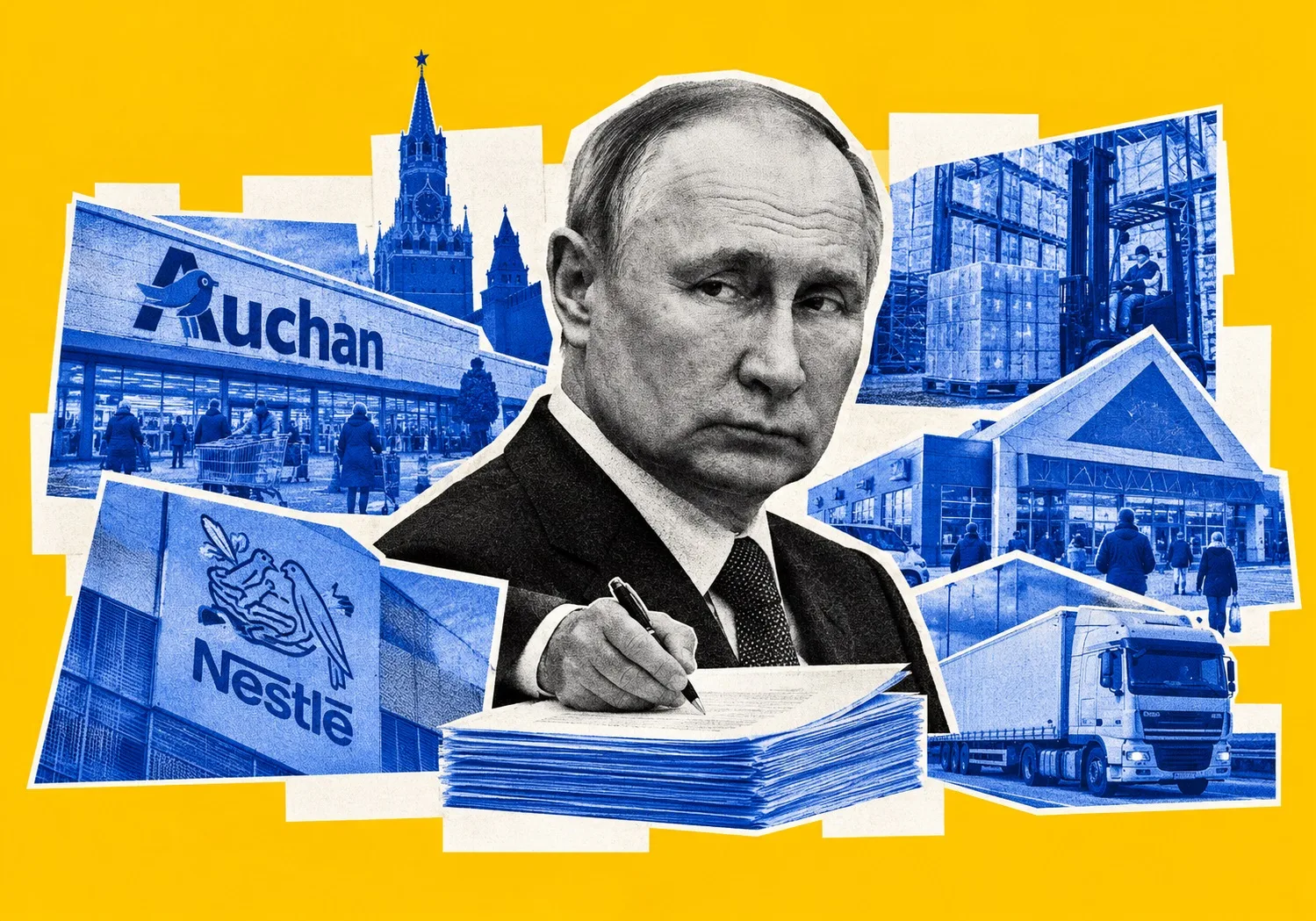
Under Vladimir Putin’s latest Decree No. 661, Russia has placed the assets of major Western corporations - including Nestlé, Auchan, and Lemana PRO (ex-Leroy Merlin) - under state-appointed management. Assigned to an obscure firm led by a former police general, this move signals a dangerous new shift: foreign ownership in Russia can now be operationalized and redistributed without formal nationalisation.
For European investors, the distinction is becoming increasingly difficult to defend.
A company with one employee takes control
L.E.V. Management hardly resembles a conventional corporate administrator. Registered in October 2024, it reported no revenue in 2025, employed one person, and recorded a net loss of 15,000 roubles. Its registered capital was also 15,000 roubles, roughly $150. Before becoming the manager of substantial foreign-owned assets, the company had been advertised for sale as a ready-made joint-stock company for 450,000 roubles.
Its transformation came remarkably quickly.
On 10 September, a week before Putin signed Decree No. 661, Andrey Krayushkin was appointed general director. Krayushkin is a retired police major-general who previously served as first deputy head of the Russian Interior Ministry’s Main Directorate for Migration Issues.
The appointment does not establish who will eventually acquire the assets. Nor does it prove that Krayushkin personally stands to benefit from their redistribution. The company’s ultimate beneficial owners remain undisclosed in Russia’s corporate register.
Yet the arrangement raises a more consequential question than the identity of any eventual buyer: why should a former senior security official lead a newly activated company entrusted with businesses developed by some of Europe’s largest multinational groups?
The answer may lie in the changing priorities of Russian corporate governance. Experience in retail, food manufacturing or international logistics appears less relevant to the appointment than the ability to operate within a state-directed system.
L.E.V. Management provides the legal vehicle. The presidential decree supplies the authority.
Ownership without control
Russia’s temporary management mechanism dates to April 2023, when Decree No. 302 established a framework for placing certain foreign-owned assets under state supervision in response to what Moscow describes as unfriendly foreign actions.
The terminology is important. Temporary management is not formally equivalent to nationalisation. Foreign shareholders retain ownership rights on paper, even as they lose the ability to direct operations, appoint management or make commercial decisions.
For a multinational company, however, the practical consequences can be severe. A parent group unable to control its subsidiary cannot manage its finances, determine investment priorities or exercise the ordinary rights associated with ownership.
Nestlé’s response illustrates the problem. Following the September intervention, the Swiss food group said it was assessing its options and would take steps to protect its rights. It also confirmed that its Russian operations would no longer be consolidated in Nestlé S.A.’s financial statements from late September.
That accounting decision matters beyond the immediate balance sheet. Deconsolidation recognises that the parent company no longer exercises the control required to treat the subsidiary as part of its consolidated business.
It does not, by itself, establish the amount of any financial loss. The briefing provides no valuation of the affected Nestlé businesses or confirmed write-off figure. Nevertheless, the separation exposes the gap between nominal ownership and economic control.
A company can remain legally connected to an asset while losing the ability to determine what happens to it.
The same uncertainty now confronts other foreign investors. Under the September decree, the affected entities included Auchan Retail Russia, two Nestlé subsidiaries, Le Monlide, which holds the Lemana PRO retail business, and logistics companies including FM Logistic, Batilogistic and NG Concept.
Further interventions in October affected businesses associated with Tarkett, Menshen, Sverige International Holdings, Sonoco and Metro.
The breadth of sectors involved is striking. The measures are no longer confined to strategically sensitive energy infrastructure or businesses already caught in complicated exit negotiations.
Staying in Russia no longer guarantees protection
The early corporate departures of 2022 were largely framed around decisions by Western companies to withdraw, sell or restructure their Russian operations. The transactions were often politically constrained, but the companies themselves had initiated the process.
The latest decrees reverse that relationship. Moscow is determining when foreign control ends, regardless of whether a business has sought to leave.
Auchan is a particularly telling example. Its Russian operations had functioned autonomously from the French parent group since 2022. Leroy Merlin's Russian business had undergone an even more substantial restructuring in 2023, with control transferred to UAE-registered Scenari Holding LP. French parent Adeo retained only a 0.007% stake in Le Monlide.
Neither arrangement prevented the September intervention.
These cases challenge an assumption that had underpinned some Western companies’ decisions to maintain a limited Russian presence: that local management, operational separation or reduced foreign shareholdings might make a business less exposed to political action.
Moscow has shown that such distinctions need not determine whether an asset becomes subject to presidential control.
There is also a practical attraction to targeting consumer businesses. Supermarkets, food producers and logistics networks are embedded in everyday economic activity. Their operations can continue under new management, preserving commercial value even after foreign shareholders lose authority.
Indeed, Russian representatives of Auchan and Nestlé said commercial activities would continue and that they would work with the appointed manager.
For customers, relatively little may change immediately. For the owners, almost everything has.
From emergency intervention to an established system
The Kremlin has precedents to draw upon.
In April 2023, Russia placed assets belonging to Finland’s Fortum and Germany’s Uniper under temporary management. Danone’s Russian subsidiary followed in July that year, with control subsequently passing to structures linked to Chechen authorities. Carlsberg also lost control of its Russian brewing business, Baltika.
Those interventions established that the mechanism could be applied across different industries. The September and October 2026 measures indicate that it has become a recurring instrument rather than an exceptional response.
According to RBC data cited in the briefing, 20 corporate groups remained under temporary management as of September 2026. Eleven companies had been targeted during 2026, the highest concentration recorded under the framework.
The pattern creates opportunities for politically connected domestic interests, although the final beneficiaries of the latest transfers have not been identified.
Temporary management offers a means of separating foreign shareholders from operational authority before any eventual disposal. A subsequent sale at a discounted valuation could transfer substantial commercial value to Russian buyers without requiring the state to undertake an immediate, explicit confiscation.
That outcome is not yet established for every company affected by Decree No. 661. But earlier cases, particularly Danone and Baltika, make the prospect difficult to dismiss.
The wider economic implications extend beyond individual ownership disputes. Where political access determines who can control valuable assets, commercial performance becomes only one factor in corporate survival.
A company’s ability to operate may increasingly depend on its relationship with the state rather than its shareholders, customers or creditors.
Europe's limited leverage
France responded on 19 September with a joint condemnation from its foreign and economy ministries. Paris described the transfers as unjustified and demanded that they be reversed.
The Kremlin defended the measures as retaliation for Western actions.
That exchange exposes the limitations of conventional diplomatic pressure. European governments can challenge the legality of seizures and support affected companies, but neither condemnation nor the existence of formal property rights necessarily restores management control inside Russia.
Legal proceedings offer another possible avenue, although the briefing does not establish which affected companies possess enforceable arbitration rights, what claims they might pursue or whether any resulting awards could be recovered.
Those distinctions matter. Winning a legal argument and recovering an asset are separate questions, particularly when the disputed business remains under the jurisdiction of the government responsible for the intervention.
European governments also face a coordination problem. The companies affected span several countries and industries, while their corporate structures and exposure to Russia differ considerably. A diplomatic response acceptable to one government or business may offer little immediate relief to another.
For Moscow, meanwhile, the mechanism serves several purposes. It creates leverage over foreign shareholders, provides an instrument of retaliation and enables the authorities to redirect control of commercially significant businesses towards domestic structures.
It also reduces the role of Western multinational groups in sectors that continue to generate revenue within Russia.
The security state's expanding commercial role
The most revealing aspect of the L.E.V. Management appointment may be what it says about the institutions now shaping Russian business.
Krayushkin’s background is not in the industries his company has been appointed to oversee. His career was built within the Interior Ministry, one of the institutions associated with Russia’s security establishment.
His appointment does not establish that the ministry itself controls the affected assets. But it places a former senior security official at the centre of a major corporate intervention, reinforcing the growing overlap between state authority and commercial administration.
Such arrangements can serve the Kremlin without requiring the government to become the permanent registered owner of every seized business. A designated manager can exercise operational control while the legal status of foreign ownership remains unresolved.
The arrangement also leaves substantial discretion over what happens next.
Foreign investors face an unusually difficult calculation. Their businesses may retain customers, employees, infrastructure, and revenue, yet those strengths no longer guarantee control. Continued profitability could even make an asset more attractive to potential domestic beneficiaries.
The contrast with the earlier period of Western investment is substantial. International companies once assessed Russia through the familiar considerations of market size, consumer demand, operating costs and regulatory exposure. The latest interventions make political decisions over ownership itself a central commercial risk.
Russia's authorities have not disclosed the ultimate beneficiaries of the assets assigned to L.E.V. Management. Until those interests become identifiable, the full distribution of economic gains will remain opaque.
But the central question for foreign shareholders has already changed. It is no longer simply whether they can sell their Russian businesses, or at what price. It is whether they will retain any meaningful influence over the terms of a transfer once the Kremlin has decided that their operational control should end.
Sources: Reuters, The Insider, Le Monde, AP, The Moscow Times