
Karelian Separatist Group Says It Is Ready to Fight for Independence from Russia

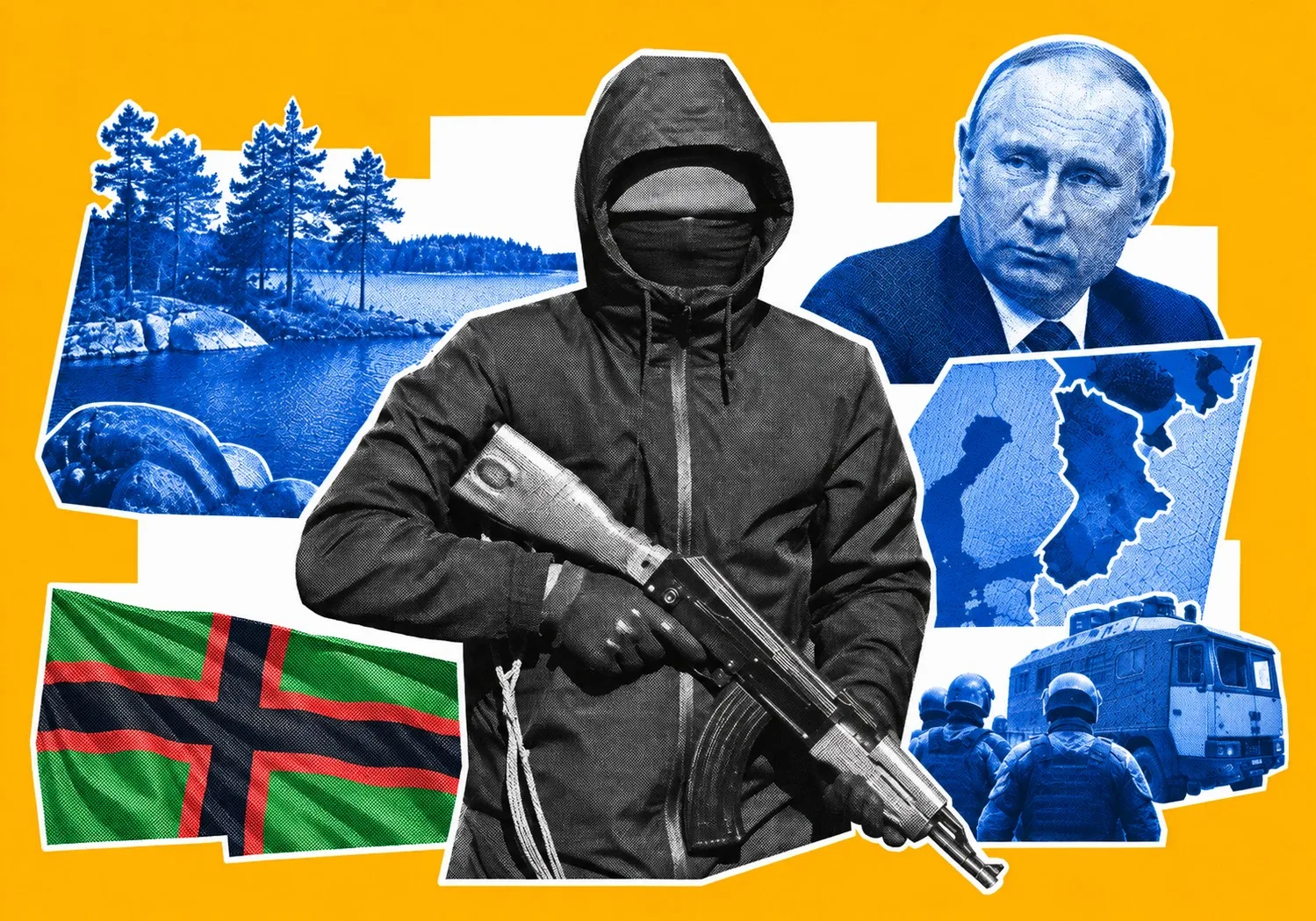
A previously little-known Karelian separatist group calling itself Pohjoinen Veljeskunta (Northern Brotherhood) says it is ready to take up arms for Karelia's independence from Russia. The declaration, made in videos circulated in early November, comes amid prosecutions of national activists and new research documenting population decline and language loss among several of Russia's ethnic minorities. The group's military capabilities remain unverified.

In videos shared on Telegram in early November 2026, masked men carrying firearms said their organisation was prepared to conduct armed operations against Russian authorities. Pohjoinen Veljeskunta claims to defend Karelians and the wider Finno-Ugric community. It describes Moscow's rule as “Neo-Bolshevism” and invokes Karelia's history of resistance to Russian expansion.
Karelians are a Finnic people whose traditional homeland crosses today's Russian-Finnish border. Finland ceded substantial territory to the Soviet Union following the wars of 1939–1940 and 1941–1944, which brought displacement and decades of Soviet rule.
The Northern Brotherhood claims responsibility for sabotage on the railway towards Murmansk in November 2023 and involvement in attacks on infrastructure near Vyborg and the Baltic port of Ust-Luga in March 2026. Neither claim has been independently verified. Its leaders and membership remain unidentified, and the locations of its videos have not been established.
On 8 November, the investigative collective InformNapalm reported public support for the group from Karjalan Heimoryhmä, or NORD, a Karelian volunteer formation whose members fight Russian forces alongside Ukraine. There is no independently established evidence of operational cooperation.
Unlike the Northern Brotherhood, whose strength is unknown, other national movements have documented protests or established organisations in exile.
National Movements Inside Russia and in Exile
In Bashkortostan, thousands protested outside a court in Baymak in January 2024 after environmental and national activist Fail Alsynov was sentenced to four years for allegedly inciting ethnic hatred. Police dispersed demonstrators and opened criminal investigations. By April 2026, at least 81 people had been implicated in the Baymak case, according to OVD-Info; 57 received prison terms of three to seven and a half years.

Ruslan Gabbasov, founder of the Bashkir National Political Centre, campaigns for independence from Lithuania. Russia sentenced him in absentia to 14 years in March 2026. In April, Lithuanian authorities announced an investigation into an alleged plot to assassinate him and pro-Ukrainian activist Valdas Bartkevičius. Investigators said suspects acted in the interests of Russian military intelligence.

Buryat independence activists also operate abroad.
Tusgaar Buryad-Mongolia, founded by opera singer Marina Khankhalaeva, held its second Congress of Supporters of Buryatia's Independence in the United States in September 2026. A Russian military court sentenced Khankhalaeva in absentia to 20 years for alleged extremist and terrorist activities. She denies the charges and says the movement uses peaceful political methods.
Other groups focus on the war and Indigenous rights without necessarily seeking independence.
The Free Yakutia Foundation, co-founded by Sargylana Kondakova, opposes military recruitment and advocates for the Sakha people. Kondakova helped organise the Indigenous Vision forum in Berlin in September 2026, bringing together representatives of ethnic republics, Indigenous organisations and international institutions.
She told The Moscow Times that without international support, “everything could end very tragically for our peoples”.
Organisations representing Tatars, Chuvash, Mari, Erzya, Moksha, Kalmyks and Ingush have networks abroad, including Free Idel-Ural, the Committee for the Independence of Tatarstan and the Ingush Independence Committee. Their objectives range from regional self-government and language rights to independence.
The Chechen movement, shaped by the wars of the 1990s and 2000s, remains active in exile through representatives of the Chechen Republic of Ichkeria; separate Chechen volunteer units have fought alongside Ukraine.
Some groups coordinate through the Free Nations League and the Free Nations of Post-Russia Forum, established in 2022, which advocates independent states on the territory of today's Russia.
In November 2026, representatives of several movements jointly opposed granting Russia observer status in the Organisation of Turkic States.
Russia Targets National and Indigenous Activists
In June 2024, Russia's Supreme Court banned a purported “Anti-Russian Separatist Movement”, although human rights groups said no formally established organisation by that name existed.
Later that year, the court designated the Free Nations of Post-Russia Forum and 172 allegedly affiliated organisations as terrorist groups. Some of those named denied links to the forum or rejected separatism. Under Russian law, supporting or participating in a designated terrorist organisation can carry lengthy prison sentences.
The prosecutions also reach Indigenous campaigners outside independence politics.
Russian authorities detained Daria Egereva, a Selkup advocate and co-chair of the International Indigenous Peoples' Forum on Climate Change, in December 2025. Amnesty International reported searches of at least 17 other Indigenous activists' and human rights defenders' homes in April 2026.
The International Work Group for Indigenous Affairs (IWGIA) has documented restrictions on organisations working on traditional livelihoods, environmental protection and international Indigenous representation.
Activists from Bashkortostan, Buryatia, Sakha and other republics continue their work in Europe or North America, sometimes while facing Russian criminal proceedings. Their campaigns also address the decline of minority languages and changes in the republics' populations.
Indigenous Populations Decline Across Several Russian Republics
An official report drawing on Russia's 2021 census listed 194 ethnic peoples, from large communities such as Tatars, Bashkirs and Chechens to groups numbering a few hundred.
The narrower legal category of Indigenous small-numbered peoples includes 47 recognised groups, 40 from the North, Siberia and the Far East, according to IWGIA's 2026 report.

Together they number just over 315,000 people.
Many depend on reindeer herding, fishing, hunting and ancestral land; recognition generally applies to peoples numbering fewer than 50,000.
Larger peoples, including Sakha, Buryats and Tatars, fall outside that category.
A July 2026 study by demographer Vasily Bublikov in Nationalities Papers found sharp declines among several Finno-Ugric peoples.
Adjusting for census weaknesses, he estimated that between 2010 and 2021 the number identifying as Komi fell by about 37%, Udmurts by 30% and Mari by 22%.

In Karelia, a Komi Science Centre study published on 5 November 2026 found that the ethnic Karelian population fell from roughly 78,900 in 1989 to 25,900 in 2021, a drop of 67%.
Of Karelians recorded in the 2021 census, 43% were aged 60 or over and just 7% were under 15.
Another November study found that only 26.6% of ethnic Karelians who answered the relevant question called Karelian their native language; almost three-quarters named Russian.
By contrast, 70.1% of Komi respondents identified their ethnic language as native, compared with 95% among the Sakha and 99.3% among Tuvans. Bublikov also recorded growth in the proportion of titular populations in some North Caucasus and Siberian republics.
Census comparisons are imperfect: 16.3 million residents had no recorded ethnicity in 2021, against 5.6 million in 2010.
The war in Ukraine has added to losses in poorer regions.
Tuva recorded 476 confirmed deaths per 100,000 residents and Buryatia 400, among Russia's highest rates. The figures cover all ethnic backgrounds and are not a complete count of military deaths.
In February 2026, the BBC reported that 39 men from Sedanka, a village of 258 people on the Kamchatka Peninsula inhabited mainly by Koryaks and Itelmens, had signed military contracts.
Twelve had been killed and seven were missing.

With few jobs available and livelihoods centred on fishing and small-scale food production, local women complained to the regional governor in March 2024 that too few men remained to prepare firewood for winter.
Anti-war activist Maria Vyushkova told the BBC that state television cast Indigenous peoples as natural warriors and marksmen to encourage recruitment. The BBC also documented deaths among Nenets, Chukchi, Khanty and other small Indigenous communities.
Researchers link regional recruitment and casualty rates partly to poverty and the comparatively high payments offered for military contracts.
Moscow's Language Policies and the Drive for a Common Russian Identity
The shift towards Russian as a native language long predates the war.
In 2018, federal education amendments made the study of regional state languages dependent on parental choice, ending compulsory instruction in several republics. Moscow called the change a protection against mandatory lessons; critics said minority languages were disadvantaged because Russian already dominated universities, government and employment.
Tatar, previously compulsory in Tatarstan's schools, lost its mandatory status.
Karelian has no state-language status in the republic named for its people. Its Latin-based script complicates recognition under federal rules requiring republican state languages to use Cyrillic unless an exception is authorised.
IWGIA also notes that, although Russian law protects some Indigenous small-numbered peoples, it does not establish the internationally recognised principle of free, prior and informed consent for decisions affecting traditional territories. Access to forests, rivers and reindeer pastures has brought communities into conflict with industry and regional authorities over resource extraction.
 In November 2025, President Vladimir Putin approved a State Nationalities Policy Strategy to 2036, effective from January 2026.
It pledges to preserve ethnic and linguistic diversity while strengthening Russian and promoting a common national identity. It identifies ethnic Russians as the “state-forming people” and aims for at least 95% of citizens to identify with a common Russian civic identity by 2036, a civic rather than ethnic target.
Sources: InformNapalm, Popular Front, The Moscow Times, IWGIA, Cambridge Univercity Press, BBC News Russian