
Remembrance Sunday 2026: King Charles Leads Cenotaph Service in London

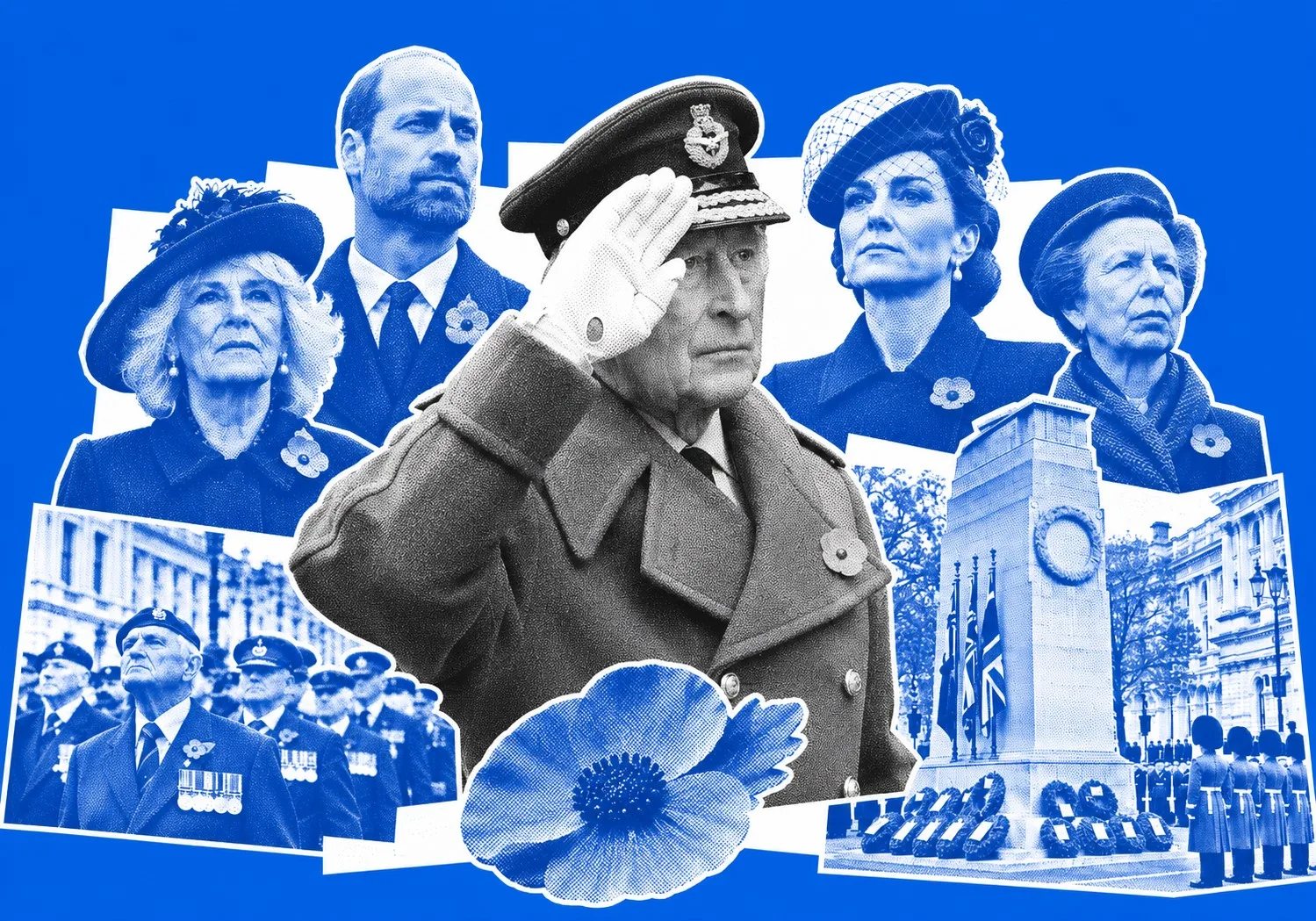
King Charles III led Britain's Remembrance Sunday commemorations on 8 November, observing a two-minute silence and laying a wreath at the Cenotaph in central London. Around 10,000 veterans, including approximately 20 who served during the Second World War, gathered for the annual ceremony honouring those who died in conflict. This year's service brought together a record nine former British prime ministers and marked Andy Burnham's first Remembrance Sunday as prime minister.

\## Britain falls silent at the Cenotaph
Military bands played as members of the Royal Family, politicians, serving personnel and veterans assembled around the memorial on Whitehall.
At the first stroke of Big Ben at 11am, the country fell silent for two minutes. Ceremonial guns fired by the King's Troop Royal Horse Artillery at nearby Horse Guards Parade marked the beginning and end of the silence. Buglers then sounded the Last Post.
The King laid the first wreath of red poppies, followed by other members of the Royal Family and senior political figures. Queen Camilla and Catherine, Princess of Wales, watched from a balcony overlooking Whitehall.

The service continued with prayers and a hymn. Among those attending was Dame Sarah Mullally, the first female Archbishop of Canterbury.
After the formal ceremony, veterans began their traditional march past the Cenotaph. More than 300 military and civilian organisations were represented, with participants travelling from across Britain and overseas. Thousands of spectators lined the surrounding streets.

\## The last generation of Second World War veterans
Among the oldest participants was Annie Duplock, 103, who joined the Women's Land Army in 1940 at the age of 16 after lying about her age.
She spent four years working on a farm in Leicestershire, helping maintain Britain's food supplies during the war. This was her first appearance in the annual Cenotaph procession.
More than eight decades after the Second World War, its surviving veterans are now in their late nineties or over 100. Their numbers have dwindled sharply, leaving fewer people able to give first-hand accounts of the conflict.
But Sunday's procession was not limited to those who served in the two world wars. Veterans of Iraq, Afghanistan and other military operations marched alongside bereaved relatives, military charities and younger participants.
Steve Hooper, 43, a former RAF serviceman who served in Iraq, joined the march with an Invictus Games alumni group.
Hooper has described witnessing serious trauma while working as an ambulance driver. After returning home, he struggled with sleep and flashbacks. Support from the Royal British Legion and the Invictus Games helped him during his recovery.
His experience was among those highlighted by the Legion ahead of the service, drawing attention to veterans whose injuries and psychological difficulties continued long after their deployments ended.
Political firsts in Whitehall
Prime Minister Andy Burnham attended his first Remembrance Sunday in office, joining King Charles III and senior political figures at the Cenotaph.

The ceremony also brought together a record nine former prime ministers: Keir Starmer, Rishi Sunak, Liz Truss, Boris Johnson, Theresa May, David Cameron, Gordon Brown, Tony Blair and John Major.
According to the BBC, when Blair left Downing Street in 2007, only two former prime ministers were still alive: Major and Margaret Thatcher.
Reform UK leader Nigel Farage also laid a wreath for the first time after his party reached the parliamentary threshold of six MPs required to participate alongside other party leaders.
Why Britain remembers in November
Remembrance Sunday is observed on the second Sunday of November. It differs from Remembrance Day, also known as Armistice Day, which always falls on 11 November.

The date commemorates the armistice between Germany and the Allied powers that took effect at 11am on 11 November 1918, ending fighting on the Western Front during the First World War.
Millions had died during the conflict, and many families had no grave to visit. In 1919, King George V called for a two-minute silence to honour the dead. The observance became an annual tradition.
Originally, Armistice Day commemorated those killed in the First World War. Its scope widened after 1945 to include the dead of the Second World War and later conflicts involving British and Commonwealth forces.
Remembrance Sunday subsequently became the principal occasion for national ceremonies. Similar services are held at war memorials, churches and public squares throughout the United Kingdom.
The commemorations also recognise those who survived military service, the families of the dead and civilians affected by war.
The Cenotaph and the red poppy
The national ceremony has taken place at the Cenotaph in Whitehall for more than a century.
Architect Sir Edwin Lutyens designed the original monument in 1919 as a temporary structure made from wood and plaster. It attracted such widespread public support that the government commissioned a permanent version in stone, unveiled by King George V on 11 November 1920.
The name comes from the Greek for 'empty tomb'. No one is buried beneath the monument.
It was built as a memorial to those who died in the First World War, particularly men whose bodies were never recovered or who were buried in military cemeteries overseas. For their families, the Cenotaph offered a place to mourn closer to home.
Its restrained design contains almost no decoration and avoids symbols of military victory.
Red poppies became associated with remembrance through In Flanders Fields, a poem written in 1915 by Canadian military doctor John McCrae. It describes the flowers growing among soldiers' graves on the battlefields of Belgium and northern France.
The Royal British Legion adopted the poppy as a remembrance symbol in 1921. Its annual appeal raises money for serving personnel, veterans and their families.
Although the poppy is widely worn in Britain during November, participation is voluntary. The Legion says the symbol represents remembrance and support for the Armed Forces community, rather than endorsement of any particular war or political position.

\## The conflicts remembered in 2026
Beyond the traditional ceremony, this year's commemorations have given particular attention to veterans of military operations in the Gulf, Iraq and Bosnia.
The Royal British Legion marked the 35th anniversary of the end of the 1990–91 Gulf War, which followed Iraq's invasion of Kuwait. More than 50,000 British service personnel were deployed during Operation Granby, the UK's contribution to the conflict. Forty-seven died.
The organisation also commemorated 15 years since the conclusion of Operation Telic, Britain's military operation in Iraq. It began with the US-led invasion in March 2003 and ended in 2011. A total of 179 British personnel lost their lives.
Another focus was Britain's involvement in international peace-support operations in Bosnia and Herzegovina, where 59 service personnel died.
These conflicts featured prominently in Saturday's Festival of Remembrance at London's Royal Albert Hall, attended by the King and Queen.
Veterans recounted their experiences of deployment, while letters sent home from Iraq offered accounts of the conditions they faced and the effects of separation on their families.
The commemorations continue on Wednesday, 11 November, when Britain will again observe two minutes of silence at 11am, marking 108 years since the armistice that ended fighting on the Western Front.
Sources: BBC, The Independent,