
Germany Polls: Chancellor Merz Hits Record Low as AfD Expands Lead

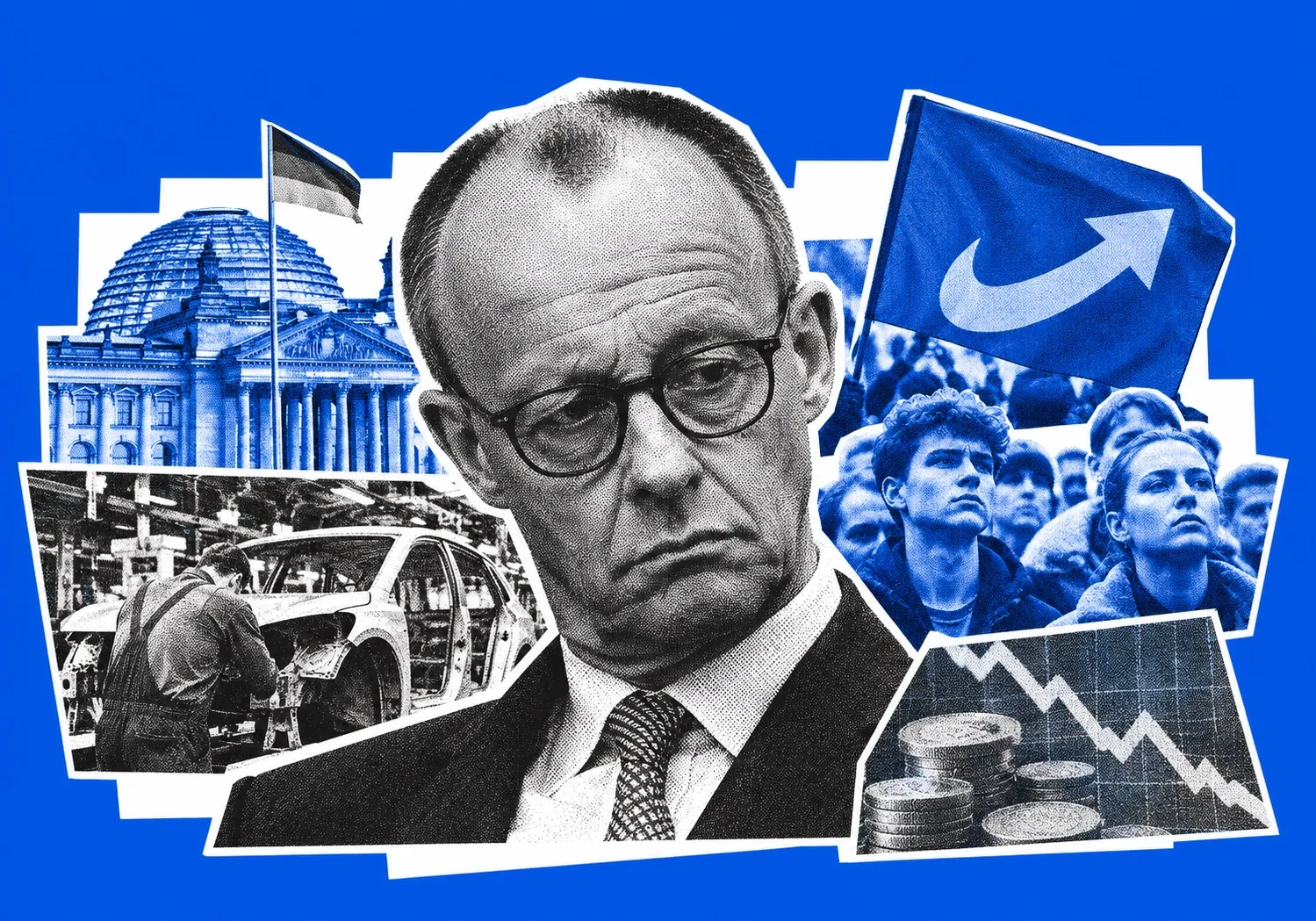
German Chancellor Friedrich Merz has recorded an all-time low approval rating, with 82% of voters dissatisfied with his performance. According to the latest polls, the far-right AfD has expanded its lead over the governing CDU/CSU-SPD coalition to nearly ten percentage points.
An INSA survey published by BILD on 7 November recorded similarly poor ratings for the CDU/CSU–SPD coalition, while six in ten Germans reported that their personal circumstances had worsened since the government took office.
The findings are consistent with November's ARD-DeutschlandTREND, conducted by Infratest dimap among 1,297 respondents between 2 and 4 November. That survey put satisfaction with Merz at 12% and approval of the coalition at 11%.
For Germany's governing parties, the more troubling figures concern voting intentions. INSA placed the AfD at 29%, ten percentage points ahead of the CDU/CSU. Infratest dimap recorded a narrower but still substantial gap, with the AfD on 27%, the conservatives on 20% and their Social Democratic coalition partners on 13%.

The surveys use different methodologies and should not be treated as interchangeable. Both, however, describe a government struggling to retain public confidence while its principal challenger gains ground.
Germany's industrial troubles become a political liability
Merz entered office with an economy already confronting problems that no change of government could quickly resolve.
Germany's industrial model has long depended on competitive energy supplies, advanced manufacturing and strong export demand. Each of those foundations is under pressure.
Higher energy costs have weakened the competitiveness of energy-intensive manufacturers. German carmakers face fierce international competition, particularly from Chinese electric vehicle producers, while the transition away from combustion engines requires substantial investment.
Volkswagen's difficulties have brought these pressures into sharper focus. Discussions over restructuring, employment and production capacity have made the future of industrial jobs an immediate political concern.
For workers in automotive manufacturing and its extensive supply chains, arguments about long-term industrial transformation have a direct connection to employment security.
The government's difficulty is that measures intended to strengthen Germany's future competitiveness can impose costs on industries already struggling to adapt.
Merz has indicated that his administration wants to reconsider rigid electric vehicle mandates and pursue a more flexible approach to automotive policy. He has also promised structural changes to Germany's social system and measures to address economic stagnation.
Yet these commitments have not translated into stronger public confidence.
The INSA finding that 60% of respondents believe their personal circumstances have deteriorated offers one explanation. Although the survey does not establish that government decisions caused those difficulties, it indicates how closely dissatisfaction with political leadership is associated with economic insecurity.
Inflationary pressures, weak purchasing power and concerns about employment have left the coalition defending its record against expectations it has struggled to meet.
The AfD has exploited that frustration by presenting itself as an opponent of existing energy, environmental and migration policies.
Its co-leader, Tino Chrupalla, has sought to portray the party as a defender of German industry against government decisions that he argues have damaged competitiveness.
That argument appeals to voters worried about industrial decline, although dissatisfaction with the government's economic record does not establish that the AfD's proposed alternatives would resolve Germany's underlying structural problems.
The coalition cannot easily escape its political constraints
Germany's governing arrangement places two parties with different political traditions in the same administration.
The CDU/CSU approaches economic and social policy from a conservative perspective, while the SPD must defend its social democratic priorities and maintain support among workers and trade union constituencies.
Those differences become particularly difficult when the government must decide how to distribute the costs of economic adjustment.
Reforming social spending, supporting industry and managing the energy transition require compromises that can disappoint supporters on both sides.
Public disputes between coalition figures have made those tensions increasingly visible.
SPD leader and Vice-Chancellor Lars Klingbeil faces the task of maintaining cooperation with the conservatives while managing criticism within his own party. Regional Social Democrats, including Ruhr SPD figure Martin Murrak, have publicly challenged aspects of the government's direction.
Merz has rejected calls to resign and continues to defend his reform programme.
His position illustrates an important distinction between political popularity and parliamentary authority. Poor opinion polls do not automatically remove a German chancellor from office. The government can continue as long as it retains the parliamentary support necessary to govern.
But maintaining a majority is different from maintaining political momentum.
The coalition must negotiate contentious reforms while both governing parties face weak electoral support. Each compromise carries the possibility of further alienating voters, while public disagreements risk reinforcing the impression of an administration unable to act decisively.
There is another constraint: the Brandmauer, or political firewall, through which Germany's established democratic parties refuse governing coalitions with the AfD.
That exclusion limits the AfD's route into executive office despite its polling strength. It also narrows the coalition options available to the CDU/CSU.
The result is an uncomfortable political arrangement. The parties currently governing together have strong reasons to disagree over policy, but limited attractive alternatives for assembling a governing majority.
The firewall itself does not explain the government's economic difficulties or its poor approval ratings. It does, however, shape how electoral fragmentation translates into coalition politics.
The AfD's gains expose a generational divide
The AfD's national polling lead conceals substantial regional differences.
In eastern states including Thuringia, Saxony and Brandenburg, its support ranges from 37% to 44%, considerably above its national standing.
The figures show how far the party has established itself in regions where conventional party loyalties have weakened.
Economic insecurity and dissatisfaction with established parties provide part of the political context. Migration and opposition to government environmental policies also feature prominently in the AfD's appeal.
But the available polling does not establish a single explanation for its particularly strong eastern performance. Regional voting patterns cannot be reduced to industrial concerns alone.
A further challenge for the traditional parties comes from younger Germans.
ARD polling found that 82% of respondents believe politicians pay insufficient attention to young people's interests.
Among people aged 18 to 34, reported trust in the CDU/CSU and SPD stood at just 5% and 3% respectively.
Those figures raise questions about the parties' ability to rebuild support beyond their established electorates.
The Greens, polling at 16% in the November ARD survey, remain ahead of the SPD, while Die Linke stands at 11%. The Free Democrats and the Sahra Wagenknecht Alliance each register 3%.
Germany's political competition is therefore becoming more fragmented, even as the AfD emerges as the strongest individual party in the surveys.
Polling leads are not election results, and current voting intentions cannot establish how Germans will vote in future federal contests. Nevertheless, the scale of the AfD's support makes it increasingly difficult for the established parties to dismiss its position as a temporary protest phenomenon.
A weakened Berlin complicates Europe's political agenda
Germany's domestic difficulties matter beyond its borders because of the country's economic weight and central role in European policymaking.
Accounting for roughly a quarter of EU economic output, Germany is indispensable to negotiations over industrial competitiveness, trade and European security.
A government consumed by domestic disagreements may find it harder to secure agreement on ambitious European initiatives, particularly those requiring substantial expenditure or politically sensitive economic adjustments.
That does not mean Berlin has ceased to function or that European decisions are automatically blocked by Merz's low approval ratings. The more immediate risk is reduced room for political compromise.
France faces a comparable problem of executive unpopularity.
An October YouGov European leadership tracker recorded positive ratings of just 11% for Merz against 84% negative. French President Emmanuel Macron received 14% positive and 82% negative ratings.
These figures place both leaders among Europe's least popular national executives, although their constitutional positions and domestic political circumstances differ.
The parallel weakness matters because Franco-German cooperation remains important to European decisions on defence coordination, industrial policy and economic reform.
Both governments must balance European commitments against domestic political pressures, making agreement on costly or contentious initiatives potentially more difficult.
For Merz, the immediate test is whether his coalition can turn its economic programme into decisions that command sufficient parliamentary and public support.
His proposed changes to social policy and automotive regulation will require cooperation from an SPD increasingly exposed to criticism from its own political constituency.
The government has not reached a formally established point of collapse. Its parliamentary survival and its capacity to deliver reforms remain separate questions.
With the AfD polling ahead of both governing parties and younger voters expressing exceptionally low confidence in traditional political organisations, Merz must pursue economic changes through a coalition whose members have increasingly limited political room to concede ground.
Sources: Bild, T-online, Tagesschau, DW, Politico