
Ukraine’s Refinery Strikes Force Oil-Rich Russia to Import Fuel and Ration Petrol

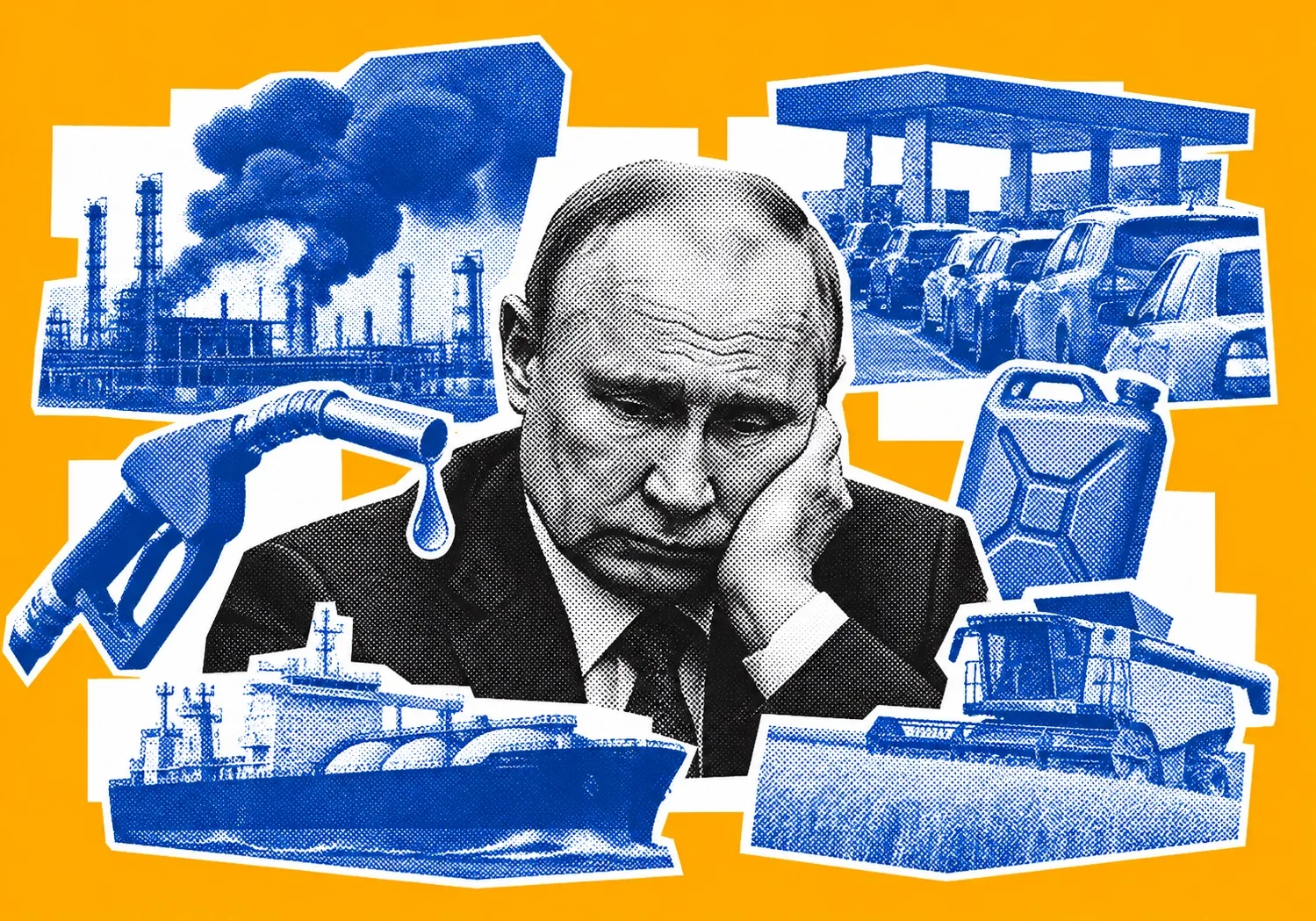
Despite remaining one of the world's largest crude producers, Russia is facing acute domestic fuel shortages following a renewed wave of Ukrainian strikes on its oil refineries. With up to 30% of refining capacity disrupted, Moscow has been forced to ban fuel exports, ration petrol at the pump, and import gasoline and diesel from abroad - putting mounting strain on its war economy and global energy trade.
At petrol stations in parts of Russia, motorists are once again facing restrictions on how much fuel they can buy. In Karelia, purchases have been limited to 30 litres of gasoline and 50 litres of diesel at certain highway filling stations. Similar measures have appeared thousands of kilometres away in Siberia.
These consequences extend beyond petrol stations. They are reaching agricultural producers, transport operators, industrial businesses and a federal budget already under pressure from the costs of the war in Ukraine.
How refinery attacks created a fuel shortage
Russia's difficulty is not a shortage of crude oil. It is a shortage of dependable refining capacity.
Oil extracted from Russian fields cannot simply be delivered to petrol stations. Refineries must process it into gasoline, diesel, aviation fuel and other products. When these facilities are damaged, the supply of finished fuels can fall even if crude production remains relatively stable.
Ukraine has increasingly targeted this part of Russia's energy infrastructure, striking refineries, storage facilities and transport installations.
According to Reuters, at least eight major Russian refineries were attacked during the two weeks preceding November 9. One of the latest targets was the Kirishi refinery in the Leningrad region, Russia's second-largest oil-processing facility.
The renewed attacks coincided with the return of fuel restrictions in Karelia, Buryatia, Zabaykalsky Krai and several other regions.
The scale of the disruption is significant, although estimates need to be distinguished carefully.
Industry assessments reported in November suggested that facilities representing roughly 30% of Russian refining capacity had been affected by attacks. That does not mean national fuel production had permanently fallen by the same proportion.
Reuters-linked industry estimates indicated that actual processing could decline by approximately 200,000 tonnes per day from a late-October level of around 700,000 tonnes.
Meanwhile, estimates cited by Ukraine's Defence Ministry suggested that 20–35% of Russia's refining capacity could have been temporarily unavailable.
The duration of the disruption matters as much as the initial damage. Some refinery equipment can be repaired relatively quickly, while sophisticated processing units may require months of work. Repeated strikes can interrupt repairs and make production schedules harder to maintain.
Russian companies can redirect crude oil to other facilities, draw on inventories or adjust fuel deliveries between regions. But those measures become more difficult when several major refineries are affected simultaneously.
Why an oil-exporting country is importing gasoline
Russia has not ceased to be a major energy exporter. It continues to sell crude oil internationally and retains substantial refining capacity.
What has changed is its growing need to purchase certain finished petroleum products from abroad while domestic production is disrupted.
According to information published by Ukraine's Defence Ministry, citing Financial Times reporting, Russia has been importing gasoline by sea from countries including Turkey, Morocco and Egypt.
Belarus and Kazakhstan have also been identified as sources of fuel supplies.
These imports illustrate a fundamental distinction between producing crude oil and maintaining a reliable domestic fuel market.
A country can export millions of barrels of crude while simultaneously lacking enough gasoline or diesel in particular regions. The availability of refining equipment, transport capacity and fuel storage determines whether domestic consumers receive the products they need.
Ukraine's Defence Intelligence has also documented the maritime supply routes being used.
In September, the agency identified 17 tankers involved in delivering more than 562,000 tonnes of gasoline and diesel to Russia between July and September 2026.
The reported supply network involved shipments associated with India and transhipment routes through Egypt, Turkey, Morocco and South Korea.
These routes do not necessarily establish the country where every shipment was originally refined. A vessel departing from a particular port may be carrying fuel produced elsewhere.
Nor does supplying petroleum products to Russia automatically constitute a sanctions violation. The legal status of individual transactions depends on the origin of the products, the companies involved, applicable restrictions and the jurisdictions concerned.
Nevertheless, the expansion of these routes demonstrates how Russia is seeking external alternatives to its disrupted refining system.
Moscow restricts exports to keep fuel at home
The pressure on domestic supplies has forced Russian authorities to make another difficult choice: restrict exports of products that would otherwise generate revenue.
Russia reintroduced gasoline export restrictions during the summer of 2026, when an earlier series of Ukrainian refinery attacks coincided with strong seasonal demand.
In July, the government also imposed restrictions on overseas diesel sales.
These measures were intended to increase the amount of fuel available to Russian consumers and businesses.
Yet export restrictions come with an economic cost.
Petroleum products are an important part of Russia's energy trade. When domestic shortages force producers to redirect supplies away from foreign markets, opportunities to earn export revenue are reduced.
Refined fuels can also command different margins from crude oil, depending on market prices, processing costs and transportation expenses.
Consequently, selling crude instead of refining it domestically does not necessarily preserve the same economic value.
The situation is particularly complicated for companies operating damaged refineries. They may face repair costs, interrupted production, altered logistics and reduced opportunities to sell higher-value products.
At the same time, the government must maintain sufficient fuel supplies to prevent further disruption to the domestic economy.
The growing cost of keeping fuel affordable
One of the less visible consequences of Russia's fuel difficulties is the growing burden on the federal budget.
Russia operates a fuel-damper mechanism designed to compensate producers for supplying fuel to the domestic market when selling abroad would otherwise be more profitable.
The mechanism helps limit the impact of international energy prices on Russian consumers, but it also requires substantial public expenditure.
According to Ukraine's Foreign Intelligence Service, payments under the mechanism increased from approximately $2.30 billion in August to $3.56 billion in September 2026.
That represented a monthly increase of 55%, reaching the highest level since April 2022.
The intelligence service also reported that compensation arrangements had been extended to imported fuel, adding another dimension to the government's financial obligations.
The distinction is important: not all fuel-damper payments are caused by imports or refinery attacks. The existing mechanism also responds to international prices and domestic market conditions.
However, the need to support imported supplies creates additional pressure at a time when Russia is struggling to maintain production.
The same intelligence assessment reported that Russian oil and gas budget revenues fell by 17.2% year on year during January–September 2026, reaching approximately $63.82 billion.
Russia's Finance Ministry subsequently reduced its forecast for annual oil and gas revenue to $88.4 billion.
These figures reflect several influences, including energy prices, taxation, export conditions and sanctions. Refinery disruptions are an additional source of pressure rather than the sole explanation for declining revenue.
The broader fiscal problem is straightforward: Moscow needs money to support domestic fuel supplies while receiving less revenue from a sector on which the state has traditionally depended.
Farmers and transport companies face the consequences
Diesel shortages are particularly sensitive because diesel powers much of Russia's agricultural machinery, freight transport and industrial equipment.
Reports of supply difficulties have included important agricultural areas such as Krasnodar Krai, Stavropol Krai and Rostov Oblast.
For farmers, fuel availability can determine whether machinery operates when weather and harvesting conditions are favourable.
A delay in fieldwork can affect crop quality, increase operating expenses and create problems for subsequent transport and storage.
Smaller agricultural businesses may be especially exposed because they have fewer resources to maintain large fuel reserves or arrange alternative deliveries.
Transport operators face similar challenges.
A company unable to obtain sufficient diesel locally may have to change routes, travel farther to refuel or reduce vehicle utilisation. Each adjustment adds time and expense.
Those costs can eventually spread through supply chains, affecting food distribution, construction materials and other goods.
The effect is not necessarily an immediate nationwide shutdown. Russia has substantial transport infrastructure and the ability to prioritise deliveries.
Instead, the danger lies in repeated regional disruptions that make ordinary commercial activity more expensive and less predictable.
The return of rationing in November, only months after the summer shortages, suggests that the fuel distribution system remains vulnerable to renewed refinery attacks.
What the shortages mean for Russia's war economy
Fuel is also essential to military operations.
Armoured vehicles, military trucks, generators and transport networks all depend on reliable energy supplies. Disruptions to civilian refining and distribution therefore create an additional challenge for a country sustaining a large-scale war.
There is no verified evidence in the available reporting that the latest shortages have caused a general interruption of Russian military fuel supplies.
Military requirements may receive priority over civilian demand, and Russia retains the ability to redistribute available resources.
Nevertheless, maintaining those supplies can become more expensive as domestic production is disrupted.
Fuel transported over longer distances requires additional logistics. Imported products may involve higher procurement and delivery costs. Damaged refineries require repairs, replacement equipment and protective measures.
These are resources that cannot simultaneously be used elsewhere.
For Moscow, the problem is therefore not simply whether enough fuel exists to keep military vehicles operating. It is how much money and logistical effort must be devoted to maintaining that supply.
Why the crisis matters beyond Russia
Russia's changing fuel trade also has implications for international energy markets.
When a major exporter restricts shipments of gasoline or diesel, buyers that previously depended on those products may need alternative suppliers.
At the same time, Russian demand for imported fuel creates new commercial opportunities for refiners, traders and shipping companies.
The consequences for European markets are indirect but relevant.
Although the European Union has substantially restricted imports of Russian petroleum products, global fuel markets remain interconnected. Changes in Russian exports and import demand can affect trading patterns, shipping routes and regional price differentials.
The precise impact depends on the volume and duration of the disruptions, as well as the ability of other producers to increase supplies.
There is also a sanctions-policy dimension.
The use of multiple trading and transhipment hubs makes the origin and movement of petroleum products more difficult to assess. For European governments seeking to maintain pressure on Russia's energy revenues, understanding these trade flows is increasingly important.
However, the existence of a supply route should not be treated as evidence of sanctions evasion without transaction-specific proof.
Can Russia restore its fuel independence?
Russia still possesses a large refining industry, considerable crude oil reserves and established energy trading relationships.
Those advantages make a complete collapse of its fuel supply system unlikely on the basis of the currently available evidence.
But restoring damaged facilities is not always straightforward.
Complex refining equipment may be difficult to replace quickly, particularly when access to specialised foreign technology is restricted. Repair schedules can also be disrupted by additional attacks.
Russia can respond by increasing imports, redirecting crude to functioning refineries, adjusting export rules or providing further financial support to domestic suppliers.
Each option addresses part of the problem, but none is free of cost.
Imports require foreign suppliers and transport capacity. Export restrictions reduce commercial opportunities. Subsidies increase fiscal expenditure. Repairs consume money and industrial resources without guaranteeing protection from subsequent attacks.
The central question is therefore not whether Russia will stop producing or exporting oil. It is whether its refining system can recover quickly enough to reduce dependence on emergency imports and government intervention.
For decades, Russia's oil industry helped generate the revenue that supported the state. In 2026, parts of that same industry increasingly require financial support and foreign fuel supplies to keep the domestic market functioning.
Russia continues to sell crude oil abroad. But the need to buy gasoline and diesel from other countries reveals how vulnerable its energy economy has become when the infrastructure between the oilfield and the petrol station is repeatedly disrupted.
Sources: Reuters, Ministry of Defence of Ukraine, Foreign Intelligence Service of Ukraine, LB.ua, Glavcom, LSM