
Part of Crimea Bridge Collapses After Ukrainian Strike, Halting Road and Rail Traffic

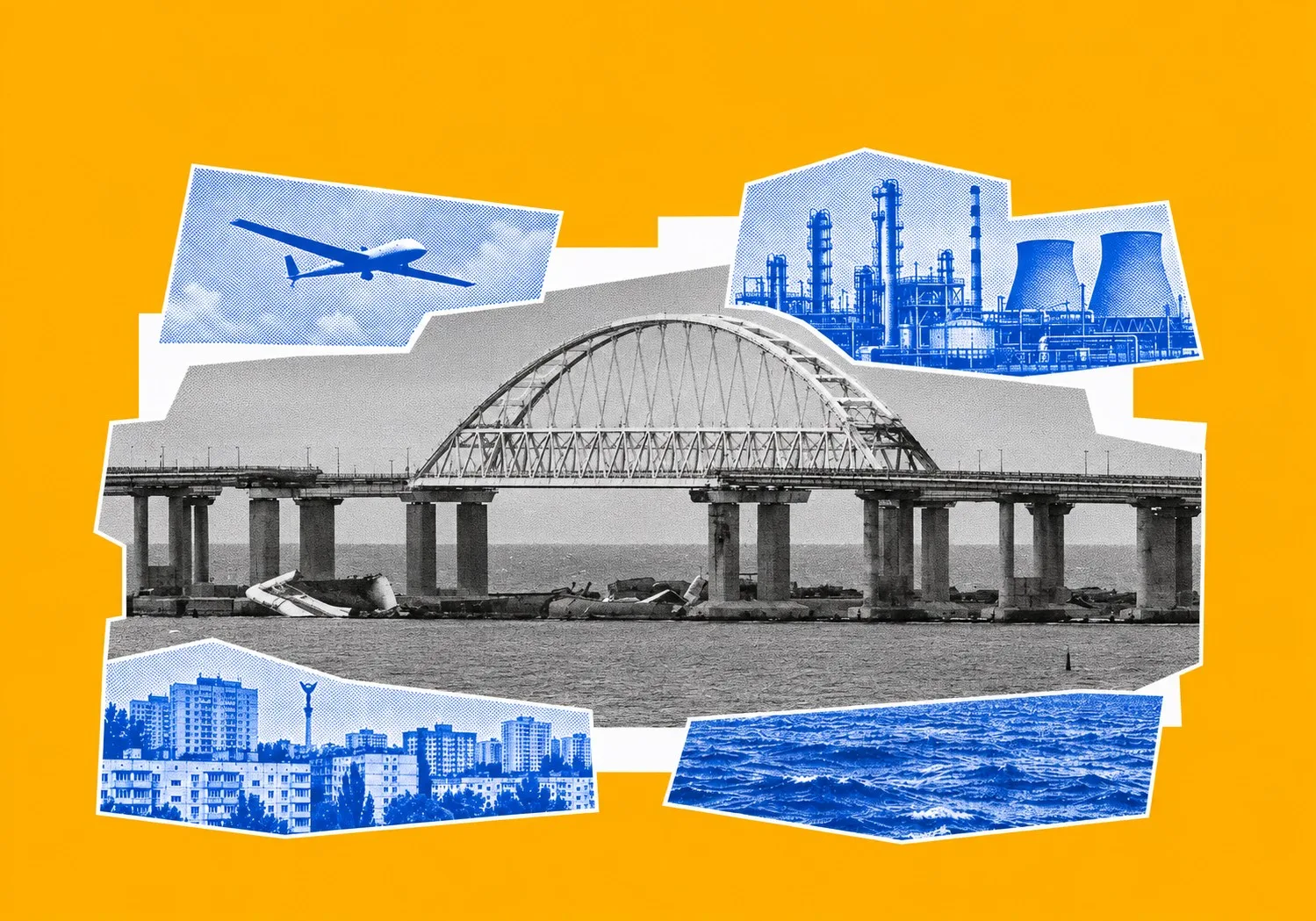
A section of the road deck on the Kerch Bridge appeared to have fallen into the sea early on Tuesday, after what Russia said was Ukraine’s second strike on the crossing in two days. Russia’s transport ministry suspended road and rail traffic to occupied Crimea. A Ukrainian monitoring group said the fallen arch had also blocked the shipping channel into the Sea of Azov. Hours earlier, Russian missiles hit two bridges carrying traffic across the Dnipro in Kyiv. The city closed both crossings, and the wider overnight attack damaged part of the metro network and left parts of the capital without power, water or heating.

Kerch Traffic Grinds to a Halt
For a few hours on Monday evening, motorists could cross the Kerch Strait again.
Russian officials had reopened a single lane after a strike shut the road for roughly 17 hours.
Cars took turns crossing in each direction. Trains, officials said, had continued to run. The Kremlin described the damage as minor. Deputy prime minister Marat Khusnullin said officials had already assembled designers and builders for repairs and were working on logistics with the regional authorities.
That limited reopening ended overnight. Sergei Aksyonov, Moscow’s appointed head of occupied Crimea, said the bridge had been attacked again and urged residents and visitors to stay away. Russia’s transport ministry said it had suspended trains as well as road traffic while specialists assessed the damage. By Tuesday morning there was no clear timetable for reopening the crossing or an official account of the condition of the rail deck.
Images published by the Kyiv Independent appeared to show a section of the road deck missing between two supports. Ukrainian officials had yet to comment on Tuesday morning. Aksyonov separately reported that two people had been killed in a drone attack in Crimea. The transport ministry said its preliminary information indicated there had been no casualties on the bridge itself.
Petro Andriushchenko, head of Ukraine’s Centre for the Study of Occupation, said the road arch had fallen into the Kerch–Yenikale Canal, blocking navigation between the Black Sea and the Sea of Azov. The canal is about 120 metres wide. Larger merchant ships and naval vessels use the dredged channel because the waters beneath neighbouring spans are too shallow for them.
A blockage would cut off larger ships sailing to and from Mariupol and Berdiansk, now under Russian occupation, and restrict the movement of Russian naval vessels that use the channel. The extent and duration of the reported obstruction remained unclear on Tuesday morning.
Kyiv’s River Crossings Shut
Shortly before midnight on Monday, Kyiv’s mayor, Vitali Klitschko, said initial reports indicated that missiles had hit the Northern and Southern bridges.

Ukraine’s air force had warned of incoming missiles. President Volodymyr Zelenskyy had said earlier that day that Ukrainian intelligence expected Russia to strike that evening and into Tuesday.
The strikes hit civilian transport infrastructure in a capital of more than three million people. The UK Home Office cited a population estimate of about 3.3 million in October. The Dnipro runs through the capital, and journeys to work, school and hospital often start on one bank and end on the other. By Tuesday morning, both bridges were closed. A further overnight missile attack damaged above-ground metro infrastructure, cutting Green Line services between Osokorky and Chervonyi Khutir. Trains continued to run on the section between Syrets and Vydubychi.
With the bridges closed, some buses that normally used the Northern Bridge were sent across the Podilskyi crossing towards Kontraktova Ploshcha metro station. Other services crossed via the Darnytskyi Bridge. The city shortened several trolleybus services, suspended others and put more vehicles on alternative routes.
Klitschko reported interruptions to water and heating, and parts of the capital lost electricity. It was unclear when services would be fully restored.
Kyiv had already had to divert traffic after attacks on the Northern Bridge in October. On 3 October, damage to the road surface blocked traffic towards the right bank and delayed buses and trolleybuses. A Russian drone hit the roadway the following morning, injuring two people. Buses later returned to their regular routes.
Zelenskyy had accused Russia the previous week of trying to divide Ukraine along the Dnipro and make life harder on both banks. Russia’s defence ministry said its forces had struck transport, energy and military facilities in Kyiv and elsewhere in Ukraine.
Moscow’s Lifeline to Crimea
When Russia seized Crimea in 2014, the peninsula’s roads led into mainland Ukraine. Motorists approaching from Russia had to cross the Kerch Strait by ferry. A bridge would give Moscow a permanent connection to the territory it had seized and allow it to move people and goods there directly from Russia. The UN General Assembly affirmed Ukraine’s territorial integrity and said the referendum held under occupation provided no basis for changing Crimea’s status.
Construction began in early 2016. Russia’s Federal Road Agency put the cost at about 228 billion roubles. The main contract went without a tender to Stroygazmontazh, owned by Arkady Rotenberg, a longtime associate of Vladimir Putin, according to Poland’s Centre for Eastern Studies. Ukraine objected to construction on sovereignty grounds and raised concerns about the effects on fishing, shipping and the environment.
Putin opened the road crossing in May 2018, driving a truck across the strait.

Passenger trains began running in December 2019. Across 19 kilometres of road and railway, residents, businesses and visitors gained a direct link between Crimea and Russia’s Krasnodar region. The EU, meanwhile, said the bridge limited access to Ukrainian ports on the Sea of Azov, when Mariupol and Berdiansk were still under Kyiv’s control.
After Russia launched its full-scale invasion in February 2022, the crossing acquired a more immediate military purpose. Russian forces used it to enter Crimea before advancing into parts of the Kherson and Zaporizhzhia regions. The bridge subsequently carried supplies for those forces. The bridge’s separate road and rail structures gave Russia a route for cars and lorries alongside a railway that could move heavy loads to the peninsula.
An explosion in October 2022 brought down sections of the road deck and set a fuel train alight. All four road lanes reopened in February 2023. Russia announced that the second rail track had reopened in May, more than six months after the explosion.
Another attack damaged the road crossing in July 2023. Two people travelling by car were killed and their daughter was seriously injured. Ukraine’s security service, the SBU, later acknowledged its role in both attacks. It took nearly three months for Russia to reopen all four lanes after the July strike. In June 2025 the SBU announced a further attack and said it had damaged the bridge below the waterline. Russian bridge updates recorded a closure of about three hours before services returned to normal.
Moscow Claims Record Drone Attack
Russia said the latest overnight barrage was Ukraine’s largest drone attack since the full-scale invasion began. The Russian defence ministry claimed it had intercepted 1,441 drones across 22 regions, including in occupied parts of Ukraine. The previous overnight tally was 1,336. The BBC separately reported a Russian claim of 2,049 drones and four long-range Flamingo missiles intercepted over a 24-hour period covering the earlier attack.
Moscow’s mayor, Sergei Sobyanin, said about 600 drones had been launched towards the Moscow region from Sunday evening. In Ilsky, in southern Russia’s Krasnodar region, local officials said falling drone debris injured six people, including children, and a fire broke out at an oil refinery. Russian officials also reported attacks on industrial areas in Bashkortostan. In Salavat, the Russian outlet Astra analysed eyewitness photographs and identified a fire at Gazprom Neftekhim Salavat, one of Russia’s largest petrochemical complexes. Residents reported explosions in the city and said the glow from the fire could be seen as far away as Sterlitamak.
The extent of the damage was unclear.
Ukrainian local authorities reported three injuries in the Cherkasy region. Officials also reported attacks in the Kharkiv and Dnipropetrovsk regions.
In Zaporizhzhia, Russian strikes hit industrial sites in three districts on Tuesday morning. One man was killed and the number of injured rose to 18, according to the regional military administration.
The strikes damaged production buildings and warehouses and started fires. The administration also reported emergency power cuts across the region after Russian attacks on energy infrastructure left many residents without electricity.
Sources: Reuters, Ukrinform , Euronews, RBC-Ukraine , UK Home Office , European External Action Service