
Ukraine to Produce Weapons in Finland as EU States Push for Russia Crypto Sanctions

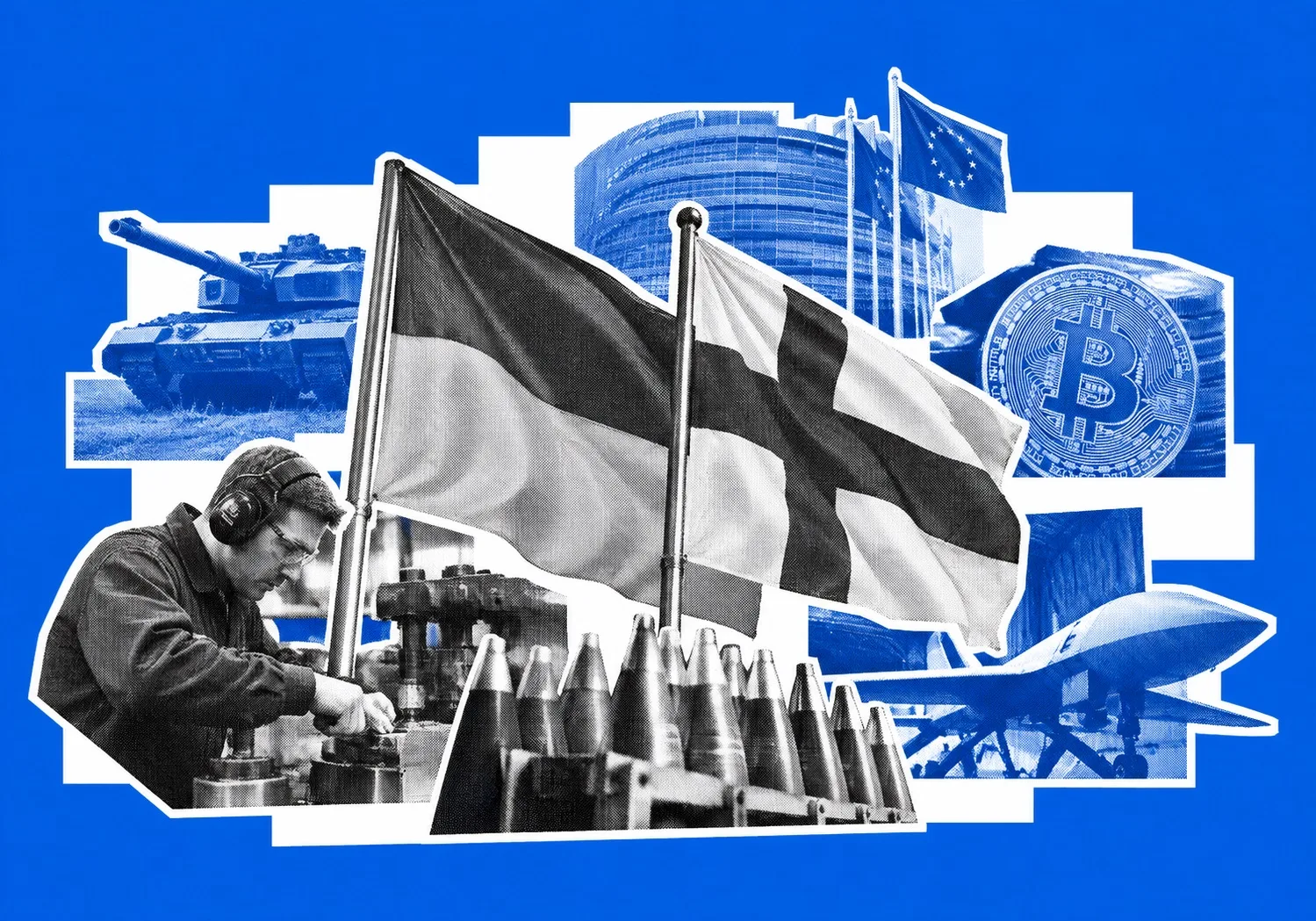
Kyiv and Helsinki have signed a defence manufacturing deal in Brussels allowing Ukrainian weapons to be produced on Finnish territory. Meanwhile, Finland, France, and three other EU nations are urging the bloc to tighten cryptocurrency sanctions to stop Russia from evading financial restrictions.
The two initiatives are separate, but they address problems that European governments have struggled with throughout the war: how to maintain military supplies over several years and how to stop Russia from finding new ways around financial restrictions.
Ukraine's defence industry gets a foothold in Finland
Ukrainian Defence Minister Yevhenii Khmara and Finnish Defence Minister Antti Häkkänen signed the memorandum during meetings in Brussels connected to the Ukraine Defense Contact Group, also known as the Ramstein format.
The agreement will allow Ukrainian defence technologies to be manufactured in Finland. It also covers joint research, investment, technology transfers and cooperation between defence companies.
Most of the equipment produced under the arrangement is expected to go to Ukraine's armed forces while the war continues.
The governments have not yet announced which weapons will be manufactured, which companies will take part or when the first production lines might become operational.
Those details matter. Signing a memorandum is only the first stage of an industrial partnership. Manufacturers still need to agree on projects, secure financing, obtain the necessary approvals and organise production.
A joint steering committee will oversee the process and help the two countries resolve licensing and regulatory questions.
For Ukraine, one of the main advantages is the opportunity to manufacture equipment beyond the reach of many of the attacks that regularly threaten factories at home.
Russia has repeatedly targeted Ukrainian industrial and energy infrastructure. Moving some production abroad could make military supply chains less vulnerable to disruption, although manufacturing in Finland would still depend on reliable access to components, skilled workers and funding.
Finland also has something to gain. Ukrainian companies have spent years developing and modifying military equipment in response to battlefield conditions. Their experience could help Finnish manufacturers develop products suited to the demands of modern warfare.
The memorandum does not specify whether drones, electronic warfare equipment, artillery systems or other weapons will be among the first projects.
During their discussions, the two defence ministers also addressed Ukraine's continuing need for air defence equipment, particularly as winter places additional pressure on the country's energy infrastructure.
Five countries want Brussels to follow Russia's crypto payments
While Helsinki was preparing to expand industrial cooperation with Kyiv, Finnish Foreign Minister Elina Valtonen was pursuing another issue: the use of cryptocurrency to get around sanctions.
On November 16, Finland, Denmark, Estonia, France and Lithuania called for tougher EU measures against Russian cryptocurrency networks and the intermediaries that help move money through them.
The concern is that restrictions on conventional banking have not eliminated Russia's ability to make international payments.
Companies involved in purchasing equipment for Russia can use intermediaries registered outside the country. Payments may pass through several businesses before reaching their final destination, making it harder to establish who is buying the goods and who ultimately receives them.
Digital assets can add another layer to those arrangements.
Cryptocurrency transactions do not necessarily require the same banking channels that European authorities have spent years restricting. Some payments can move between digital wallets before being converted into conventional currency through exchanges or other service providers.
Valtonen and her counterparts want the EU to address these methods more effectively.
Their proposal concerns cryptocurrency services, digital wallets, stablecoins and intermediary networks that may be used to conceal Russian financial activity.
The ministers have called for stronger restrictions and better enforcement, but the proposal has not yet become EU law.
Any new sanctions will have to be negotiated by member states, and their final scope remains uncertain.
Why existing restrictions are difficult to enforce
The EU already has measures aimed at limiting Russian access to cryptocurrency services and financial infrastructure.
But restricting a particular exchange or company does not necessarily stop the people behind a transaction from finding another route.
A payment can move between several digital wallets. Some services operate across multiple jurisdictions, while others have limited customer identification requirements.
Stablecoins create an additional challenge because they offer a way to transfer digital assets without the large price fluctuations associated with cryptocurrencies such as Bitcoin.
For businesses making international payments, that relative stability can be useful. It can also make stablecoins attractive to networks trying to move money outside conventional banking systems.
However, cryptocurrency is not automatically anonymous. Transactions on many blockchains can be traced, sometimes in considerable detail.
The difficulty often lies in connecting a wallet address to the person or company controlling it.
Investigators may identify a suspicious payment but still need information from exchanges, banks or foreign authorities to determine who was involved.
The problem becomes more complicated when money passes through companies in countries that do not enforce EU sanctions.
For European regulators, this means that adding names to a sanctions list may not be enough. Authorities also need to identify the people and businesses providing financial services to sanctioned networks.
That requires cooperation between national regulators, financial intelligence units and law enforcement agencies.
The five governments are asking Brussels to strengthen its response before more Russian-linked transactions move into channels that are harder to supervise.
Finland is joining a wider change in European arms production
Ukraine's agreement with Finland is not the first attempt to bring Ukrainian defence manufacturing into closer cooperation with European industry.
Germany's Rheinmetall has developed industrial projects with Ukrainian partners, while KNDS has been involved in arrangements supporting the maintenance and repair of military equipment.
Britain's BAE Systems has also pursued cooperation with Ukraine's defence sector.
The projects differ considerably. Some involve repairing Western equipment already supplied to Ukraine. Others concern manufacturing, technology sharing or future production.
What they have in common is an effort to make military cooperation less dependent on individual weapons deliveries.
In the first stages of Russia's full-scale invasion, European countries transferred equipment from their own armed forces. Those deliveries were essential, but they also exposed the limits of available stocks.
Replacing donated weapons takes time. Factories need orders, investment, workers and access to materials. Production cannot always increase as quickly as military requirements change.
Joint manufacturing offers another option.
Instead of waiting for a partner to produce and deliver a finished system, Ukrainian companies can work directly with European manufacturers, sharing expertise and expanding production capacity.
For Finland, the agreement also fits into its changing security position.
The country joined NATO in 2023 after decades of military non-alignment. Its long border with Russia gives Helsinki a particular interest in European defence readiness and the outcome of the war in Ukraine.
Closer industrial ties with Kyiv could strengthen Finland's defence sector while helping Ukraine maintain access to equipment.
Still, the benefits will depend on what the two governments and participating companies actually produce.
Until projects, budgets and delivery schedules are announced, the agreement remains a framework for future cooperation rather than evidence of additional weapons already entering service.
Brussels faces a different challenge on sanctions
The five-country cryptocurrency initiative has its own obstacles.
Unlike the Finnish-Ukrainian defence memorandum, which can be implemented through bilateral cooperation, new EU sanctions require agreement among member states.
Sanctions decisions under the EU's foreign policy framework generally require unanimity.
Finland, Denmark, Estonia, France and Lithuania can put forward proposals and build support, but they cannot introduce EU-wide restrictions on their own.
Other governments will have to consider how additional measures would affect financial services, regulatory responsibilities and relations with countries outside the bloc.
There are also practical questions about enforcement.
Cryptocurrency networks can operate internationally, and some transactions may take place entirely outside EU jurisdiction. Even where European authorities can identify suspected sanctions evasion, they may need cooperation from other countries to investigate or disrupt it.
The Commission therefore faces a task that goes beyond drafting another list of prohibited transactions.
It must consider how national authorities can exchange information, how financial service providers should identify suspicious activity and how restrictions can reach intermediaries operating through several countries.
The final measures may differ from what the five foreign ministers have requested.
What happens after the agreements
The next steps will determine how much changes in practice.
For Ukraine and Finland, attention will turn to selecting manufacturing projects, identifying companies and securing the investment needed to begin production.
The agreement gives the two countries a basis for doing that work, but it does not establish a timetable for deliveries.
For the five governments seeking tougher cryptocurrency sanctions, the immediate priority is persuading other EU members to support additional restrictions.
Both efforts are likely to take time.
Building a factory or establishing a new production line involves decisions that cannot be completed through a diplomatic agreement alone. Investigating financial networks is equally complicated when the companies, payment services and individuals involved operate across several jurisdictions.
Europe is now dealing with both challenges at once.
Ukraine needs weapons that can be produced and replaced throughout a prolonged war. At the same time, European governments are trying to prevent Russia from using international financial networks to purchase restricted goods and sustain its military operations.
The Finnish agreement offers one route towards expanding Ukraine's production capacity. The five-country sanctions proposal seeks to make it harder for Russian-linked networks to finance procurement through digital assets.
Neither initiative guarantees an immediate result. Their importance will depend on the factories that eventually begin operating, the equipment they deliver, and the financial restrictions that EU governments ultimately agree to enforce.
Sources: [Ministry of Defence of Ukraine,](https://mod.gov.ua/en/news/ukraine-finland-joint-defence-production-memorandum ) [Ministry for Foreign Affairs of Finland,](https://um.fi/current-affairs/-/asset_publisher/gc654PySnjTX/content/suomi-tanska-viro-ranska-ja-liettua-vaativat-tehokkaampia-toimia-venajan-kryptovaroihin-puuttumiseksi ) [Council of the European Union,](https://www.consilium.europa.eu/en/meetings/fac/2026/11/17/ ) [The Kyiv Independent,](https://kyivindependent.com/european-foreign-ministers-call-on-eu-to-crack-down-on-russian-crypto-networks-financing-war-against-ukraine/ ) [European Pravda ](https://www.eurointegration.com.ua/news/2026/11/17/7250185/ )