
Trump to Meet Xi and Putin in China for Nuclear Arms Talks

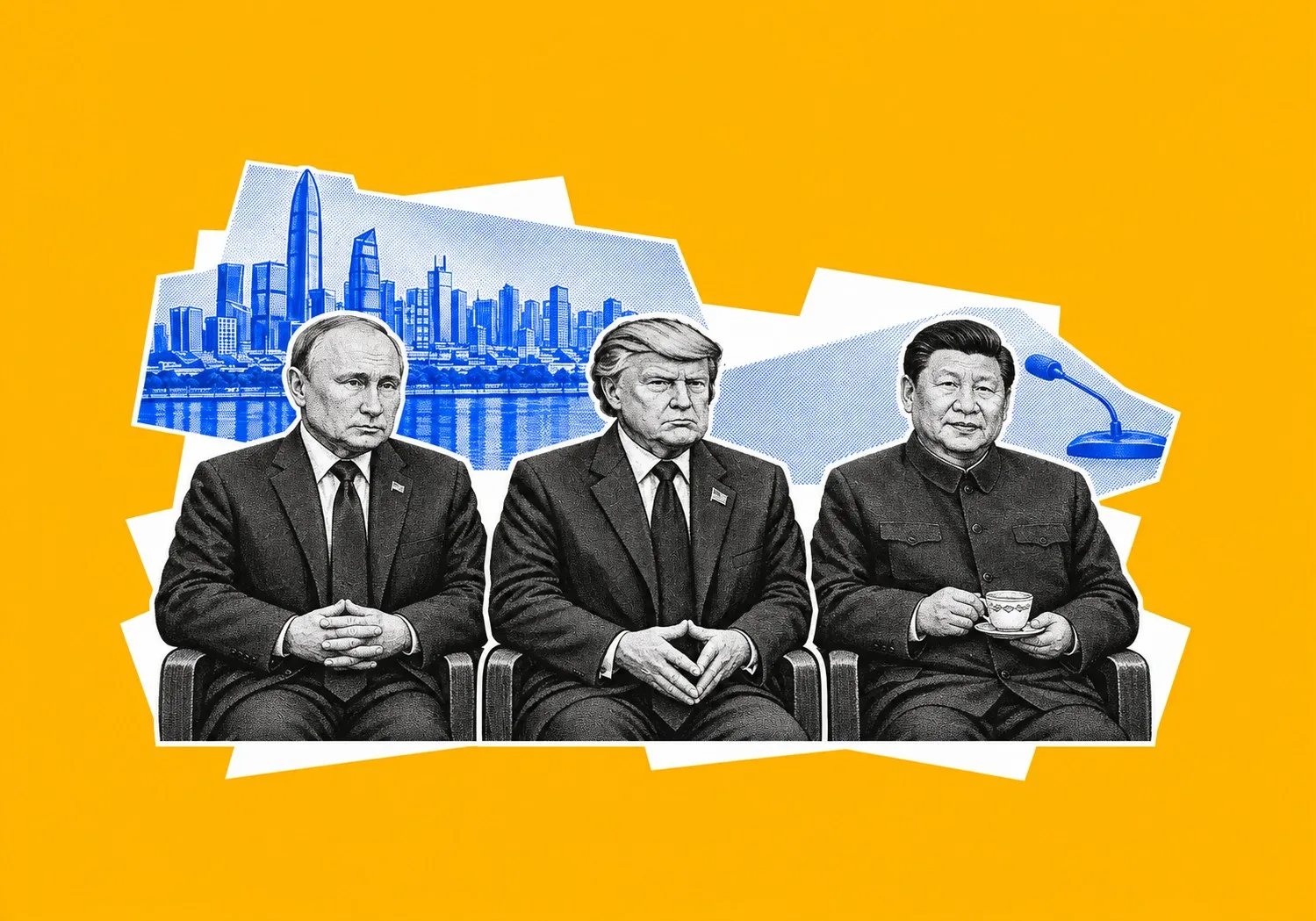
Donald Trump will meet Xi Jinping and Vladimir Putin in Shenzhen, China, on Thursday 19 November, the White House has said. Trump plans to discuss cuts to nuclear arsenals on the sidelines of the Asia-Pacific Economic Cooperation (APEC) summit. A senior US official said Russia’s war in Ukraine was off the agenda for the three-way meeting. The official said Trump would also raise the war with Iran. The Kremlin, meanwhile, says Putin intends to speak to Trump in Shenzhen about efforts to end the war in Ukraine. It has given no details about when such a conversation might take place, and the US official said a separate meeting between the two presidents was not expected. Ukraine’s president, Volodymyr Zelenskyy, has expressed concern that the leaders could discuss a settlement without Kyiv.

Xi, who is chairing the two-day summit, is due to hold separate talks and a working lunch with Trump before Putin joins them for the first meeting of its kind between the three countries’ leaders.
Washington sees that meeting as an opening discussion on nuclear arms.
‘We do not expect to get to any kind of agreement,’ the US official said.
Why Moscow Is Talking About Yalta
The historical comparison came from Russia’s chief negotiator in the Ukraine talks.
Speaking to Russian television after this week’s meetings in Abu Dhabi, Vladimir Medinsky called for a European security arrangement modelled on a ‘new modern Yalta or Potsdam’. He argued that such an arrangement could secure peace for decades. He was talking about how European security should be organised after the war, a much broader subject than the nuclear discussion Washington has announced for Shenzhen.
At Yalta in February 1945, Winston Churchill, Franklin D Roosevelt and Joseph Stalin met in Crimea as Nazi Germany neared defeat.
They discussed the occupation of Germany, the future United Nations and the terms on which the Soviet Union would enter the war against Japan. Poland’s future was also on the table. The three leaders agreed that its provisional government would be broadened and that it would hold free elections. Soviet forces were already in Poland, and the promise of a free vote failed to prevent the country’s incorporation into the Soviet bloc.
That history gives the analogy particular weight in Poland and elsewhere in eastern Europe. The governments whose future was being discussed had little say in the decisions. For Kyiv, the practical concern is that a conversation among the three presidents could influence what Washington later asks Ukraine to accept on territory or security guarantees, even if Shenzhen produces no formal agreement.
The Kremlin has played down the parallel. Its spokesman, Dmitry Peskov, said any agreements reached in Shenzhen could not be imposed on other countries. Beijing’s public preparations have focused on the economic summit and relations with Washington. In a call with US secretary of state Marco Rubio on 11 November, Chinese foreign minister Wang Yi spoke of managing differences and supporting each country in hosting its major summit this year. Beijing’s account of the call set out no plans to discuss a new European security arrangement.
The Limits That Expired With New START
Trump’s call for nuclear arms cuts comes nine months after the expiry of New START, the last nuclear arms treaty between Washington and Moscow. It capped each country’s deployed strategic nuclear warheads at 1,550 under the treaty’s counting rules. A separate ceiling of 700 covered deployed intercontinental ballistic missiles, submarine-launched ballistic missiles and nuclear-capable heavy bombers.
The treaty also provided for data exchanges, notifications and on-site inspections. Those measures gave Washington and Moscow ways to check each other’s declarations about the weapons covered by the agreement. An arsenal can include weapons in storage and retired warheads awaiting dismantlement, so a country’s total inventory can be much larger than the number counted against the treaty ceiling.
When New START expired on 5 February, António Guterres, the United Nations secretary-general, said the two countries were without binding limits on their strategic nuclear arsenals for the first time in more than half a century. He urged both governments to agree on a successor that would restore ‘verifiable limits’.
Putin had proposed that Moscow and Washington continue to observe the deployment ceilings voluntarily for another year. Trump rejected the offer and called for work on a replacement. His push to involve China raises questions that the American and Russian negotiators did not have to settle under New START. The three governments would have to agree which weapons to count, how much to disclose about their forces and whether the same limits should apply to countries with very different arsenals.
Why Beijing Wants Washington and Moscow to Go First
The Stockholm International Peace Research Institute estimates that Russia had 5,420 nuclear warheads in January 2026, the United States had 5,042 and China had about 620. The American and Russian inventories together accounted for nearly 86 per cent of the global total. China’s estimated inventory rose from about 600 a year earlier.
Washington sees that growth as a reason to bring Beijing into talks now. China points to the difference in scale. When New START expired, Chinese foreign ministry spokesman Lin Jian called its demise regrettable and urged the United States to resume talks with Russia. Beijing’s position is that the countries with the largest arsenals should take the lead in cutting them.
Those positions leave the shape of any agreement open. A freeze at current levels would preserve the gap between China and the other two powers. A common ceiling could require substantial cuts from Washington and Moscow while leaving Beijing room to expand, depending on where the ceiling was set. Even an agreement on the numbers would leave the question of how the three governments would check compliance. China has made no public commitment to begin those negotiations.
Xi is hosting a forum whose main business is regional trade and economic co-operation. He is also due to address a separate gathering of business leaders in Shenzhen. The nuclear discussion sits outside that programme.
The schedule gives Trump time to raise arms cuts directly with Xi and Putin, while Xi and Trump’s working lunch gives them a separate opportunity to discuss relations between their two countries.
The war with Iran brings a different set of interests to the meeting.
Russia has deepened its military and diplomatic ties with Tehran. China has an economic interest in keeping oil moving through the Strait of Hormuz, a route for Gulf supplies to Asian markets.
On Thursday, Iran’s military said explosions had struck four tankers in the strait. The account could not immediately be independently verified.
Minghao Zhao, a professor at Fudan University, told a conference in Abu Dhabi that he regarded Russia’s invasion of Ukraine and Trump’s war with Iran as strategic mistakes by their respective leaders. In his assessment, China was managing the consequences of both conflicts. Keeping Gulf shipping routes open gives Beijing a direct interest in what happens next. The US briefing gave no indication that Beijing had agreed to mediate.
Sources: Reuters, Associated Press, Washington Post, The Guardian