
Putin Proposes Trilateral Ukraine Summit With Trump and Xi—Without Zelenskyy

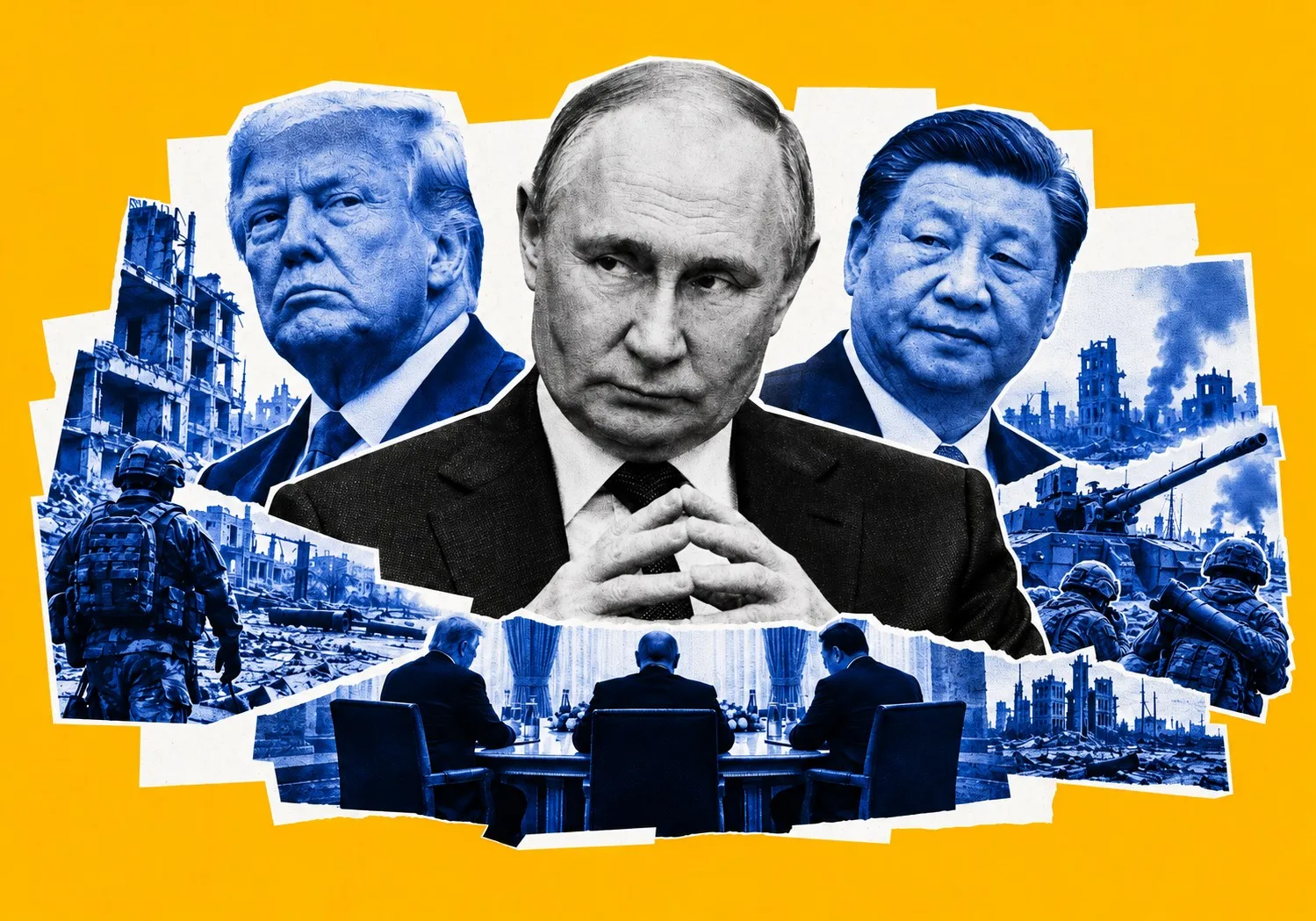
Russian President Vladimir Putin has proposed a high-level trilateral summit with U.S. President Donald Trump and Chinese leader Xi Jinping to negotiate an end to the war in Ukraine on Moscow’s terms, intentionally excluding Ukrainian President Volodymyr Zelenskyy from the negotiations. The proposal, set for the upcoming APEC gathering in Shenzhen, aims to establish a three-way bargaining model for European security as Washington simultaneously grants Russia key sanctions relief in exchange for diesel exports.
Asked about the proposed gathering during a visit to Uzbekistan, U.S. Secretary of State Marco Rubio confirmed that high-level talks were taking place.
“There’s been talks of a meeting. I don’t know whether it’s been finalised, but the president has been clear,” Rubio said. “He’d like the war in Ukraine and Russia to end.”
Rubio then articulated the strategic anxiety quietly driving the White House’s search for an exit.
“We see a lot of downside to it, including the very real risk of escalation and spread of this thing... into another country because of a failed sabotage attack, because of drones that are hit with electronic warfare and they wander into a neighbouring country,” U.S. Secretary of State said.
For Kyiv and its European neighbors, this is the realization of a long-standing nightmare.
Washington’s impulse for a quick deal is overriding European security architecture, eroding the post-World War II prohibition against sovereign border alterations imposed by great powers.
Bargaining for Diesel
The momentum behind the Shenzhen proposal did not emerge by chance.
It rests on an abrupt and profound warming of direct diplomatic and commercial channels between Moscow and Washington, driven primarily by immediate domestic economic pressures inside the United States.
During an October 9 telephone call, Trump and Putin struck an immediate commercial bargain: the resumption of Russian diesel exports to the United States.
The objective was to tame surging domestic fuel pump prices ahead of the U.S. midterm elections, exacerbated by worsening instability across the Middle East and lingering maritime supply disruptions.
Regulatory relief from Washington followed with extraordinary, unprecedented speed.
Only weeks prior, the U.S. Congress had enacted the Lindsey O. Graham Sanctioning Russia and Iran Act, a sweeping piece of legislation designed to enforce secondary tariffs of up to 500 percent on Russian imports and up to 100 percent on foreign entities trading in Russian hydrocarbons.
The statute was explicitly drafted to choke off Moscow’s remaining export revenues and penalize third-country intermediaries facilitating Russian state-backed trade.
Yet on October 16, President Trump signed an executive order invoking a statutory waiver, freezing the implementation of the Graham Act’s punitive measures before they could take effect.
Concurrently, the Treasury Department’s Office of Foreign Assets Control issued General Licence No. 135, formally greenlighting commercial transactions for Russian-origin diesel fuel.
Trump was characteristically blunt when addressing critics across the political spectrum.
"My decision on Russia is a very simple one," he posted on his Truth Social platform, arguing that enforcing harsh economic pressure would "drive, foolishly, Russia away from the bargaining table." In subsequent broadcast interviews, he doubled down on his skepticism toward the Ukrainian leadership, stating bluntly that he was "not a big fan" of Volodymyr Zelenskyy and claiming it was far harder to strike a diplomatic compromise with Kyiv than with Moscow.
To contain domestic fuel inflation and protect consumer sentiment, the administration effectively dismantled the enforcement mechanism of its own legislative sanctions regime. Minimal, unverified promises of diplomatic compliance from the Kremlin were exchanged for tangible, immediate economic relief.
European partners, who spent four arduous years uncoupling their industrial bases from Russian hydrocarbon dependencies at enormous economic cost, were left stranded on the policy sidelines, forced to watch Washington restore trade links with Moscow to satisfy short-term domestic political necessities.
The Ceasefire Collapses
While diplomats in Washington and Beijing debate the theoretical parameters of a grand summit in China, the physical reality of the conflict continues to dismantle diplomatic pretenses on the ground.
An informal "energy ceasefire" brokered by the White House earlier this month collapsed almost immediately under the weight of irreconcilable strategic goals.
Citing persistent and unpunished Russian strikes against Ukrainian logistics and civil grid assets, Kyiv resumed its long-range drone campaign against the Russian energy interior.
In a coordinated, large-scale operation, Ukraine launched over one thousand uncrewed aerial systems deep into Russian airspace.
The strike targeted vital energy infrastructure in St. Petersburg, setting fire to major oil export terminals and refining facilities.
The operation demonstrated that despite mounting diplomatic pressure from Washington, Ukraine retains both the capability and the political will to inflict severe economic friction on Russia's export capacity.
Moscow’s retaliation was swift, calculated, and devastating.
A massive overnight volley on Sunday featuring 16 ballistic missiles—including advanced jet-powered variants—and more than 200 attack drones tore through Ukraine's fragile energy grid.
More than ten primary power generation and transmission facilities sustained severe damage, leaving at least 550,000 households without electricity as winter approached.
The bombardment also caused civilian casualties and inflicted structural damage on medical clinics, schools, and urban metro stations across Kyiv and surrounding regions.
Worse for Kyiv than the physical damage was the sudden, dangerous breakdown in operational coordination with Western partners. Ukrainian officials confirmed receiving no advance tracking warnings or radar telemetry from Western intelligence networks prior to the inbound ballistic missile salvos.
The tracking lapse coincided with acute, high-profile disputes regarding operational access to SpaceX’s military-grade Starshield satellite system.
Although SpaceX Chief Executive Elon Musk publicly clarified that Starshield infrastructure remains under strict U.S. government contractual control, and the White House denied ordering blackout curbs, the broader signal to Kyiv was unmistakable: American operational and intelligence support is now directly tethered to diplomatic compliance.
US Secretary of State Marco Rubio has stated that he has no information regarding the absent warning for the Russian ballistic attack on Kyiv last night.
But he said that on previous occasions there were "software problems".
Answering a question from Radio Free Europe correspondent about Ukraine's statements that last night it again received no warning before Russian ballistic missiles struck Kyiv.
"Whatever happened last night, I don't know exactly. I can't comment on what happened last night,"- Rubio said.
Alone in Kyiv
In public, Ukrainian officials are attempting to maintain a diplomatic posture of constructive engagement to prevent a total rupture with their primary security benefactor.
Serhiy Derkach, Ukraine’s First Deputy Minister for Recovery, Infrastructure and Transport, carefully told international reporters that Kyiv still hoped Washington would refrain from taking sides and at least “stay in the middle.”
Behind closed doors, however, the assessment among Ukrainian military and political planners is far darker and increasingly desperate.
Zelenskyy has directed his sharpest accusations directly at Washington, warning that the White House is drifting into a dangerous, self-serving denial of wartime realities. "When deliveries of missiles for Ukraine's air defence are blocked while Russia is granted relief or delays in sanctions, this is, unfortunately, a denial of reality on the part of our partners," he stated following the devastation in Kyiv.
In an interview with Bloomberg, Zelenskyy was even more explicit about the trajectory of White House policy and the psychological pressure being applied to his administration by American leadership: "Steps have been taken to convince Ukraine to capitulate. I don’t want to think that our American partners believe the war could be ended sooner at Ukraine’s expense. But that’s how it looks."
According to report by The Wall Street Journal, the prospect of a summit convened without the involvement of Volodymyr Zelenskyy is unprecedented, sending alarm bells ringing across European capitals and beyond.
Sources familiar with the discussions told the newspaper that Beijing has signaled through diplomatic channels that it would not object to a three-way meeting if Donald Trump agrees, while Kremlin spokesman Dmitry Peskov confirmed that all three parties acknowledge the hypothetical possibility of such a gathering.
Sources: The Wall Street Journal, Reuters, The Moscow Times, Liga.Net, Ukrainian Pravda