
Tricked into War: How Russia Uses Human Trafficking Networks to Recruit Foreign Soldiers

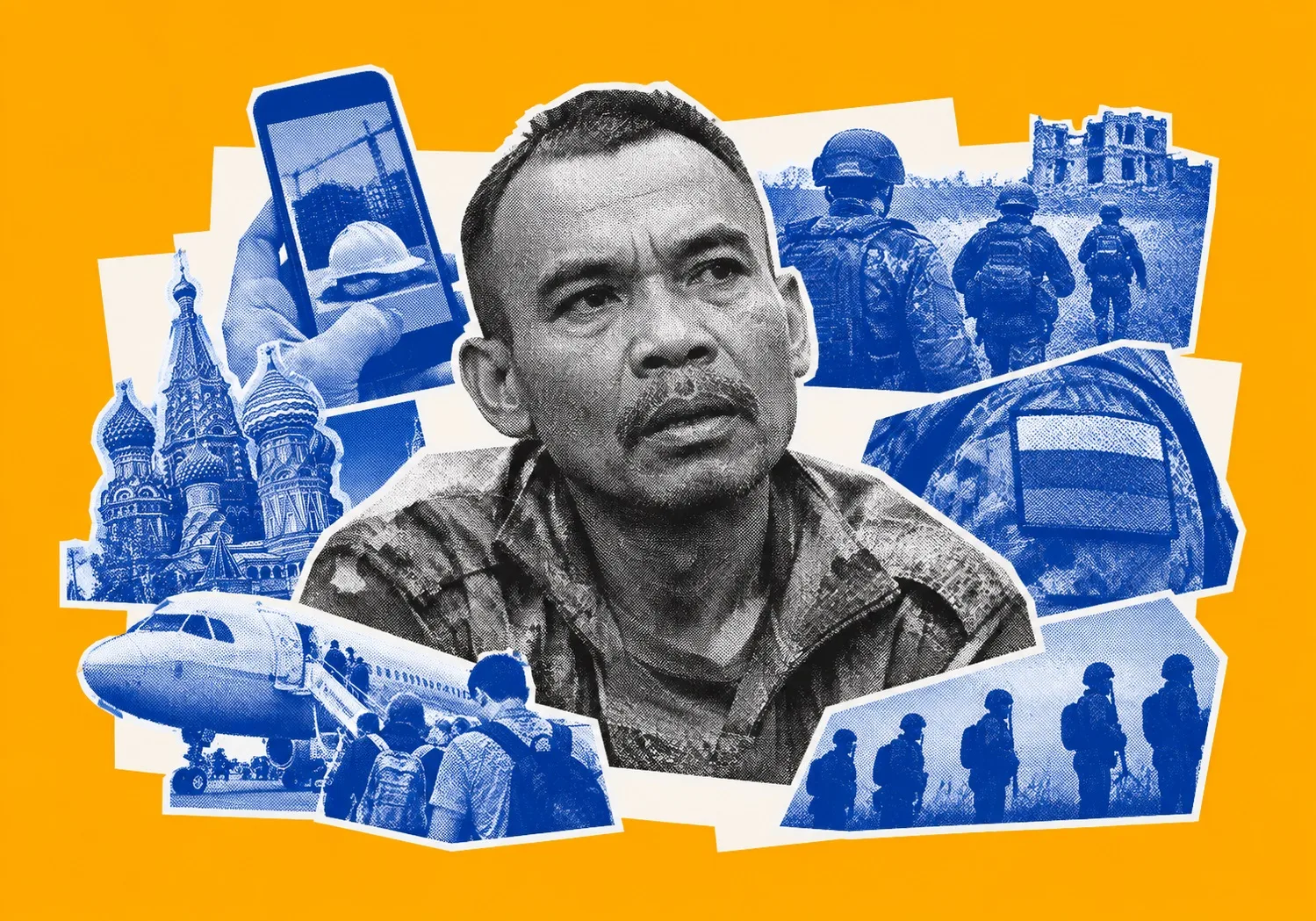
The capture of an Indonesian man coerced into fighting for Russia in Ukraine has laid bare a global human trafficking scheme, where foreign workers are lured with fake job offers and forced onto the frontline.
Sukamto Ayok, a 49-year-old from Java, was taken prisoner by Ukrainian forces in the Zaporizhzhia region after his unit came under drone attack, marking the first documented capture of an Indonesian citizen serving in Russia's armed forces.
It comes amid a sharp increase in recruitment from Indonesia. Ukraine's state-backed I Want to Live project estimates that approximately 283 Indonesians joined Russian forces during the first nine months of 2026. Across the preceding three years, the estimated total was around ten.
The figures have not been independently verified, but the reported increase has prompted a diplomatic confrontation between Jakarta and Moscow, alongside a criminal investigation into suspected human trafficking networks operating inside Indonesia.
The case raises a question that extends beyond one captured soldier: how much of Russia's foreign military recruitment depends on people who never intended to fight?
A construction job that led to the frontline
Ayok's journey reportedly began with an approach from a former school classmate. The acquaintance connected him to an intermediary identified as Alexander, who arranged travel to Russia for Indonesians seeking employment.
Ayok believed he was accepting civilian construction work. In July 2026, he travelled to Moscow with another foreign national and was accommodated in an apartment alongside two Russian citizens.
He was subsequently presented with what appeared to be a one-year construction contract. According to his account, reported by The Guardian and Ukraine's I Want to Live project, the document was a contract with the Russian Ministry of Defence.

Ayok said he realised what had happened only after boarding a bus bound for Russian-occupied Donetsk.
He and another Indonesian attempted to escape but were detained. Ayok alleges that military personnel forcibly tattooed an identification number onto his chest before sending him into an assault unit without training.
His account has not been independently corroborated in every detail. Nevertheless, the recruitment method he describes closely resembles allegations Indonesian police are now investigating.
The distinction matters. A foreign national who knowingly accepts a military contract presents a different legal and political case from someone recruited for civilian employment and subsequently coerced into combat.
Neither nationality nor possession of a Russian military contract establishes whether an individual volunteered or was trafficked.
How online job advertisements feed military recruitment
Indonesian investigators have identified a suspected trafficking network that used social media and messaging applications to advertise employment opportunities in Russia.
Facebook, Instagram and TikTok were among the platforms used to reach potential recruits, according to the Indonesian National Police.
The advertised positions included logistics, border security and defence-related construction. Some offers promised signing bonuses of up to $35,000 and monthly earnings of approximately $3,000.
Such sums could make overseas employment particularly attractive to applicants seeking substantially higher incomes. Yet the apparent employment opportunity concealed a different destination.
Investigators describe a process in which intermediaries arranged flights and tourist visas, allowing recruits to enter Russia without initially travelling through a formal military recruitment channel.
Once there, some were reportedly isolated, pressured into signing military agreements, and sent to active combat zones.
The arrangement creates several obstacles for law enforcement. Recruitment begins through ordinary online advertisements, travel can resemble civilian migration, and the alleged coercion occurs after individuals have crossed international borders.
Responsibility is also distributed among recruiters, travel organisers, and those receiving recruits in Russia.
Indonesian police have identified 13 suspects, including Russian and Ukrainian nationals. The investigation followed the reported death of an Indonesian serving with Russian forces in Ukraine in October 2026.
The suspects' nationalities do not establish the involvement of their respective governments. Nor does the investigation yet demonstrate how closely individual trafficking networks are directed or supervised by Russian military authorities.
That distinction remains central to understanding whether the operation is centrally coordinated, opportunistic or a combination of both.
Jakarta demands an end to recruitment
Indonesia has moved beyond investigating individual recruiters.
In early November, Foreign Ministry spokesperson Yvonne Mewengkang demanded that Moscow take the necessary measures to stop recruiting Indonesian citizens into its armed forces or associated positions.
Jakarta characterised the practices as human trafficking and requested Indonesia's inclusion on Russia's military recruitment exclusion list.
Countries reportedly covered by such restrictions include India, Sri Lanka, Nepal, Laos, Colombia and South Africa.
For President Prabowo Subianto's government, the dispute presents an uncomfortable diplomatic problem.
Indonesia has traditionally pursued a non-aligned foreign policy, maintaining relationships with competing international powers rather than organising its diplomacy around a single geopolitical bloc.
Its response to recruitment allegations therefore centres on protecting Indonesian citizens and challenging the activities of trafficking intermediaries, rather than adopting a broader position on Russia's war.
The requested exclusion would provide a formal basis for preventing recruitment, although the available evidence does not establish how effectively Moscow enforces such restrictions or whether intermediaries can circumvent them.
Jakarta's police investigation also offers a separate route to accountability. Domestic recruiters can potentially be investigated and prosecuted without waiting for Russia to change its military recruitment practices.
The limits are equally apparent: Indonesian authorities can investigate suspected trafficking networks at home, but their ability to intervene after recruits arrive in Russia is considerably more constrained.
Russia's search for manpower extends across continents
Russia's recruitment of foreign nationals did not begin in Southeast Asia.
Following its full-scale invasion of Ukraine in February 2022, Moscow expanded its sources of military personnel beyond domestic contract soldiers and prisoners.
Recruitment subsequently reached Central Asia, African countries including Kenya, Uganda and South Africa, and parts of the Middle East, including Yemen.
The Indonesian figures indicate a potentially significant expansion of that geographical reach.
Ukrainian intelligence estimates that Russia's target for recruiting foreign fighters in 2026 is at least 18,500 personnel. This is an intelligence assessment of recruitment ambitions, rather than a verified count of people successfully enlisted.
Ukraine's I Want to Live initiative, established in September 2022 through the Coordination Headquarters for the Treatment of Prisoners of War with support from defence and military intelligence institutions, has documented foreign recruitment while providing channels through which Russian servicemen and foreign fighters can seek to surrender.
Its figures offer a window into the practice, but they are not a comprehensive census of Russia's foreign military personnel.
The wider picture remains incomplete. Reports involving nationals from Vietnam and the Philippines indicate that Indonesia is not the only Southeast Asian country affected, yet reliable totals across the region are unavailable.
The military significance also requires qualification.
Foreign recruitment can supplement Russia's personnel supply and potentially reduce pressure for further domestic mobilisation. But recruitment totals alone reveal little about battlefield effectiveness, survival rates or the proportion of foreign personnel deployed into assault operations.
The evidence supports an expanding international recruitment apparatus. It does not establish that foreign fighters can replace Russia's domestic manpower requirements.
The unresolved link between trafficking and the Russian military
For European security policymakers, the Indonesian investigation offers another perspective on the resources sustaining Russia's war against Ukraine.
Military recruitment is taking place through channels that overlap with civilian labour migration, international travel services and online employment advertising.
Such networks can operate far from the battlefield, complicating efforts to identify where ordinary recruitment ends and coercive military procurement begins.
The Indonesian case also exposes a problem for governments whose citizens become involved in the war without their knowledge or consent.
A person recruited through deception may simultaneously be a victim of trafficking and a member of a military force fighting in Ukraine. Establishing the circumstances of enlistment is therefore important for criminal investigations, diplomatic intervention and the treatment of captured personnel.
Ayok's capture provides a documented individual case, while Jakarta's investigation indicates that similar recruitment methods may involve a wider network.
What remains unknown is the extent to which Russian military institutions direct these operations, knowingly accept trafficked recruits or rely on intermediaries whose methods they do not scrutinise.
Indonesia has demanded that Moscow stop the recruitment. Its investigators are pursuing suspected traffickers at home. Neither measure, on the evidence currently available, establishes what happens to Indonesians who have already reached Russian military units or how they might be released from contracts they say they never knowingly accepted.
Sources: The Guardian, Foreign Policy, AOL, Jakarta Globe