
How Russia Uses Fake Student Visas to Import North Korean Workers and Bypass UN Sanctions

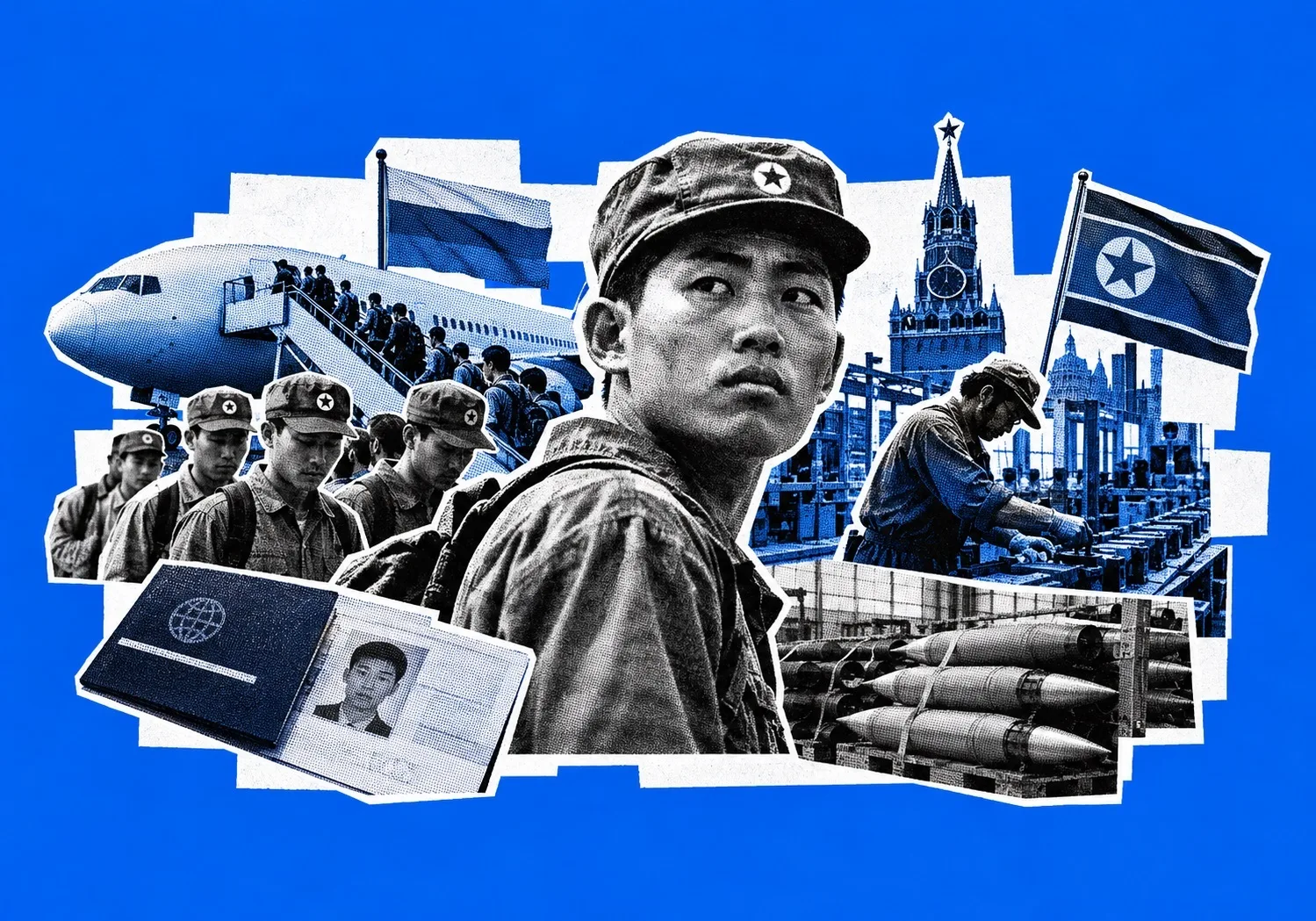
Russia is using thousands of North Korean workers disguised as university students to supply its war economy and construction sites, bypassing UN sanctions and exposing a major loophole in international restrictions. Investigations through October 2026 reveal a sophisticated recruitment pipeline that operates through Russian educational institutions, prompting coordinated sanctions from the EU and the US.
The findings raise a question extending well beyond labour exploitation: whether sanctions designed to isolate North Korea can function when Russia, itself subject to extensive Western restrictions, provides both a market for its workers and the administrative means to conceal their employment.
The Student Visa Route into Russia’s Factories
The scale of the arrangement becomes apparent in Russia’s immigration figures. In 2025, Moscow issued 36,400 visas to North Korean nationals, including 35,849 classified as educational. That represented nearly four times the previous year's number.
Yet estimates put the North Korean workforce in Russia at between 15,000 and 30,000 people by the end of 2025.
The figures cannot establish how many individual visa holders entered industrial employment. They nevertheless point to a substantial discrepancy between the stated purpose of entry and the employment system documented by investigators.
Under the arrangements identified by the Hague-based human rights foundation Global Rights Compliance (GRC), North Koreans are enrolled in Russian educational institutions without attending courses. They are subsequently assigned to factories and other workplaces under the designation of vocational training.

The distinction is central to the scheme.
UN Security Council Resolution 2375, adopted in 2017, prohibited new work permits for North Korean nationals. Resolution 2397 went further, requiring countries to repatriate North Korean citizens earning income overseas by December 2019.
Neither measure was intended to prevent legitimate academic study. The recruitment networks appear to have exploited that distinction, using educational documentation to facilitate employment that would otherwise breach the restrictions.
Rather than relying exclusively on clandestine border crossings or undeclared employment, the system operates through recognised administrative channels. Colleges, visas, commercial contracts and industrial placements collectively provide an appearance of legitimacy.
That makes the arrangement particularly difficult to address through conventional sanctions enforcement. Its individual components can resemble ordinary civilian activity even when their combined purpose is prohibited.
A Commercial Market for Controlled Labour
Investigations by GRC, alongside reporting by the Financial Times, Reuters and The Independent, identified Russian intermediaries offering North Korean workers to businesses seeking large, organised labour groups.
Among the networks examined was Black Horse, a Moscow-based holding associated with businessman Vladimir Sokolov. Its KNDR.su platform marketed groups of 50 to 100 workers to industrial employers.
The advertised conditions included 12-hour working days over 28 days each month. Recruitment commissions could reach 150,000 roubles, approximately $1,860, per worker.
GRC tested the recruitment system by approaching intermediaries while posing as prospective customers. Its findings indicated that the supply of North Korean labour was being marketed as a commercial service rather than arranged through isolated informal agreements.
For Russian employers facing labour shortages, the attraction is evident. Recruitment agencies can provide substantial groups of workers under tightly controlled conditions, reducing the uncertainty associated with ordinary hiring.
But the workers themselves have little of the autonomy normally associated with employment.
Investigators documented restrictions on movement, strict supervision of passports and separation from workers of other nationalities. North Korean embassy personnel and handlers stationed at workplaces monitor their activities.
The coercion extends beyond Russia. Workers face threats of political and physical retaliation against themselves and their families in North Korea if they breach contractual conditions or attempt to escape.
Such arrangements make the apparent existence of employment contracts a poor indicator of genuine consent.
The financial distribution is equally revealing. North Korean workers reportedly retain just 10 to 25 per cent of their earnings, with the remainder appropriated by Pyongyang.
The result is an employment system in which Russian companies obtain labour, intermediaries receive commissions and the North Korean state captures most of the wages.
Workers bear the costs.
From Consumer Goods to the War Economy
The workplaces identified in the investigations illustrate how widely the recruitment system has spread.
North Korean labour has been documented at KPP Ruskon, a pet food manufacturer in Ramensky in the Moscow region, and at a facility producing military rations. Other identified industrial connections include drone manufacturing, metallurgy, shipbuilding and agriculture.
The involvement of companies associated with Russia’s defence supply chain gives the arrangement a strategic significance that ordinary sanctions violations would not necessarily carry.
Military production depends on considerably more than weapons assembly. Food supplies, industrial metals, manufacturing capacity and supporting infrastructure all contribute to sustaining wartime operations.
Foreign workers employed across these sectors can therefore help relieve pressure on the Russian economy even when they are not directly manufacturing weapons.
The investigations also implicated Samolet Group, a major Russian property developer, in the use of North Korean workers on construction sites. Its chief executive, Anna Akinshtina, was among those targeted by the EU sanctions announced in October.
The inclusion of a property developer alongside recruitment businesses and industrial employers indicates that the arrangement is not confined to a narrowly defined defence sector.
It is a broader labour market serving Russian economic needs, with some of its activities directly connected to wartime production.
For Pyongyang, the benefits are financial as well as political. Estimates place the revenue generated by North Korean overseas labour at $450 million to $800 million in 2025.
Those earnings provide foreign currency to a government whose nuclear and ballistic missile programmes are the explicit targets of the UN restrictions.
The relationship therefore operates in both directions. North Korea supplies labour that supports Russian industry, while the income extracted from those workers contributes to North Korea's own military capabilities.
This is a more durable form of cooperation than a discrete transaction involving ammunition or military equipment. It creates continuing economic incentives for both governments to preserve the arrangement.
Sanctions Enforcement Without Moscow’s Cooperation
The institutional problem is especially difficult because Russia occupies a permanent seat on the UN Security Council, the body responsible for the resolutions being circumvented.
Moscow's decision to block the continuation of the UN panel of experts monitoring North Korean sanctions weakened the established mechanism for investigating violations.
Eleven countries subsequently established the MSMT to continue collecting evidence and coordinating scrutiny outside the Security Council framework.
Its findings have helped bring attention to the labour arrangements, but monitoring and enforcement are different tasks.
The MSMT can document suspected violations and provide governments with information supporting national sanctions. It cannot compel Russia to enforce the UN resolutions on its territory.
That limitation helps explain the Western response in October.

By targeting Sokolov, Black Horse, Golden Autumn Agroholding and Akinshtina, the EU sought to impose costs on the commercial structures facilitating recruitment rather than relying solely on diplomatic demands addressed to Moscow.
The subsequent US Treasury measures extended the pressure through financial restrictions, while the joint declaration by MSMT members signalled a broader effort to coordinate enforcement.
Asset freezes, travel restrictions and financial blacklisting can complicate transactions involving designated individuals and companies. They may also discourage other businesses from entering comparable arrangements.
Their practical effect, however, depends on whether the recruitment networks need access to jurisdictions or financial systems where those restrictions can be enforced.
A business operating predominantly inside Russia, recruiting workers from North Korea and serving Russian customers may have fewer immediate reasons to comply with Western financial pressure.
Intermediaries could also reorganise their activities through different corporate structures. The investigations show how adaptable the existing recruitment system has already become.
The Limits of Targeting Individual Brokers
The October measures place Russian companies and executives under greater scrutiny, but the central weakness identified by investigators lies in the administrative system enabling the labour transfers.
Sanctioning a broker does not automatically prevent a college from enrolling foreign students, an employer from accepting trainees or immigration authorities from issuing educational visas.
Nor does financial blacklisting by itself dismantle the mechanisms through which North Korean officials control workers and extract their earnings.
The challenge for Western governments is consequently broader than identifying additional intermediaries. It involves distinguishing legitimate educational exchanges from industrial recruitment while tracing the commercial relationships connecting colleges, labour suppliers and employers.
That requires evidence about how workers are recruited, where they are deployed, who controls their movements and how their wages are distributed.
The available investigations have established important connections, but the differing figures for visas and active workers also illustrate the difficulty of measuring the full operation.
The diplomatic consequences are harder to resolve.
The UN restrictions were designed around an expectation that member states, including permanent Security Council members, would implement the obligations they had collectively adopted.
Russia's role as both an alleged facilitator of violations and a participant capable of obstructing international monitoring exposes the fragility of that assumption.
The MSMT offers an alternative means of investigation, and Western sanctions provide tools for imposing financial penalties. Neither can replace the territorial enforcement that the original UN system requires.
As Moscow and Pyongyang develop economic arrangements that serve their respective military priorities, the question is no longer simply whether individual Russian companies can be punished. It is how far international restrictions can reach when a government responsible for enforcing them has become an essential part of the system designed to evade them.
Sources: FT, ABC, Internazionale, SBS news