
Russia Is Turning Foreign Job Seekers Into Frontline Soldiers

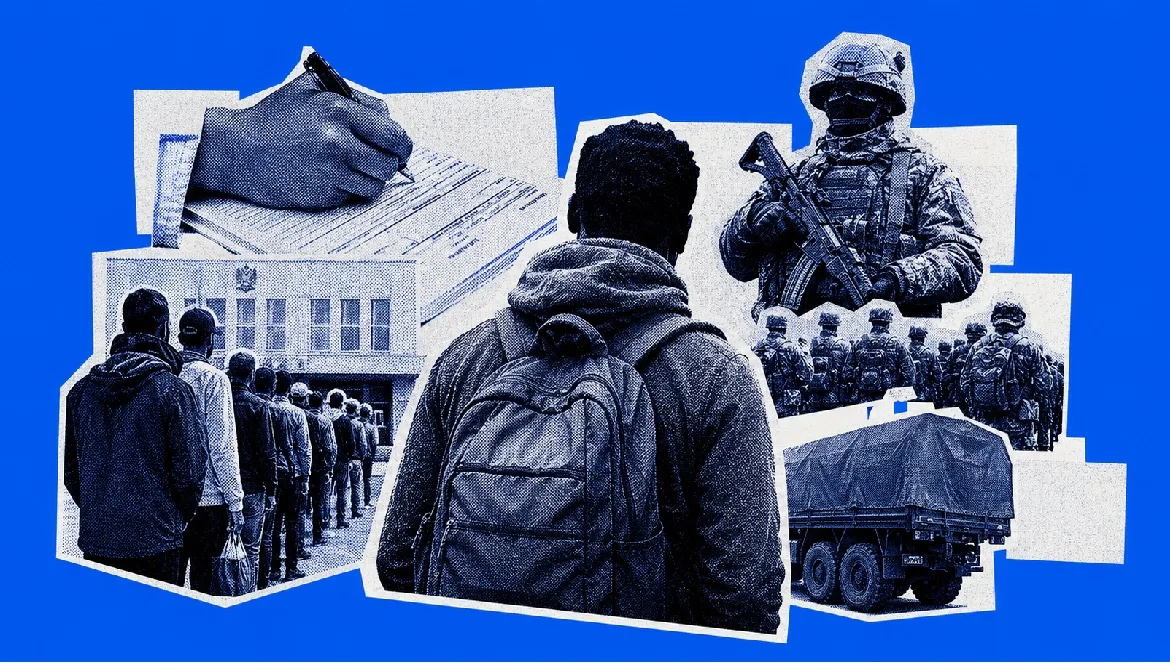
Russia’s war machine is increasingly looking beyond its own borders for soldiers. Foreigners from Africa, Asia and Latin America are being drawn to Russia with promises of jobs, high salaries or citizenship — only to find themselves signing military contracts and heading to Ukraine. Testimonies from former recruits and foreign prisoners of war reveal a system built on deception, coercion and exploitation. As Moscow struggles to replace its battlefield losses without another politically dangerous mobilisation, the Kremlin is turning economic vulnerability abroad into a source of disposable manpower.
For years, Moscow presented its military presence abroad as a symbol of Russia’s global reach. Today, a different picture is emerging. Young men from Africa, Asia and Latin America are being drawn into the Russian army through promises of civilian employment, high salaries, education or citizenship. Many arrive expecting to work. Some sign documents they cannot read. Others are told they will perform auxiliary or security duties. Instead, they are sent to Ukraine.
The system is becoming one of the clearest signs of the Kremlin’s growing manpower problem. Russia is still capable of recruiting soldiers inside the country, but the cost of doing so is rising. Moscow has tried to avoid another politically dangerous mass mobilisation while maintaining the enormous human requirements of a war that consumes tens of thousands of replacements every month. The answer has increasingly been to search for soldiers beyond Russia’s borders.
The result is a recruitment pipeline that human rights organisations and researchers increasingly describe in terms of trafficking, coercion and exploitation. A May 2026 analysis by the Africa Center for Strategic Studies described Russia’s recruitment of Africans as a “bait-and-switch” system in which vulnerable job seekers are drawn into military service through deception and pressure. The scale is expanding. Ukrainian intelligence has said Russia plans to recruit around 20,000 foreign nationals in 2026, while a recent report by the International Federation for Human Rights documented foreign recruits from dozens of countries and warned that the number is likely significantly higher than open-source estimates.
The Job Offer That Ends at the Front
The pattern is remarkably consistent. A foreigner sees an online job advertisement or is approached by an intermediary. The offer promises work in Russia, often with a salary that is difficult to ignore in countries where wages are considerably lower. The position may be described as construction, logistics, security, agriculture or technical work.

The reality becomes clear only after arrival.
Stephen Oduor, a Kenyan, told The Guardian that he believed he was travelling to Russia for a plumbing job. Instead, he was taken to a military base, fingerprinted, issued military documents and given a weapon. He said he and other recruits were sent towards the front with almost no meaningful preparation. After surviving a drone attack, Oduor eventually escaped to the Kenyan embassy in Moscow. “I didn't know how to shoot,” he told the newspaper.
His story is not an isolated case. Richard Kanu, a former Sierra Leonean soldier who had moved to Russia as a migrant worker, said he signed Russian-language paperwork after applying for a job in St Petersburg. He did not understand that he had signed a military contract. Only after arriving at a base near Rostov-on-Don did he realise that he had been recruited into the Russian armed forces.

The language barrier is central to the system. A contract written in Cyrillic can become a trap for someone who does not speak Russian. The person may understand that he is signing documents, but not what those documents legally mean. By the time the deception becomes obvious, he may already be on a military base, without his passport and with no practical way to leave.
The Foreign Soldier Is Cheap Manpower
Russia’s recruitment system is not uniform. Some foreigners knowingly sign military contracts because they want the money or a Russian passport. Others understand that they are joining the army but believe they will be assigned to non-combat roles. A third group appears to have been recruited under entirely false pretences.
That distinction matters. It is misleading to describe all foreign recruits as mercenaries. The word suggests that these men knowingly made a straightforward commercial decision to fight. In reality, the recruitment pipeline includes people who believed they were accepting civilian employment, people who were deceived about the nature of their military role and people who were pressured into service after arriving in Russia.

The International Federation for Human Rights has documented a rapidly expanding foreign recruitment system involving Central Asians, South Asians, Africans and Latin Americans. Open-source estimates cited in its report include more than 10,000 recruits from Central Asia, around 1,800 from South Asia, between 1,700 and 4,000 from Africa and thousands more from Latin America. The report says the number of foreign fighters increased by more than 30 per cent between September 2025 and February 2026.
For Moscow, the attraction is obvious. Foreign recruits help fill the ranks without the political cost of a new mobilisation campaign. They can be promised large sums of money, accelerated citizenship or legal status. If they are killed, their deaths do not generate the same political pressure inside Russia as the death of a Russian citizen.
The foreign soldier becomes a form of disposable manpower.
The Frontline Reveals What the Recruitment System Is For
The testimonies of foreign prisoners captured by Ukraine offer a glimpse into what happens after recruitment.
Men from Nepal, India, Cuba, Africa and other countries have appeared in Ukrainian custody after being captured while serving in Russian units. Some say they were promised non-combat positions. Others describe being deceived about the contracts they signed or being sent to the front after only minimal training.
A Kenyan recruit described being taken from a job offer to a military base and then towards the battlefield. A Sierra Leonean veteran said he did not understand that he had signed a military contract. In another case, an African recruit described receiving only a few days of training before being sent to the front. The stories differ in detail, but the pattern is the same: the distance between recruitment and combat is often extraordinarily short.
The brutality of the system is also visible in accounts of how foreign recruits are treated by the Russian units that use them.

A video circulated online and was described as showing a Russian soldier attaching an explosive device to an African comrade and forcing him to run under threat of being shot. The incident has been cited as an example of the extreme abuse foreign recruits may face inside Russian formations. However, the available evidence does not independently establish all details surrounding the recording, and the case should therefore be treated as a reported incident rather than a fully verified account.
Even without relying on that single case, the broader picture is already disturbing. Reports describe foreign recruits being sent into assault operations, operating with little knowledge of Russian and limited military preparation, and being treated as expendable by the units that recruited them. The Africa Center for Strategic Studies has described the recruitment pipeline as a deliberate system of exploitation, while a recent analysis reported that African recruits have been integrated into assault waves designed to overwhelm Ukrainian defensive positions through attrition.
The logic is brutally simple. Russia needs bodies. Foreign recruits are available. Their vulnerability makes them easier to deceive, pressure and control.
Africa Is Becoming a Major Target

The expansion of Russian recruitment networks across Africa is particularly significant.
Kenya has become one of the clearest examples. Kenyan authorities have warned that hundreds of citizens were recruited to fight for Russia after being promised jobs. By early 2026, Kenyan officials and reports cited estimates reaching around 1,000 recruits. In March, Kenya announced an agreement with Russia intended to end the recruitment of Kenyans into the Russian army. The deal followed growing concern about recruitment networks, with Kenyan officials accusing criminal networks and rogue officials of helping facilitate the process.
The case has become a diplomatic problem for Moscow. Russia wants to preserve its political influence across Africa, presenting itself as an alternative to Western powers. Yet the recruitment of African citizens into a war they did not expect to fight risks exposing the transactional nature of that relationship.
Ghana has also faced the consequences. Ghanaian officials have reported that dozens of its citizens were killed after being drawn into Russia’s war, while hundreds more may have been recruited. South Africa has investigated the recruitment of citizens allegedly deceived through job offers. Across the continent, the same vulnerabilities recur: unemployment, low wages, migration networks and the promise of a better life abroad.

The Kremlin’s strategy is therefore not simply military. It is economic. Russia is exploiting the gap between what a young man believes he is travelling to Russia to do and what the Russian state ultimately wants him to do.
Moscow’s Foreign Soldiers Are Not Its Allies
The most revealing part of the story may come after capture.
Foreign fighters captured by Ukrainian forces are increasingly left in legal and political limbo. Russia has often shown little interest in bringing them back through prisoner exchanges. A recent report by United24 Media said that hundreds of foreign nationals from 48 countries were effectively stranded in the prisoner system, while Russia largely refused to include them in negotiations. A Le Monde report similarly described the uncertain fate of foreign prisoners from countries including Kenya, Mali, Nepal, Sri Lanka and Egypt.
This creates a striking contradiction. Moscow is willing to recruit foreigners, offer them citizenship and send them into one of the most dangerous wars in Europe. But once they are captured, the same people may no longer be treated as a priority.
Russia needs their bodies on the battlefield. It does not necessarily want the political responsibility that comes with bringing them home.
That is the clearest indication of how the system works. The foreign recruit is valuable while he can still fight. Once captured, wounded or dead, his importance changes.
A Manpower Crisis Disguised as Global Influence
Moscow would prefer the world to see foreign recruitment as evidence of Russia’s international appeal. The reality is more uncomfortable.
A country confident in its military strength does not need to lure plumbers, migrants, students, unemployed workers and young men from poor countries into its army through misleading job offers. A country with sufficient domestic manpower does not need to build recruitment networks across continents to sustain a war in a neighbouring country.
Russia’s foreign recruitment system is therefore not a demonstration of strength. It is a symptom of weakness.
The Kremlin has built a war economy that requires a constant supply of soldiers while trying to avoid the political consequences of openly demanding more of its own population. The solution has been to push the burden outward — towards migrants, prisoners, indebted people and foreigners who may not understand the language of the contract they are signing.
The war is consuming Russia’s manpower. Moscow is now looking for replacements wherever it can find them.

The most disturbing part is not that Russia is recruiting foreigners. States have always recruited foreign soldiers. It is that Russia increasingly appears to be recruiting people who never intended to become soldiers at all.
A job advertisement becomes a military contract. A promise of citizenship becomes a battlefield deployment. A journey to Russia becomes a one-way trip to Ukraine.
And for thousands of people from countries far from Europe, the Russian war machine begins not with a battlefield decision — but with a lie.
Sources: The Guardian, Aljazeera, Reuters, The Washington Post, The Star, FPRI, Le Monde, UNITED24 Media