
Russia’s New State Duma: How Putin Is Turning Ukraine War Veterans into the Political Elite

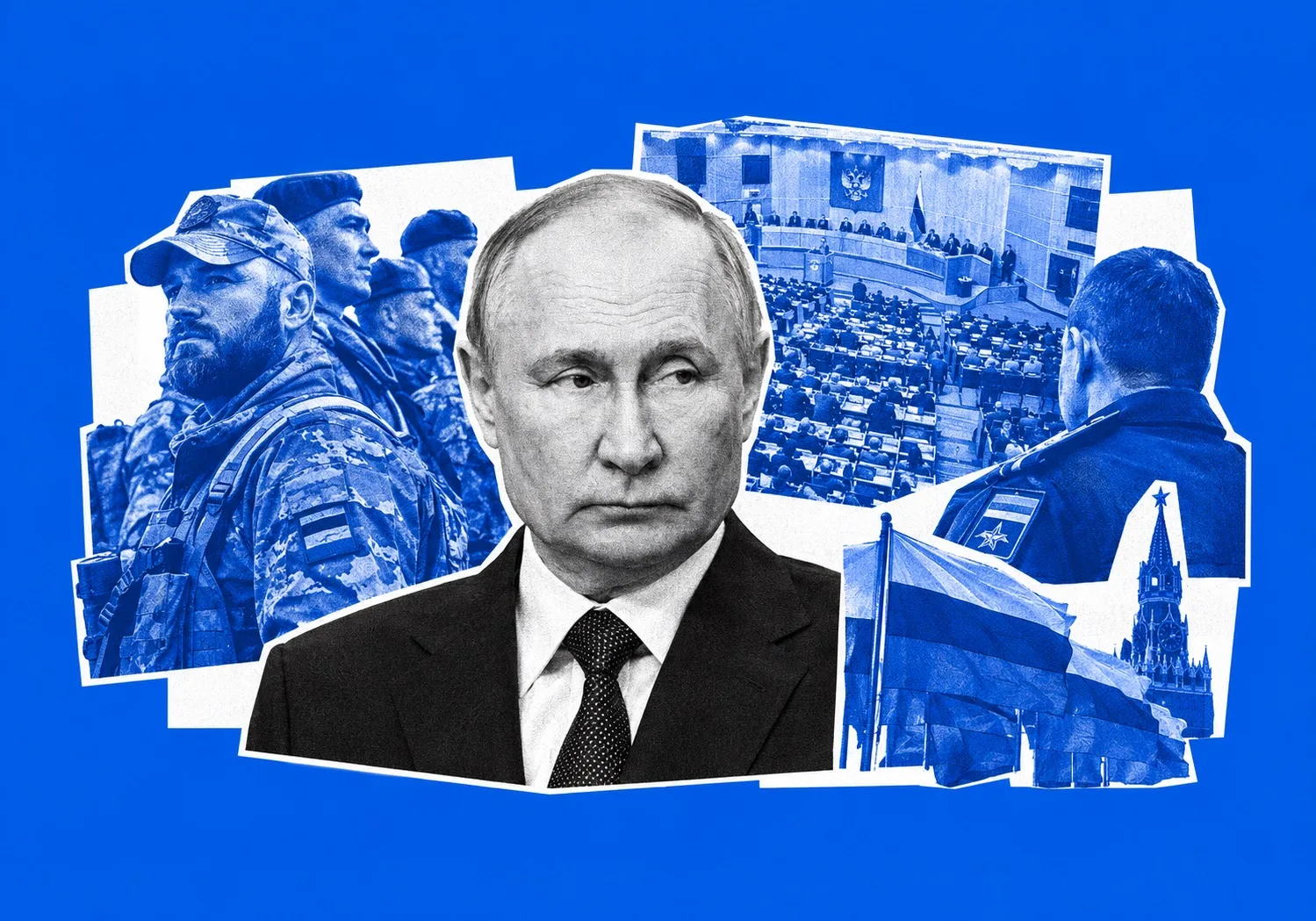
Russia has finalized its ninth State Duma, preserving United Russia’s 349-seat constitutional supermajority while systematically integrating dozens of Ukraine war veterans, military commanders, and occupation officials into federal power. Formally registered on September 29, the new 450-member parliament marks a structural shift in Russian governance: battlefield service, loyalty to the wartime state, and participation in the occupation have officially replaced traditional administrative credentials as the primary pipeline for political advancement.
Russia has long had a parliament with limited independence from the Kremlin. However, the change now underway directly reshapes the composition of the elite operating inside that system.
From the battlefield to the legislature
Officially, 46 combatants or veterans of Russia’s so-called “special military operation” won parliamentary mandates. Investigative analysis by IStories puts the number of deputies directly connected to the war at 46 as well, using a broader definition that includes military personnel, occupation administrators, defence contractors and people who have supported military operations.
An expanded estimate cited by Meduza reaches as many as 148 deputies - roughly one-third of the chamber - when veterans, security personnel, occupation officials, state media figures and other members of the wider military ecosystem are included.
The numbers differ because the definition of a “war faction” is inherently broader than the formal category of veterans. But the institutional direction is harder to dispute within the briefing: military and security credentials are becoming embedded in the parliamentary establishment.
Several appointments make that especially visible.
Admiral Vladimir Kasatonov, a senior naval commander who has held top positions in the Russian Navy, has entered the Duma through United Russia and could take a leading role on its Defence Committee. His arrival comes after the Black Sea Fleet suffered confirmed losses or severe damage to roughly 30 per cent of its operational strength.
Vladislav Golovin, known by the call sign “Struna”, is another example of the new political profile. A former officer of the 810th Naval Infantry Brigade and a recipient of the “Hero of Russia” title, he has headed Yunarmia, the state military-patriotic youth movement. He could take over the Duma’s Youth Policy Committee.
The combination is important. Defence policy and youth policy represent two different parts of the state, but together they connect the conduct of the war with the social reproduction of its ideology.
The parliament is acquiring personnel whose careers were made not primarily through legislation, economic policy or civilian administration, but through the wartime state.
The Kremlin’s new personnel pipeline
The development did not begin with this election.
In 2024, Putin launched the “Time of Heroes” programme, explicitly designed to prepare military veterans for positions in civil administration, state corporations and legislative institutions. It was presented as a mechanism for creating a “new Russian elite”.
The ninth Duma provides one of the clearest examples of how that concept can work in practice.
More than 50 prominent United Russia candidates, including regional governors and federal ministers, reportedly declined their mandates after the election. Their withdrawals allowed candidates lower down the party list to enter parliament. Among those moving into the legislature were people whose political credentials were closely tied to military service.
The mechanics matter because they separate the process from a simple story of voters choosing individual veterans. The final composition of the chamber was also shaped by decisions within the ruling party about who should actually occupy the seats.
That creates a political pipeline in which wartime service can lead to elite status, while the established political class makes room for the new cohort.
The process also changes the incentives facing the existing elite. If political advancement increasingly depends on proximity to the military and security establishment, civilian administrators have a reason to align themselves with the institutions that control the war effort.
The war consequently becomes embedded not only in policy but in career progression.
A parliament built around the security state
The new Duma includes figures whose biographies would have been politically exceptional in a more conventional parliamentary system.
Nursultan Mussagaleev, a former reconnaissance platoon commander in the 104th Air Assault Regiment and recipient of the “Hero of Russia” title, has been elected after participating in the “Time of Heroes” programme. Ukraine’s Security Service is investigating him over alleged involvement in the abduction, torture and execution-style killing of a civilian in the Bucha district during the 2022 occupation.
Alexander Lapin, a former commander of Army Group “Center”, has also received a mandate despite having been sentenced in absentia by a Ukrainian court to life imprisonment over alleged aggression and violations of territorial integrity.
Viktor Bout presents a different route into the legislature. Elected on the LDPR list, he had been convicted in the United States in 2012 and sentenced to 25 years for conspiring to illegally sell arms to the FARC in Colombia. He returned to Russia in 2022 after being exchanged for US basketball player Brittney Griner and subsequently joined the LDPR.
These cases do not constitute a single political category. Their biographies and legal histories are different.
Their common significance is institutional: foreign convictions or Ukrainian legal proceedings have not prevented entry into Russia’s federal legislature. For the Kremlin, domestic political legitimacy is increasingly defined inside a national legal and political framework that is detached from external accountability.
That is a more consequential development than the presence of any one controversial deputy.
What is disappearing from the Duma
The transformation is also visible in who did not return.
Maria Butina, former Tuva head and current Vice Speaker Sholban Kara-ool, long-serving deputy Galina Khovanskaya, economist Mikhail Delyagin and several experienced Communist Party legislators, including Sergey Obukhov, Nikolay Arefyev and Denis Parfenov, failed to secure seats.
Their political positions varied considerably. They were not members of a single civilian opposition bloc, nor did their departure produce a unified ideological alternative.
But the turnover removes parliamentary experience accumulated in areas such as economics, social policy, housing and conventional party politics.
The result is not simply a stronger United Russia. It is a different personnel balance within a legislature that was already tightly controlled.
Traditional patronage networks have not disappeared. The presence of Mikhail Rakhlin, the son of Putin’s first judo coach, and Dmitry Tuleyev, the son of a long-serving regional governor, illustrates the continued importance of established elite connections. Yet those networks are increasingly operating alongside a new source of political status: participation in the war.
The old system is therefore not being replaced wholesale. It is being subordinated to a wartime hierarchy.
The veteran constituency becomes part of the state
There is a political calculation behind this.
Russian society continues to show high abstract support for veterans and for social benefits associated with military service. At the same time, the briefing points to polling indicating growing fatigue with the war, including support for peace negotiations reaching 64 per cent in early 2026.
That creates a potential tension between symbolic respect for veterans and the practical costs of sustaining a privileged military constituency.
The Kremlin’s response is not to keep veterans at arm’s length. It is to absorb them into the state.
A former commander who becomes a deputy, a veteran who enters regional administration or a military figure who takes control of a parliamentary committee no longer exists solely as a constituency outside the political system. Their interests become connected to the institutions distributing budgets, privileges and authority.
That can also reduce the possibility of veterans developing into an independent political force. A class that might otherwise demand recognition, resources or a harder wartime policy from outside the establishment is instead given positions within it.
The parliamentary mandate becomes both reward and mechanism of control.
A legislature that locks in the war
United Russia’s 349 seats mean there is little uncertainty about the chamber’s ability to approve the Kremlin’s legislative agenda. The more interesting question is what kind of state that agenda will serve over time.
A parliament populated increasingly by veterans, security officials and occupation administrators is structurally positioned to favour defence spending, military benefits, internal security and state-controlled patriotic education. The appointment of war-linked figures to committees responsible for defence and youth policy gives that shift institutional channels.
The potential emergence of a large “war faction” does not necessarily mean that these deputies will form an autonomous political bloc. Their backgrounds may create common interests, but the Russian political system remains organised around the presidential vertical rather than competitive parliamentary factions.
Their importance may lie precisely in the opposite direction.
The Kremlin does not need a coherent military party if it can make military service one of the principal routes into the existing political hierarchy. In that model, the war faction does not challenge the system from within. It becomes part of the system.
That leaves Russia with a legislature in which the political consequences of the war are becoming harder to separate from the machinery of government itself. The battlefield is producing not only military personnel and casualties, but a new generation of officials whose authority, status and institutional interests are tied to the continuation of the wartime state.
Sources: Russia's State Duma, Rapsi News, Stories Media, Levada, The INS