
Russia War Casualties Near 400,000: Leaked Rosstat Records Reveal True Toll of Ukraine Invasion

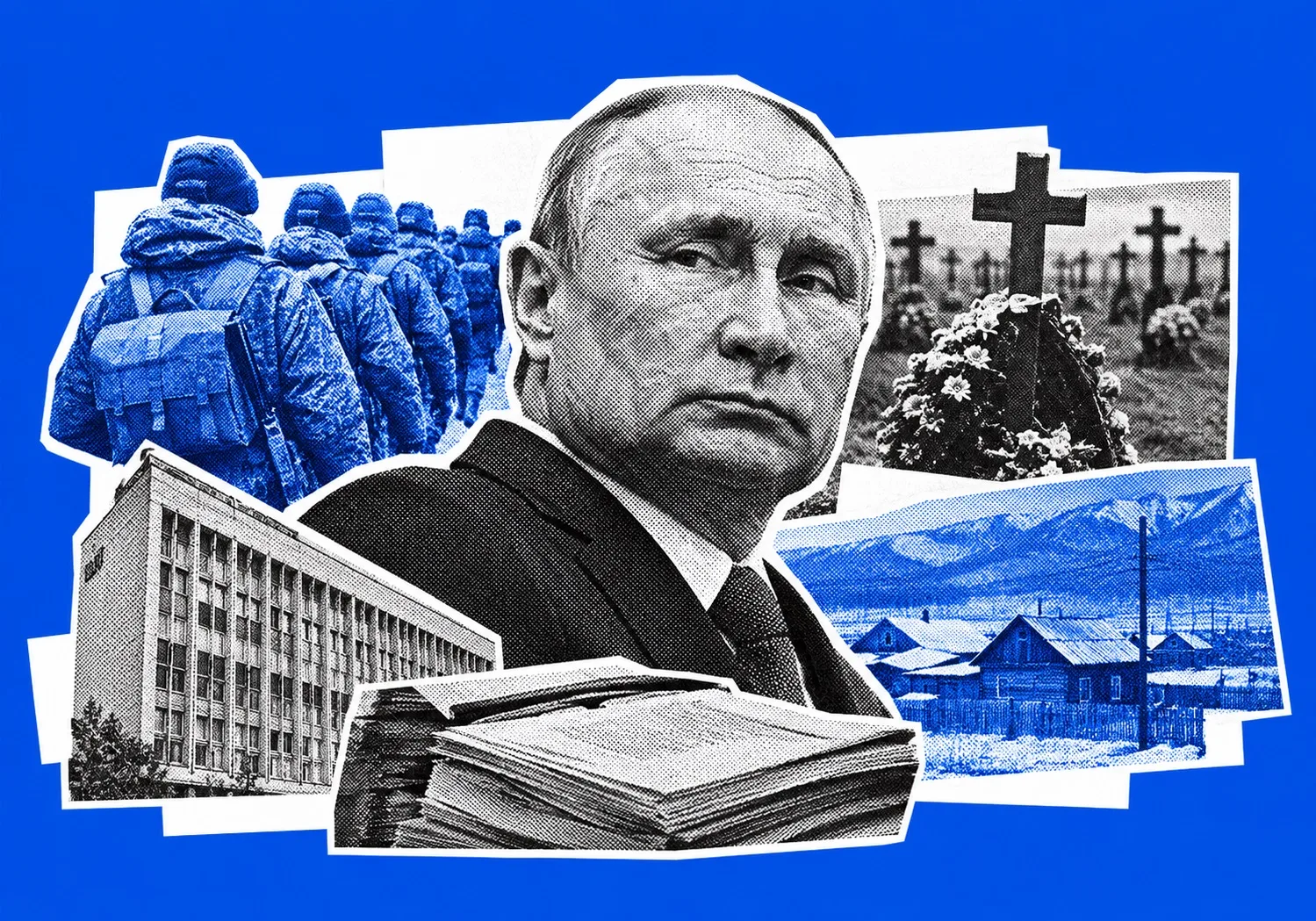
Confidential records from Russia’s federal statistics agency, Rosstat, reveal that nearly 400,000 Russian soldiers have died in Ukraine since February 2022. Obtained by hackers and analyzed by Bloomberg, the data exposes heavy regional disparities, an aging force, and severe reporting delays.
Beyond the total, the documents reveal how the burden has shifted during four years of fighting. Older men account for a growing proportion of deaths, while communities in Siberia have lost a far greater share of their working-age male population to the war than Moscow or St Petersburg.
The data also exposes a problem for anyone attempting to establish Russia’s current losses: deaths are taking increasingly long to enter the official system. By 2025, the typical delay had stretched beyond four months.
Inside the Rosstat leak
The documents reached journalists following a cyberattack claimed by Cyber Partisans, a Belarusian opposition-linked hacking group, and the Ukrainian group Silent Crow.
On 1 November, the groups announced that they had gained access to approximately 25,000 computers within Rosstat’s infrastructure and extracted 23 terabytes of information.
Among the files was a registry containing more than 11 million death certificates. Each record included information such as age, residence and cause of death.
The researchers examining the material searched for administrative codes and descriptions connecting individual deaths to the invasion. References included military operations, shelling and drone attacks.
Bloomberg checked the database against mortality figures Rosstat had previously published for 2021, 2022 and 2023. The differences were small, ranging from 0.1% to 1%. Metadata associated with the files was also consistent with genuine exports.
Those checks strengthen the case for the records’ authenticity, although they cannot establish that every entry is genuine.
Rosstat disputes the central claim behind the disclosure. The agency acknowledged cyberattacks between 29 October and 1 November that disrupted its systems and delayed economic reports, but denied that confidential databases had been accessed or leaked.
There is another limitation. The 392,700 figure counts records explicitly connected to the war. It cannot include deaths that were never registered, and may miss cases recorded under unrelated administrative classifications.
Silent Crow puts the broader total closer to 450,000 after including additional categories, although that estimate has a different evidential basis from the narrower count.
Siberia’s losses are far heavier than Moscow’s
The regional breakdown is among the most revealing findings.
In Buryatia, Tuva and Zabaykalsky Krai, roughly one-third of recorded deaths among men aged 18 to 49 were attributed to the war. In Moscow and St Petersburg, the corresponding figure was approximately one-tenth.
These percentages do not mean that a third of young and middle-aged men in those Siberian regions have been killed. They measure the proportion of deaths within that age group that were war-related.
Even with that distinction, the disparity is substantial.
Russia has relied heavily on financial incentives to attract contract soldiers, offering payments that can be particularly attractive in poorer regions. The system allows recruitment to continue without another publicly announced nationwide mobilisation on the scale of September 2022.
That mobilisation order has never formally been revoked. Since then, Moscow has expanded electronic conscription arrangements while continuing to use financial bonuses to encourage enlistment.
Some local authorities have reduced those payments as fiscal pressures have grown.
The death records cannot reveal why individual soldiers enlisted. Nor can they establish how many residents of each region joined the military. They do show where a disproportionate share of the deaths has occurred.
For communities already facing limited employment opportunities, the loss of men in their prime working years carries consequences beyond the immediate deaths. Families lose earners, local employers lose workers and the effects accumulate over successive years of fighting.
Russia’s largest cities have not escaped the war, but their recorded mortality patterns are markedly different.
The geographical divide helps explain how the Kremlin has been able to sustain recruitment while limiting the concentration of military losses in its principal urban centres. It does not prove that this distribution was centrally designed, but the outcome is visible in the records.
Russia’s soldiers are getting older
Age provides another indication of how the military’s manpower requirements have changed.
At the beginning of the invasion, war-related deaths among men aged 50 to 59 represented less than 1% of all deaths recorded in that age group.
By the first half of 2025, the figure had exceeded 16%.
This is a measure of mortality within an age category, rather than the percentage of soldiers killed who were over 50. Nevertheless, the increase indicates that the war has become a much more prominent cause of death among older Russian men.
The figures are consistent with recruitment expanding beyond the younger population that supplied much of the initial invasion force.
Older volunteers and reservists have become part of Russia’s efforts to maintain troop numbers during prolonged fighting in eastern Ukraine.
Age alone cannot determine a soldier’s effectiveness. The records provide no information about individual training, physical condition or battlefield assignments. They therefore cannot support a firm conclusion that Russia’s military capabilities have deteriorated because its personnel are ageing.
What they establish is that the human cost of the war has spread into age groups that were much less affected in 2022.
The change matters economically as well. Men in their fifties remain part of the civilian workforce, and their deaths add to the demographic losses among younger generations.
Why the death toll keeps changing
A death occurring on the battlefield does not necessarily appear promptly in Russia’s official mortality records.
In late 2023, the median registration delay for war-related deaths was approximately six weeks. By 2025, it had grown to more than four months.
That creates a considerable gap between when people die and when their deaths become visible in administrative statistics.
The leaked records contain nearly 37,800 military deaths registered for 2026 within the available reporting period. Because later registrations can be added retrospectively, the figure should not be read as a complete measure of fatalities during the year.
The reasons for the growing delays remain unclear. The available material does not establish whether they result primarily from difficulties identifying the dead, administrative backlogs or other factors.
It would also be premature to interpret the delays themselves as proof that Rosstat deliberately concealed individual deaths.
The government's wider secrecy policy, however, is established.
In 2015, Vladimir Putin signed a decree making military losses during special operations in peacetime a state secret. After the February 2022 invasion, Moscow stopped releasing regular official figures for its military dead.
Independent journalists have since relied on obituaries, cemetery records, inheritance data and other publicly available evidence to estimate the losses.
Mediazona and the BBC Russian service had identified 285,881 Russian military deaths by name through November 2026. Their count is necessarily incomplete because it depends on deaths leaving a verifiable public record.
A separate investigation by Mediazona and Meduza, using probate data, estimated 352,000 deaths through December 2025, excluding occupied territories.
These totals differ because the investigations use different methods and cover different periods. The Rosstat archive adds another source of evidence, rather than replacing the independent counts.
Ukraine’s General Staff estimates Russian casualties at approximately 1.6 million, but that figure includes both deaths and serious injuries. It cannot be compared directly with the number of death certificates.
Heavy losses have not stopped Russia fighting
The scale of Russian deaths presents an uncomfortable question for governments assessing the war: how much longer can Moscow maintain its military campaign at its current intensity?
Russian forces continued making limited territorial advances in eastern Ukraine during 2025 and 2026 despite heavy casualties. The Kremlin has also maintained extensive aerial attacks against Ukrainian cities and critical infrastructure.
The mortality data does not provide the answer to how long Russia can continue. It contains no complete account of recruitment, the number of troops available for deployment or the condition of military units.
Nor does it establish that deaths are consistently exceeding replacements. Such a conclusion would require reliable recruitment figures alongside the casualty records.
Still, replacing personnel carries costs. Recruitment bonuses require public expenditure, while training and deploying new soldiers demands resources that cannot be measured from mortality statistics alone.
For European governments, these distinctions are particularly relevant as possible ceasefire arrangements are discussed.
Russia, Ukraine and the United States are preparing talks in Abu Dhabi against a background of continued fighting and unresolved territorial questions.
A large death toll may affect Moscow’s calculations, but it does not establish that the Kremlin is ready to make concessions. Russia has continued its campaign despite losses that independent investigations now measure in the hundreds of thousands.
The leaked records provide a clearer picture of the population bearing those losses. They leave a separate question unanswered: whether Russia’s recruitment system can continue replacing the men being killed without imposing greater financial and demographic costs on the regions that have already suffered the most.
Sources: Bloomberg, DW, Repubblica, Novaya Gazeta, Heise