
Putin’s Creeping Mobilisation: How Russia Is Building a 1.55m Army on Paper and in the Budget

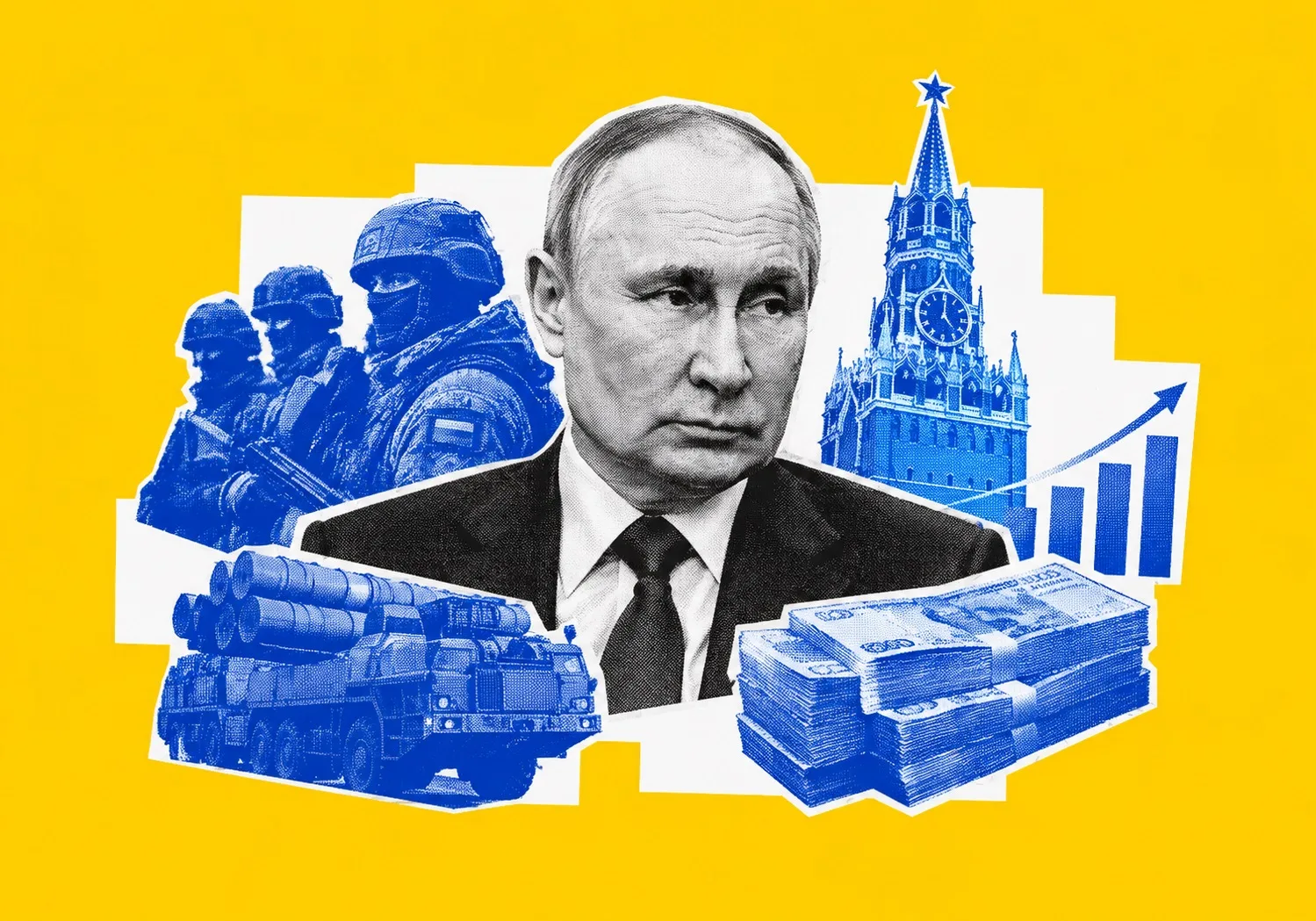
By raising Russia’s military establishment to 1.55 million active personnel for the fourth time this year, Vladimir Putin is avoiding the political shock of a second mass mobilization. Paired with a record 17.1 trillion rouble defence budget, Moscow is building the legal and financial infrastructure to sustain a long war of attrition as its new normal.
That distinction is central to understanding what Moscow is doing.
The Kremlin is not relying on one dramatic mobilisation decision to enlarge the military. Instead, it is repeatedly adjusting the machinery around the war: military staffing ceilings, recruitment structures and state financing. The result is a system designed to sustain a large-scale conflict without necessarily exposing the political costs associated with another openly declared mass call-up.
From a single expansion to a recurring mechanism
The pace of change is more revealing than the latest increase itself.
In December 2023, Russia’s authorised military establishment stood at 2,039,758 personnel, including 1,150,628 active military positions. A major increase followed in September 2024, taking authorised military posts to 1.5mn.
There were no changes to the establishment size in 2025. Presidential military decrees that year were confined to routine seasonal conscription measures.
The pattern changed sharply in 2026. Since March, the Kremlin has increased the authorised number of active military positions four times. The March decree added 2,640 positions; June brought another 7,360; July added 25,000; and September has now added 15,500.
That amounts to an increase of 50,500 active military positions since the beginning of this sequence.
The significance lies in the repetition. A military establishment is normally a relatively stable administrative framework. Four revisions in seven months indicate that the framework itself is being adapted to the requirements of a prolonged war.
The Kremlin is therefore expanding capacity before it necessarily expands the number of soldiers actually deployed.
The number on paper is not the number at the front
Russia’s distinction between authorised establishment strength, or shtatnaya chislennost, and actual filled strength, fakticheskaya chislennost, matters considerably.
The September decree authorises 1,550,500 military positions. It does not establish that all of those positions are occupied. Nor does it show how many personnel are available for combat operations at any particular moment.
That makes the decree a measure of institutional capacity rather than a battlefield order.
This is also why the latest decision should not automatically be read as evidence of an imminent second mobilisation. The decree itself contains no instruction for a new compulsory mobilisation or a specific mass recruitment campaign.
Russia has other mechanisms for filling military posts. Contract recruitment, regional incentives and the formal incorporation of auxiliary personnel can all operate within an expanding establishment. Foreign personnel can also enter the Russian armed forces through contracts, although foreign allied units operating under their own command do not automatically count towards the Russian military ceiling.
The gap between authorised positions and filled positions is consequently not a technical footnote. It is the space in which the Kremlin is attempting to manage its manpower problem.
The budget is moving in the same direction
The staffing changes become harder to separate from fiscal policy.
Draft Russian federal budget documents analysed by Reuters envisage 17.1tn roubles for national defence in 2027, about $202.6bn. That is roughly 32 per cent above the baseline 2026 defence spending projection and would amount to about 35 per cent of total federal expenditure. Defence spending would also reach approximately 6.9 per cent of GDP.
The relationship between the two developments is straightforward at the institutional level. Creating additional military positions requires the state to have the financial capacity to pay and equip them. A rising defence allocation provides that capacity.
It also creates a longer-term commitment.
A temporary surge in military expenditure can be treated as an emergency response. A military establishment repeatedly enlarged by presidential decree, backed by a defence allocation accounting for roughly one-third of federal spending, looks more like a reconfiguration of the state’s normal operating model.
The change is therefore not confined to the armed forces. It reaches into public finances, industrial demand and the allocation of labour.
The manpower problem remains
There is a limit to what administrative expansion can accomplish.
Russia can increase the number of authorised billets with a presidential signature. It cannot create trained personnel at the same speed. Nor does a larger payroll automatically produce fully equipped, combat-ready formations.
This is the structural tension behind the Kremlin’s incremental approach.
The state can expand recruitment incentives, formalise new units and direct additional resources towards defence. But every additional military position competes for people with the civilian economy. The more deeply the state commits itself to military production and military employment, the greater the pressure on the labour pool outside the defence sector.
That trade-off becomes more consequential as defence spending approaches a third of federal expenditure.
The military-industrial complex gains predictable state demand. Defence organisations can plan around sustained procurement and staffing. The civilian economy, by contrast, operates with fewer fiscal resources and potentially greater competition for workers.
The military establishment is thus becoming not simply larger, but more deeply embedded in the allocation of Russia’s economic resources.
A mobilisation without the word
The Kremlin has an additional political constraint.
Russia’s September 2022 decree on “partial mobilisation” was never formally rescinded by a subsequent presidential decree, leaving its legal mechanism in force. Yet the political experience of mobilisation remains distinct from routine recruitment and administrative expansion.
The current approach allows Moscow to increase military capacity without announcing another nationwide mobilisation campaign.
That does not make the two approaches equivalent. A larger authorised establishment cannot itself compel enough people to fill every new position. But it provides the administrative infrastructure within which recruitment can continue and future manpower decisions can be made.
Putin has also maintained in 2025–2026 that the operational grouping in the combat zone remained around 700,000 personnel. That figure, cited by independent Russian media, further illustrates why the authorised establishment should not be treated as a direct count of frontline forces.
The Kremlin can enlarge the military on paper while maintaining a different operational structure on the ground.
That flexibility is precisely what makes the incremental model useful.
Foreign manpower does not solve the accounting problem
The presence of North Korean personnel in Russia adds another dimension, but it should not be folded automatically into the new Russian establishment figure.
Ukrainian and Western intelligence estimates cited in the briefing put the number of DPRK personnel in Russia or training at roughly 8,000 to 18,000. Yet foreign allied units operating under their own command are not automatically part of the Russian Armed Forces.
Individual foreign personnel can enter the Russian military through Ministry of Defence contracts, in which case their legal status changes. Until that happens, however, their presence cannot simply be added to Russia’s 1.55mn authorised military positions.
The distinction matters because Moscow’s manpower challenge is not solved by headline troop numbers alone. What matters is how personnel are organised, financed, commanded and incorporated into the force structure.
The new Russian baseline
For European security planners, the more consequential development may therefore be the disappearance of the old baseline.
The Russian military establishment rose from 1,150,628 authorised active personnel in December 2023 to 1.55mn today. The increase is more than 50 per cent over that pre-2024 figure.
Meanwhile, the state is preparing to devote 17.1tn roubles to defence in 2027.
These figures do not establish how many Russian troops will be fighting at the front, nor do they prove that a second mobilisation is imminent. They do establish something narrower but potentially more durable: Moscow is building the legal, organisational and financial capacity for a military establishment substantially larger than the one it maintained before the current phase of the war.
That leaves European governments facing a strategic question that cannot be answered by watching for a single mobilisation decree. The more important signal may be the steady normalisation of a Russian state in which exceptionally high military staffing and defence expenditure are no longer treated as temporary wartime measures, but as part of the institutional architecture.
Sources: The Guardian, The Brussels Times, Politico, Meduza