
Russia Seizes Japan Tobacco Assets in Latest Blow to Foreign Investors in Moscow

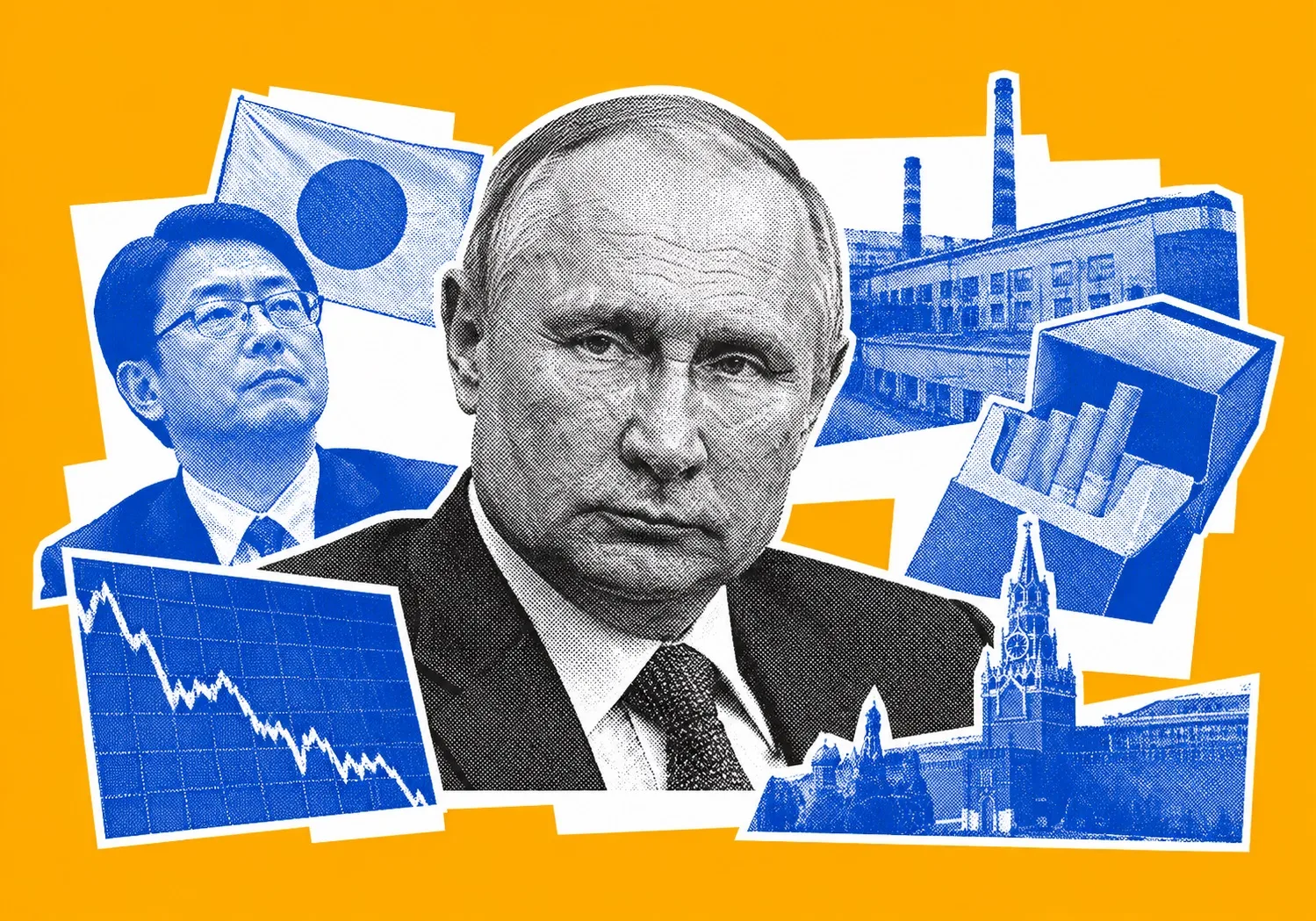
Russia has taken control of Japan Tobacco’s local operations under a state-appointed management decree, escalating Moscow’s campaign against foreign-owned corporate assets. The move threatens one of JTI’s most lucrative markets, echoing similar expropriations of European companies and signaling mounting risks for Western businesses remaining in Russia.
Putin signed the decree on 5 November, transferring management of key Russian subsidiaries of Japan Tobacco International (JTI) to a little-known Moscow company, AO Promyshlennye Aktivy. The following day, the arrangement was extended to three additional entities, bringing all seven of JTI’s Russian businesses under external control.
Japan Tobacco shares fell 19.3% on 6 November and another 15.95% on 9 November, reaching ¥5,269. The two-session decline prompted the Tokyo Stock Exchange to widen the stock’s permitted daily downward price movement from ¥1,000 to ¥4,000, effective 10 November.
For Tokyo specifically, the consequences extend beyond a standard corporate investment. Its finance ministry owns more than one-third of Japan Tobacco, making the company’s dividends a source of public revenue. The takeover also places Tokyo among the governments confronting a Russian mechanism already used against numerous European-owned businesses.
A profitable business transferred to an unfamiliar company
Russia is unusually important to Japan Tobacco’s earnings. Although the country generates approximately 10% of the group’s consolidated revenue, it accounts for about a quarter of adjusted operating profit, according to financial figures reported by Bloomberg and Reuters.
That imbalance helps explain the market reaction. Losing control of the Russian business threatens a disproportionately valuable contribution to the group’s profitability, even though its factories and distribution operations may continue functioning.
The decree initially covered shares in four corporate structures, including the Petro cigarette factory in St Petersburg and Donskoy Tabak in Rostov-on-Don. On 6 November, the authorities added Perekryostok-Tabak, JTI Russia and JTI Innovative Products.
The appointed manager, Promyshlennye Aktivy, was registered only on 16 September 2026 with statutory capital of 100,000 roubles.
An investigation by independent Russian outlet Agentstvo identified its sole owner as Sergei Dremov, a former Federal Security Service officer who previously served as an LDPR deputy in the State Council of Russian-occupied Crimea. He also had business connections involving a boxing club linked to the state-owned defence conglomerate Rostec.
Those connections raise questions about who benefits from the transfer of valuable commercial assets. They do not, by themselves, establish that the company's future profits will be diverted to particular officials or security institutions.
The mechanism is nevertheless consequential. Under Russia’s temporary management framework, the foreign shareholder retains formal legal ownership while losing the ability to appoint management, direct operations or distribute domestic profits.
For JTI, the distinction between ownership and control has become decisive. The Japanese parent retains its legal interest in the businesses but cannot exercise the rights normally associated with that investment.
The company has indicated that operations continue locally while it assesses the financial consequences across its seven Russian entities. Continued production, however, does not mean continued economic benefit for the original shareholder.
How Russia’s temporary management system expanded
Moscow’s intervention is part of an established practice rather than an entirely new approach to foreign investment.
Presidential decrees introduced in 2023 and expanded subsequently have allowed Russian authorities to place assets belonging to companies from countries imposing sanctions under temporary administration.
Reuters has documented more than 135 foreign-linked companies subjected to such arrangements since Russia launched its full-scale invasion of Ukraine in 2022. Many have European owners.
The framework allows the Russian authorities to take effective control without formally transferring ownership to the state. That legal distinction may complicate disputes over confiscation, although it does not necessarily prevent foreign investors from pursuing compensation claims.
Whether JTI can successfully challenge the measure through international arbitration remains unresolved. The briefing provides no specific treaty basis, arbitration proceedings or recovery precedent that would justify predicting the outcome.
What makes the Japanese case particularly revealing is the nature of the business involved.
JTI is a consumer-goods manufacturer with substantial local production, rather than an energy company operating strategically sensitive infrastructure. Its continued presence in Russia did not protect it from the same administrative intervention previously applied to other foreign businesses.
The appointment of a recently established company headed by a former security officer adds another dimension. Russian authorities can redirect control of established commercial operations to domestic entities without requiring those entities to purchase the assets through a conventional transaction.
That arrangement creates potential economic benefits for the appointed manager, although the ultimate distribution of profits and the longer-term ownership arrangements remain unknown.
For European companies retaining Russian subsidiaries, the JTI decision reinforces a problem that predates November: an investment can remain legally registered to its foreign owner while becoming inaccessible in practice.
Tokyo faces a financial problem beyond the stock market
Japan’s response has been unusually direct.
The foreign ministry summoned Russian Ambassador Nikolai Nozdrev, while Japanese officials in Moscow delivered a formal protest demanding the decree’s withdrawal.
Chief Cabinet Secretary Minoru Kihara called for the protection of the lawful rights and interests of Japanese citizens and businesses in Russia. Finance Minister Satsuki Katayama also confirmed urgent diplomatic intervention.
The available evidence does not establish why Tokyo chose diplomatic protests rather than immediate additional economic sanctions. Nor does it indicate whether Moscow intends to reconsider the decision.
The dispute comes amid deteriorating relations between the two countries. Japan has aligned itself with G7 sanctions over the invasion of Ukraine, while territorial tensions intensified following Putin’s August visit to the disputed Kuril Islands, claimed by Japan.
In October, Russian authorities arrested Hokkaido Shimbun correspondent Yuki Imai in Sakhalin on espionage allegations. The arrest added another source of friction, although there is no documented evidence that it directly caused the JTI takeover.
Japan’s financial exposure gives the confrontation an additional domestic dimension.
For the fiscal year ending March 2026, government dividend receipts from Japan Tobacco were estimated at ¥103.5 billion, equivalent to approximately $655 million.
That represents only around 0.1% of Japan’s total tax revenue. Yet those payments account for roughly 44% of the income of a specialised government fund supporting industrial and innovation projects.
According to Bloomberg’s reporting, Goldman Sachs analysts Takashi Miyazaki and Megumi Taniguchi estimate that shareholder dividends could fall by as much as 25% if the Russian business is excluded from consolidated reporting and existing dividend policies remain unchanged.
It is a conditional projection, not an announced dividend cut.
Japan Tobacco has also largely financed its dividends without repatriating Russian cash since 2023 because of capital controls. Consequently, the loss of operational control does not automatically translate into an equivalent immediate reduction in government receipts.
The distinction matters for Prime Minister Sanae Takaichi’s industrial ambitions.
Her government has unveiled a public-private investment programme exceeding ¥370 trillion through March 2041, including ¥101.6 trillion intended for artificial intelligence and semiconductors.
The precise funding arrangements have yet to be defined. A decline in Japan Tobacco dividends could therefore place pressure on one existing public revenue stream, but the available figures do not establish how much of the broader programme would be affected.
The European precedent behind Japan’s losses
For European investors, the Japanese dispute is familiar in its legal mechanics, even if the scale of the market reaction in Tokyo is distinctive.
The more than 135 foreign-linked companies identified in Reuters’ reporting show that temporary management has become a recurring instrument of Russian economic policy.
Its effects depend on the structure of each investment. Companies with substantial factories, distribution networks and local earnings have assets that can continue operating after foreign management is removed.
The Russian state can therefore preserve domestic production while depriving overseas shareholders of control and potential returns.
Japan Tobacco’s experience also complicates the assumption that remaining in Russia necessarily offers better protection for an investment than withdrawing. The company maintained significant operations, yet that presence did not prevent the decree.
There are limits to what can be inferred. The evidence does not prove that every remaining foreign company will be taken over, or that all appointed managers operate under identical political arrangements.
It does establish that profitable foreign-owned consumer businesses remain exposed to administrative intervention, irrespective of their contribution to the Russian market.
For Tokyo, the immediate questions concern the treatment of Japan Tobacco’s earnings, the future of shareholder distributions and the effectiveness of its diplomatic demands.
For the company, an even more fundamental uncertainty remains: whether its Russian assets can ever again be managed for the benefit of their legal owner while Moscow’s temporary management regime remains in force.
Sources: Bloomberg, Reuters, Jili Press, Japan IR