
Poland’s Constitutional Crisis Escalates as Nawrocki Accuses Tusk of Seizing Control of Top Court

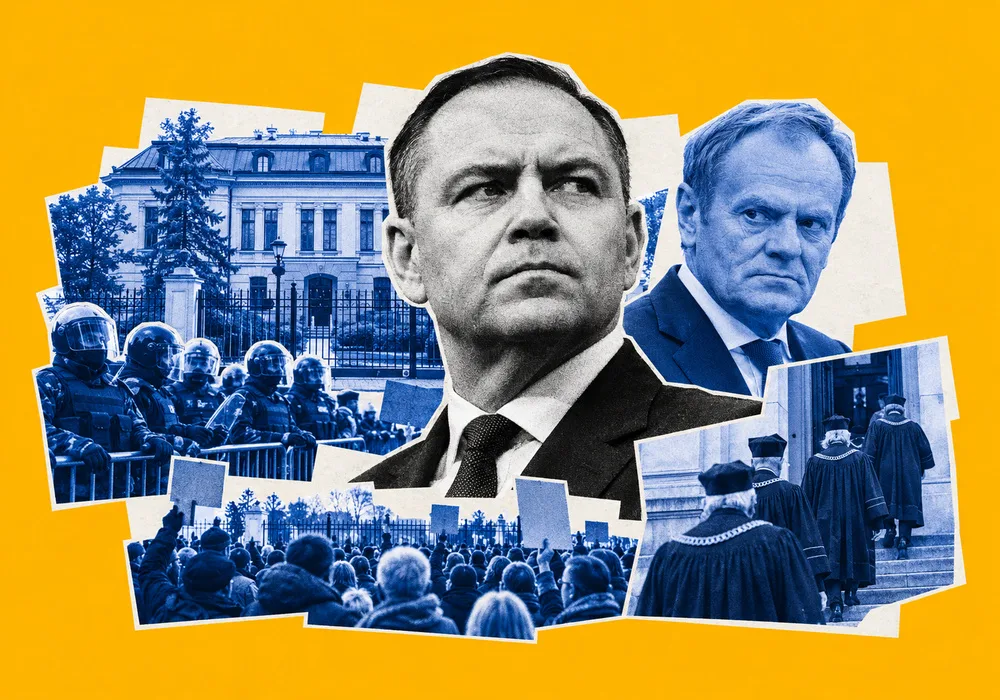
Poland’s confrontation over judicial independence has escalated into an open institutional crisis after President Karol Nawrocki accused Prime Minister Donald Tusk’s government of forcibly taking control of the Constitutional Tribunal. The suspension of the court’s president, police deployment in Warsaw and competing claims of constitutional legitimacy have exposed the depth of the political divisions threatening Poland’s judicial system.
Poland’s long-running dispute over judicial independence has entered a more confrontational phase after President Karol Nawrocki accused Prime Minister Donald Tusk’s government of orchestrating a forced takeover of the Constitutional Tribunal. The crisis erupted on Friday evening, 30 October, when the tribunal’s longest-serving judge, Anna Korwin-Piotrowska, announced the suspension of its president, Bogdan Święczkowski, and assumed temporary leadership of the institution. The tribunal’s vice-president, Bartłomiej Sochański, was also suspended.
Święczkowski, a former deputy justice minister appointed during the previous Law and Justice (PiS) administration, is closely associated with the nationalist political camp supporting Nawrocki. His removal therefore represents another escalation in the struggle between the president and Tusk’s pro-European coalition over the composition, authority and legitimacy of Poland’s highest constitutional institution.
The confrontation developed rapidly. Seven judges elected by parliament entered the tribunal building on Friday, accompanied by officers from the State Protection Service. The following hours brought competing claims over who had the authority to control the institution, with the existing leadership rejecting the legitimacy of the newly elected judges and Korwin-Piotrowska announcing the suspension of Święczkowski and Sochański.
The president interrupted his official visit to Senegal and returned to Poland, arguing that the situation required his immediate presence. After arriving in Warsaw, Nawrocki visited the tribunal during the night, where footage showed a confrontation between him and judges who disputed his position on the institution's leadership.
In a statement issued on Saturday morning, Nawrocki described the developments as a violation of Poland’s constitutional order and the forcible takeover of a state institution. He demanded that government-deployed security forces leave the tribunal's premises and called for urgent consultations with representatives of parliamentary political groups. The president argued that the confrontation posed a threat to Poland’s internal security and required immediate political intervention.
Competing claims over constitutional legitimacy
The government and the presidency have offered fundamentally different interpretations of the events. Tusk maintains that his administration is taking necessary steps to restore the rule of law after years of political interference in the judiciary under PiS. He acknowledged that the process was difficult and sometimes painful but insisted that decisive action was unavoidable.
The government's position is rooted in the institutional changes introduced during PiS's eight years in power. Between 2015 and 2023, the party transformed the judicial system through appointments and legislative reforms that became the subject of prolonged disputes with the European Commission and European courts. Critics argued that these changes undermined the independence of the judiciary and weakened the separation of powers.
The Constitutional Tribunal became one of the central institutions in that confrontation. Its composition was reshaped during the PiS administration, with the appointment of judges to positions that had already been filled by the previous parliamentary majority. European judicial institutions subsequently challenged the legality of some of those appointments, raising questions about whether the tribunal could be considered an independent and impartial court.
Tusk's coalition, which took office in December 2023, promised to reverse the previous government's judicial reforms. However, its efforts have repeatedly encountered resistance from Nawrocki, who has used presidential powers to block appointments and challenge the government's approach. Earlier in 2026, he refused to swear in several judges elected by parliament, while Święczkowski declined to allow judges appointed by the current parliamentary majority to take up their positions.
The president argues that the government's actions are themselves undermining constitutional procedures. His allies maintain that the suspension of the tribunal's leadership has no legitimate legal basis and constitutes an attempt to replace one politically contested institutional arrangement with another. The government, meanwhile, considers the existing leadership an obstacle to restoring the tribunal's lawful functioning.
The dispute has consequently developed into a conflict in which both sides question the legitimacy of the other's actions. Rather than resolving the institutional problems inherited from the previous government, the competing interventions have created further uncertainty over who has the authority to represent the tribunal and issue decisions in its name.
Police deployment and political mobilisation
The confrontation quickly spilled beyond the courtroom and into the streets of Warsaw. Hundreds of protesters gathered outside the tribunal building, including supporters of PiS and representatives of other right-wing political groups. Prominent opposition figures, including PiS leader Jarosław Kaczyński and former prime minister Mateusz Morawiecki, joined demonstrations against the suspension of the tribunal's leadership.
Police maintained a significant presence around the building as tensions increased. Some protesters attempted to breach security barriers and threw objects at officers. Three people were detained during the overnight demonstrations.
Kaczyński described the developments as an assault on the Constitutional Tribunal and warned that Poland was moving towards a police state. Other opposition representatives accused the government of using state institutions to impose political control over the judiciary. The demonstrations provided PiS with an opportunity to mobilise its supporters around an issue that has remained central to its criticism of Tusk's administration.
The government has also faced criticism over the manner in which the confrontation unfolded. Justice Minister Waldemar Żurek expressed concern about Nawrocki's conduct during his visit to the tribunal and said he hoped prosecutors would investigate the incident. He also argued that the suspended judges should face legal consequences for obstructing the work of judges elected by parliament.
The dispute has therefore expanded beyond the question of judicial appointments. Police deployment, competing claims of unlawful conduct and the involvement of the president have turned the tribunal into the centre of a broader confrontation over the use of state power.
The unresolved legacy of PiS judicial reforms
The current crisis reflects a problem that has persisted throughout Tusk's term: the difficulty of reversing institutional changes without triggering new constitutional disputes. The government came to power with a clear commitment to restoring judicial independence and rebuilding relations with European institutions, but its ability to implement reforms has been constrained by presidential opposition and the contested legal status of existing appointments.
The issue is particularly complicated because the Constitutional Tribunal has the authority to review legislation and determine whether laws comply with Poland's constitution. Its institutional legitimacy is therefore essential to the functioning of the country's political and legal system. If competing groups of judges and political authorities continue to reject each other's decisions, the tribunal risks becoming increasingly unable to perform its constitutional role.
The government's strategy has also generated questions about consistency. In September, parliament appointed Maciej Berek, who had previously served in Tusk's administration, as a candidate for the tribunal. Critics argued that the nomination weakened the government's claim that its reforms were intended to remove political influence from the judiciary. The appointment illustrated how difficult it has become to separate the process of institutional restoration from the political interests of the competing camps.
The Venice Commission, the Council of Europe's advisory body on constitutional matters, has also become involved in the wider dispute. It has called on Nawrocki to swear in judges elected by parliament, adding an international dimension to the disagreement over the legitimacy of the tribunal's composition.
Implications for Poland and the European Union
The confrontation presents a significant challenge to Poland's political stability and its efforts to rebuild confidence in democratic institutions. The dispute is particularly sensitive because it concerns an institution responsible for determining the constitutionality of government decisions and legislation. A tribunal whose leadership and membership are openly contested risks weakening legal certainty and further undermining public confidence in the judiciary.
For the European Union, the situation creates a difficult distinction between supporting judicial reform and assessing the methods used to achieve it. Brussels has repeatedly criticised the PiS-era changes to Poland's judicial system and supported Tusk's commitment to restoring the rule of law. However, the latest events demonstrate that reversing those changes remains politically and legally complicated, particularly when the presidency and parliament are controlled by opposing political forces.
The confrontation also carries broader implications for Poland's position within the EU. Judicial independence is central to the mutual recognition of court decisions, the protection of fundamental rights and the functioning of the European legal order. Prolonged institutional paralysis could weaken the credibility of Poland's legal system at a time when the country is seeking to strengthen its political and strategic influence in Europe.
The political consequences are likely to extend into the next parliamentary election, scheduled for 2027. Tusk's coalition faces pressure to demonstrate that its promises of institutional reform can produce tangible results, while PiS is seeking to portray the government as increasingly willing to bypass constitutional safeguards. Nawrocki's intervention gives the opposition a powerful platform from which to challenge the government's legitimacy and mobilise voters around the defence of state institutions.
Poland's latest constitutional confrontation demonstrates that the change of government in 2023 did not resolve the country's judicial crisis. Instead, the conflict has shifted from disputes over the legacy of PiS reforms to a direct struggle between the executive, the presidency and competing groups within the judiciary. Unless a mutually recognised legal framework for restoring the tribunal's functioning can be established, the institution risks remaining paralysed by the very political divisions it is constitutionally expected to arbitrate.
Sources: President of Poland, Polskie Radio