
Romania Remains Without a Stable Government as Political Deadlock Continues

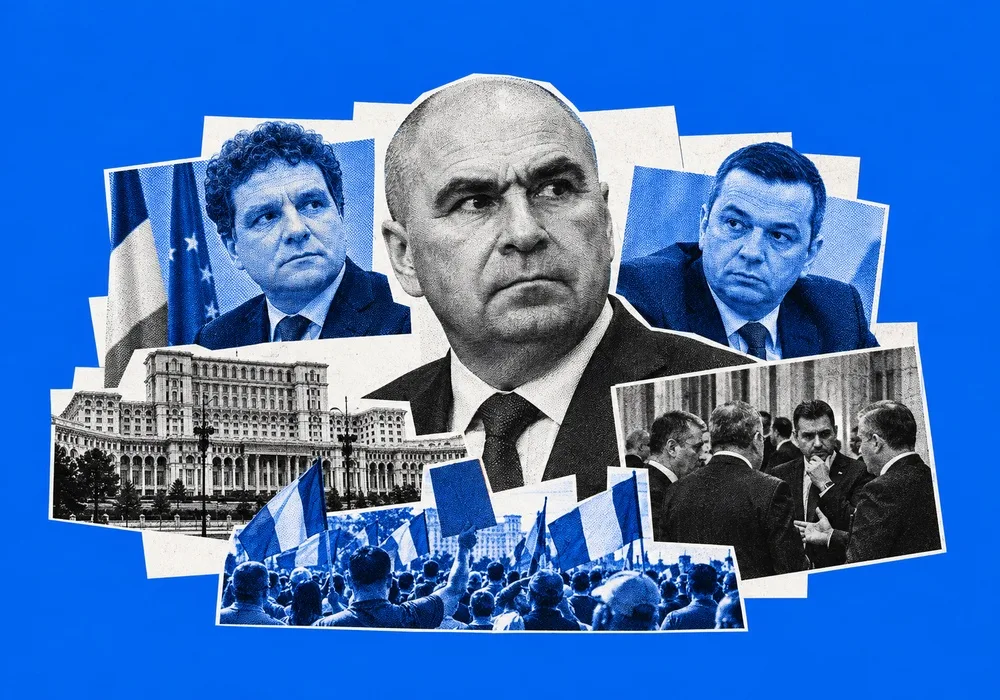
Romania has entered its fifth month without a fully empowered government as President Nicușor Dan holds another round of consultations with parliamentary parties. The latest talks have again exposed divisions over who should lead the government and what coalition formula could secure parliamentary support, while economic and fiscal pressures increase the need for a functioning administration.
Romania is still without a fully empowered government more than four months after the collapse of Prime Minister Ilie Bolojan’s cabinet, with another round of consultations failing to immediately resolve the political deadlock. President Nicușor Dan summoned parliamentary parties to Cotroceni Palace on September 17 to identify a candidate for prime minister, but the positions presented by the main political forces remain sharply divided. The talks are taking place as pressure grows for a government capable of taking urgent economic and budgetary decisions.
The current crisis began on May 5, when Bolojan’s government was brought down by a no-confidence vote. Since then, attempts to establish a new parliamentary majority have repeatedly stalled. Dan has already held several rounds of formal and informal consultations, while two attempts to put forward a new prime minister have failed to produce a government approved by Parliament.
Another Attempt to Break the Deadlock
The September 17 consultations were the latest effort to identify a political formula capable of securing parliamentary backing. Dan met representatives of the Social Democratic Party (PSD), the Alliance for the Union of Romanians (AUR), the National Liberal Party (PNL), Save Romania Union (USR), the Democratic Alliance of Hungarians in Romania (UDMR) and representatives of smaller parliamentary groups. The presidential administration had scheduled meetings throughout the day, including with independent MPs.
The talks exposed the same divisions that have prevented a new coalition from emerging. PSD said it was prepared to take responsibility for forming the government and again backed its leader, Sorin Grindeanu, for the premiership. AUR also put itself forward as a governing force, while saying it would not support a cabinet in which it did not participate.
PNL took a more conditional position, saying it would negotiate with whichever candidate Dan ultimately nominates. Party leader Ilie Bolojan said Romania needs a credible prime minister, competent ministers and a programme capable of continuing efforts to reduce state expenditure and put public finances on a more sustainable footing.
USR has meanwhile discussed minority-government options, while UDMR indicated that it could support a government if PSD and PNL reach an agreement. The range of positions illustrates the central problem: individual parties are willing to participate in government or support one, but the combinations currently on the table do not easily translate into a stable majority.
A Crisis That Has Already Lasted More Than Four Months
The scale of the impasse is unusual even by Romania's recent political standards. By September 17, 135 days had passed since Bolojan's government was removed from office, making the current episode the country's longest political crisis of this kind, according to Romanian media.
Dan first nominated former MEP Eugen Tomac as prime minister on June 4, but Tomac withdrew his mandate after concluding that he lacked sufficient parliamentary support. Ten days later, the president nominated PNL first vice-president Adrian Veștea. His proposed government was rejected by Parliament on June 22, with 189 votes against it and 23 in favour among the 212 votes cast.
The failed attempts have left the presidency facing a difficult constitutional and political balancing act. Under Article 103 of Romania's Constitution, the president designates a candidate for prime minister after consulting the parliamentary parties when no single party holds an absolute majority. The nominee must then assemble a cabinet capable of winning parliamentary approval.
The difficulty is therefore not simply finding an individual willing to become prime minister. The more fundamental obstacle is building a parliamentary arrangement that can survive beyond the investiture vote and provide sufficient support for legislation, budgetary measures and structural reforms.
Competing Paths Out of the Crisis
The main parties have been advancing different solutions. PSD argues that it should assume responsibility for government, pointing to its parliamentary position and previous experience in office. AUR has also sought a direct role in government and has raised the possibility of early elections as an alternative to another coalition formula.
PNL, meanwhile, has signalled that it could work with the prime minister selected by the president, provided that the government's programme and personnel meet its conditions. UDMR has identified minority-government formulas as one possible route, while USR has also discussed minority configurations. These positions leave open several possible combinations but do not yet provide a clear parliamentary majority.
The smaller parliamentary groups add another layer to the negotiations. Some have proposed their own candidates, while others have called for additional time before the president makes a nomination. One parliamentary group, S.O.S. România, did not attend the September 17 consultations.
The immediate next step is for Dan to decide whom to nominate. But the previous failed nominations show that a presidential designation alone does not resolve the crisis: the candidate still needs enough parliamentary support to form a government.
Economic Pressure Is Raising the Stakes
The prolonged political uncertainty comes at a sensitive moment for Romania's public finances. A fully empowered government is expected to deal with urgent budgetary decisions, including a budget revision, while continuing measures aimed at controlling state spending. Romanian public broadcasters have highlighted the need for a government with full powers to address these issues rather than relying indefinitely on an interim arrangement.
The political stalemate also complicates the implementation of longer-term economic policies. Romania has been under pressure to improve fiscal discipline, while political parties remain divided over the distribution of the burden created by spending reductions and other adjustment measures.
For European institutions and investors, the issue is therefore broader than the appointment of a new prime minister. The longer the political vacuum continues, the harder it becomes for Bucharest to provide a predictable policy framework for fiscal decisions, economic reforms and the implementation of commitments made at European level.
A Wider European Dimension
Romania's political stability carries particular weight because of its position on NATO's eastern flank and its role in regional security. The country hosts important allied military infrastructure, including the Mihail Kogălniceanu air base, and remains a significant logistical hub for NATO's presence in the Black Sea region.
This makes institutional continuity particularly important as European governments reassess defence spending, military readiness and support for Ukraine. Romania has also been part of recent European initiatives aimed at strengthening the EU's strategic role in the Arctic, underlining Bucharest's participation in wider discussions about Europe's security environment.
The domestic crisis does not mean Romania has withdrawn from its European or NATO commitments. But the absence of a stable government limits the political space for taking new decisions and implementing potentially difficult measures at a time when security, fiscal policy and European competitiveness are increasingly interconnected.
The Search for a Working Majority
The September consultations have not yet produced a final governing formula. Instead, they have once again exposed the gap between the need for a functioning administration and the political interests of the parties that would have to sustain it in Parliament.
The central challenge for Dan is now to nominate a candidate who can do more than receive a presidential mandate: that candidate must assemble a cabinet and a parliamentary arrangement capable of surviving political disagreements after the initial vote of confidence. Previous attempts have shown how difficult that task has become.
Romania's interim government can keep the state functioning, but it cannot substitute indefinitely for a government backed by a durable parliamentary arrangement. The next nomination will therefore be another test of whether the country's fragmented political forces can move from competing proposals to an agreement capable of ending the longest political deadlock of the current period.
Sources: The Romania Journal, Romania Insider