
Poland’s Constitutional Crisis: Tusk Accuses Russia of Exploiting Judicial Standoff

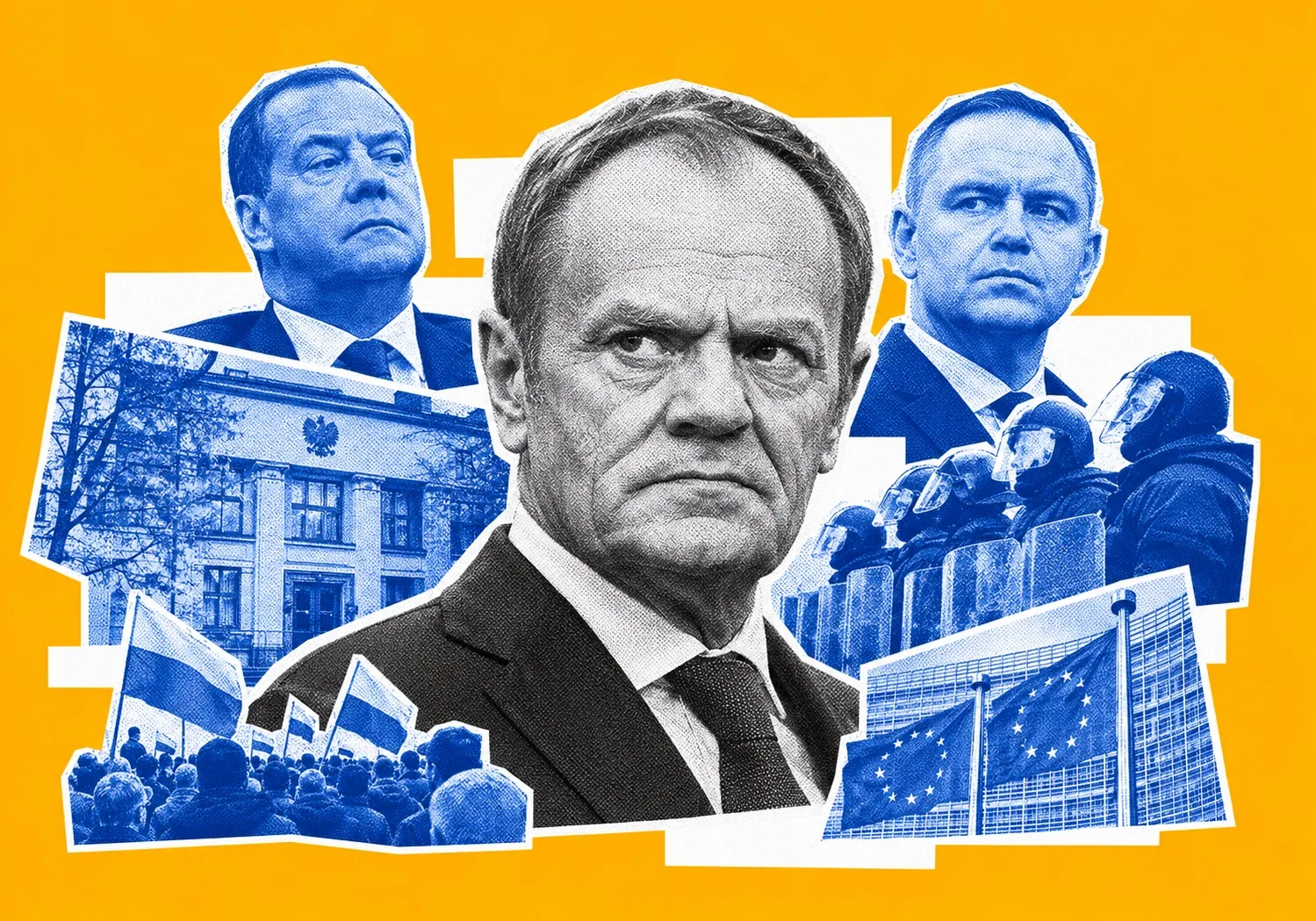
A bitter standoff at Poland’s Constitutional Tribunal has escalated into an international dispute after Prime Minister Donald Tusk accused Moscow of using Russian bot networks to fuel domestic unrest. The confrontation, which drew police, opposition protesters, and President Karol Nawrocki to the court, marks a critical test for Warsaw’s relations with both the EU and the Kremlin.
The immediate trigger was the removal of the Tribunal’s president, Bohdan Święczkowski, and vice-president, Bartłomiej Sochański. But the confrontation has exposed a deeper problem for Tusk’s government: restoring institutions whose legitimacy was disputed under the previous Law and Justice (PiS) administration may require measures that its opponents regard as equally illegitimate.
That disagreement is no longer confined to courtrooms.
A Constitutional Dispute Reaches the Streets
Police entered the Constitutional Tribunal building on 30 October after acting president Anna Korwin-Piotrowska reported concerns about staff safety, public order and the arrival of seven judges under State Protection Service escort.
Outside, opposition politicians led by PiS chairman Jarosław Kaczyński joined demonstrators associated with Gazeta Polska clubs and Ruch Obrony Granic. Protesters breached the perimeter fence and threw objects at police officers. Three people were arrested.
The confrontation continued into the early hours when Nawrocki, having cut short a visit to Senegal, arrived at the Tribunal with members of his staff at approximately 1 am.
Inside the building, Judge Maciej Berek alleged that the president approached judges aggressively and pushed Korwin-Piotrowska. Nawrocki, meanwhile, condemned what he described as a forcible takeover of a constitutional state body and called for urgent consultations.
The opposing accounts illustrate how far the dispute has moved beyond disagreements over judicial appointments. Both sides claim to be defending constitutional government. Both accuse the other of violating the principles that give state institutions their authority.
For Tusk, the Tribunal remains entangled in the legacy of PiS rule, when disputes over its composition and independence became central to Poland’s relationship with European institutions. His coalition argues that replacing contested leadership and appointing new judges are necessary steps towards restoring the rule of law.
PiS and its allies see a government attempting to reshape an independent constitutional body through political pressure. Nawrocki’s intervention has given that position the backing of the presidency.
The physical confrontation matters because the court’s authority depends on something neither police intervention nor political mobilisation can readily provide: acceptance that its decisions are legally binding, even among those who oppose them.
Why Moscow Entered the Argument
The following evening, Tusk used X to accuse domestic politicians challenging Poland’s democratic institutions of receiving support from pro-Russian forces and an "army of Russian bots".
His remarks followed comments by Dmitry Medvedev, deputy chairman of Russia’s Security Council, who described the developments in Poland as a "state coup" and accused liberals associated with Tusk of oppressing PiS conservatives.
Tusk highlighted Medvedev’s intervention with a short response: "And everything is clear."
The political purpose was apparent. By drawing attention to Moscow’s endorsement of a narrative resembling that advanced by his opponents, Tusk sought to portray the domestic confrontation as part of a broader attempt to weaken Polish democracy.
Yet the distinction between Russian political messaging and an organised digital influence operation is important.
Medvedev’s public intervention is documented in the briefing. Tusk’s allegations concerning Russian bots have not been accompanied by a published technical investigation identifying a specific network involved in the Tribunal crisis. Nor has an independently verified account of such an operation or a related criminal case been made public.

That leaves two separate questions. Russia has plainly taken an interest in Poland’s constitutional confrontation. Whether coordinated Russian-controlled accounts have materially influenced the dispute remains unproven on the available evidence.
Moscow does not need to manufacture a political crisis to benefit from one.
Medvedev’s description of events as a coup gives international prominence to an argument already circulating within Poland’s opposition. It presents the governing coalition as an authoritarian force and its conservative opponents as victims of political repression.
Such language is particularly useful because it draws on an existing domestic controversy. The dispute over the Tribunal’s legitimacy is genuine, and the disagreement between the government and presidency cannot simply be explained as the product of foreign manipulation.
Russian officials can exploit that disagreement without controlling the politicians involved or directing the protests themselves.
The risk for Tusk is that treating the opposition’s constitutional objections primarily as evidence of Russian influence may further harden domestic divisions. Political agreement with a statement made in Moscow does not, by itself, establish coordination with Moscow.
For the Kremlin, however, the public argument offers an opportunity to cast doubt on the democratic credentials of a government firmly aligned with European institutions.
Brussels Faces a Difficult Legal Test
The European Commission has entered the dispute with a position that addresses both the functioning of the Tribunal and the appointment of new judges.
It has called on Polish authorities to ensure that the court operates normally in accordance with the Polish Constitution and the practices of the Court of Justice. It has also affirmed that appointing eight new judges falls within the constitutional powers of the Sejm and urged Nawrocki to swear them in.
This places the president under additional pressure while giving Tusk’s coalition European support for a central element of its judicial reform programme.
But Brussels cannot resolve every aspect of the confrontation by endorsing the Sejm’s appointment powers.
The argument extends to the removal of the Tribunal’s leadership, the legitimacy of its current composition and the methods used to secure control of the institution. The Commission’s position does not automatically settle those disputes.
For European policymakers, the difficulty is familiar but increasingly acute. Poland’s government is attempting to reverse institutional changes that it considers damaging to judicial independence. Its opponents reject the legitimacy of the corrective measures.
If each change in political leadership produces a competing claim to constitutional authority, the judiciary risks becoming an extension of electoral conflict rather than an institution capable of settling it.
That is particularly consequential in Poland, whose position within both NATO and the EU makes domestic institutional stability relevant to wider European security and legal cooperation.
A prolonged dispute over the Tribunal could also complicate the government’s efforts to rebuild confidence in Poland’s judicial system. Even reforms supported by European institutions may struggle to command lasting authority if substantial sections of the political establishment refuse to recognise their legitimacy.
Nawrocki Changes the Political Calculation
The president’s arrival at the Tribunal marked a significant escalation.
Until then, the confrontation could be understood principally as a struggle between the governing coalition and opposition forces resisting changes to a court shaped during PiS rule. Nawrocki’s direct involvement turned it into an open contest between the presidency and the government over the exercise of constitutional authority.
His refusal to accept the developments at the Tribunal also raises practical questions about the appointment of new judges.
The Sejm’s constitutional powers are one part of the process. The president’s role in swearing in judges is another. Where the two institutions disagree, the dispute becomes harder to resolve through ordinary parliamentary action.
Nawrocki has considerable political incentive to resist what he regards as executive overreach. PiS, meanwhile, can use the confrontation to mobilise conservative voters around the defence of institutions it considers threatened.
The government faces a different problem. It must show its reforms are legally defensible while preventing the dispute from descending into repeated confrontations involving police, judges, and elected officials.
Neither side has an obvious route to compromise while conceding so much symbolic ground.
The involvement of the Confederation party, which has also rejected the government’s measures as unlawful, indicates that resistance extends beyond PiS alone. Yet the briefing establishes no detailed common legal strategy or agreed timetable for further opposition action.
The immediate political confrontation is therefore clearer than its eventual institutional outcome.
A Crisis That Russia Can Exploit Without Controlling
Poland’s predicament illustrates an uncomfortable feature of modern political interference: foreign actors can benefit from divisions whose origins are entirely domestic.
The controversy over the Constitutional Tribunal predates Medvedev’s comments. It arises from competing interpretations of judicial independence, parliamentary authority, and the legitimacy of appointments made under successive governments.
Russian messaging enters that dispute at a point when the opposing political camps already regard each other’s actions as threats to constitutional government.
For Moscow, the advantage lies in reinforcing those perceptions. A government struggling to establish the authority of judicial reforms, a president openly challenging its actions, and protesters confronting police provide material for a narrative of democratic instability.
For Tusk, the temptation is to connect that narrative directly to Russian interference. The documented Russian political response gives him grounds to question Moscow’s motives, but the absence of independently verified evidence about the alleged bot network limits what can be established about the scale or mechanism of any digital campaign.
There is a further institutional danger. The more the conflict is framed as a struggle between defenders of democracy and agents of its destruction, the less room remains for resolving contested constitutional questions through recognised legal procedures.
The European Commission can insist on constitutional compliance. Parliament can exercise its appointment powers. The presidency can contest the government’s interpretation of the law.
But the Tribunal itself is supposed to provide an authoritative forum for disputes of precisely this kind.
Poland now faces the possibility that the institution responsible for determining the constitutional limits of political power will remain at the centre of a confrontation in which the principal political actors cannot agree on who legitimately controls it.
Sources: Prime Minister of Poland Donald Tusk/X, Rzeczpospolita, Wiadomości, Meduza, Polsatnews