
Kosovo Avoids New Election but Political Crisis Is Far From Over

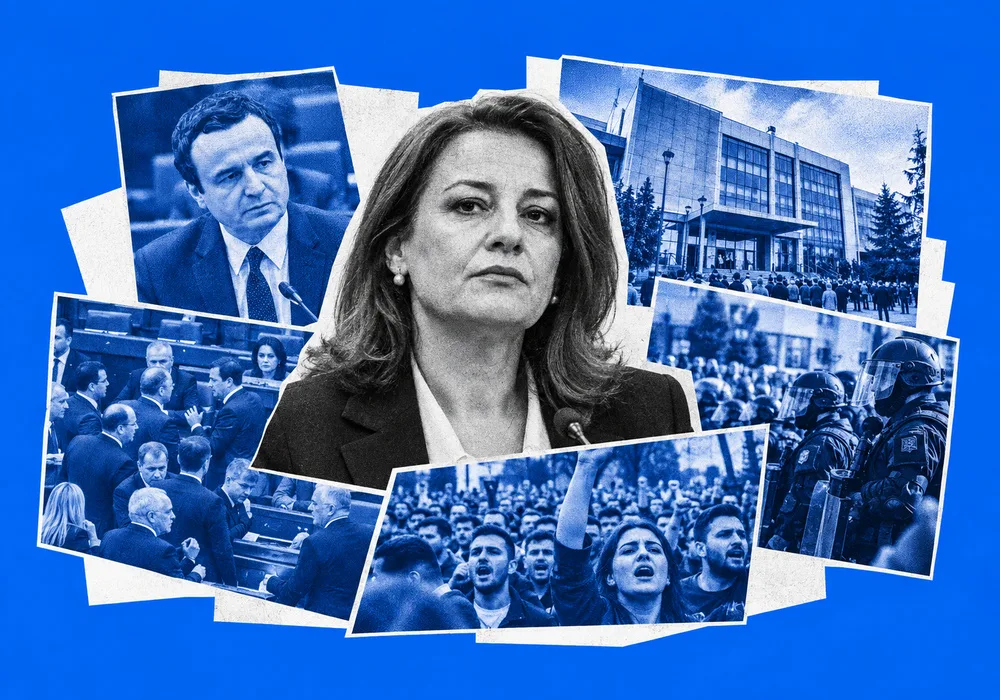
Kosovo has narrowly avoided another snap election after lawmakers elected Justina Shiroka Pula as president in a last-minute political compromise. The deal was closely linked to controversial changes limiting the powers of the Hague-based Kosovo Specialist Chambers, highlighting the unresolved tensions between Kosovo’s wartime legacy, international justice and its European integration path.
Kosovo has narrowly avoided another snap parliamentary election after lawmakers elected economist and academic Justina Shiroka Pula as the country’s new president. She secured 81 votes in the 120-seat Assembly, only one vote above the required threshold, in a late-night session that brought an extended political crisis to a temporary end. The vote came just before the constitutional process that could have led to another dissolution of parliament and a fourth election cycle in less than two years.
Shiroka Pula, who previously headed the Kosovo Academy of Sciences and Arts and served as economy minister, was put forward as a compromise candidate by Prime Minister Albin Kurti’s Vetevendosje party. Her candidacy was accepted by the opposition Democratic Party of Kosovo (PDK), allowing the two sides to overcome a deadlock that had prevented the election of a permanent head of state. The presidency is largely ceremonial, but it retains important responsibilities in foreign policy and as commander-in-chief of Kosovo’s armed forces.
The agreement was not simply about filling the presidency. It was tied to a much more sensitive dispute over Kosovo’s Specialist Chambers in The Hague, the court established to prosecute alleged crimes committed by members of the Kosovo Liberation Army during and after the 1998–99 war. Parliament approved amendments limiting the court’s powers immediately before voting for the president. The changes include restrictions on prison terms, provisions allowing sentences to be served in Kosovo and the possibility of presidential pardons for people convicted by final judgments.
The issue has become particularly explosive following the September convictions of former Kosovo President Hashim Thaçi and three other senior KLA figures. Thaçi received a 25-year sentence, while the other defendants were sentenced to between 13 and 18 years. Their convictions have triggered demonstrations in Pristina, where many Kosovars view the former KLA commanders as central figures in the struggle that led to independence from Serbia.
The protests have also demonstrated how closely Kosovo’s unresolved wartime legacy remains connected to its contemporary political system. On October 5, clashes between demonstrators and police left at least 17 people injured, while police used tear gas and water cannon to disperse crowds around government and parliamentary buildings. The dispute has therefore moved beyond a legal argument about the jurisdiction of an international court and become part of a broader confrontation over Kosovo’s national narrative and the limits of international accountability.
A temporary break in Kosovo’s political deadlock
The presidential vote provides Kurti’s government with an important degree of political breathing space. Kosovo has experienced prolonged institutional paralysis, including repeated elections and difficulties forming stable governing arrangements. Kurti’s Vetevendosje won the June parliamentary election but failed to secure the majority needed to govern without support from other parties, while disagreements over the presidency threatened to reopen the electoral cycle.
Avoiding another election is particularly significant because political instability has already slowed Kosovo’s ability to implement reforms and advance its European integration agenda. Brussels has repeatedly stressed the need for functioning institutions capable of delivering reforms connected to EU membership. Continued electoral uncertainty would have further complicated legislation, economic policy and access to European funding.
But the compromise that produced the new president may create a different problem. The amendments concerning the Specialist Chambers have raised questions about Kosovo’s international commitments and could face constitutional scrutiny. The court was created precisely because Kosovo’s domestic institutions were considered insufficient to handle allegations against senior KLA figures, meaning attempts to substantially narrow its authority risk creating friction with Western partners that supported Kosovo’s post-war state-building.
This puts Pristina in a difficult position. Kosovo needs functioning institutions and political stability to advance its EU ambitions, but the political compromise that restored institutional stability has been built partly around an issue that touches directly on its relationship with international justice and its Western partners.
The wider Balkan dimension
For the EU, Kosovo’s political stability matters beyond the country’s relatively small economy. The unresolved relationship between Kosovo and Serbia remains one of the Balkans’ most persistent security and diplomatic problems, while the EU has invested heavily in preventing political crises in the region from developing into broader instability.
The new presidency does not resolve the structural divisions inside Kosovo. It merely removes one immediate trigger for another election. Kurti’s government still has to manage opposition pressure, public anger over the Hague court and the broader question of how Kosovo balances its national interpretation of the 1998–99 war with the international legal framework underpinning its relations with Europe.
The election of Shiroka Pula therefore represents less a political reset than a fragile compromise. Kosovo has avoided another vote, but the confrontation over the Specialist Chambers shows that the country’s institutional problems are closely tied to unresolved questions about its wartime past, relations with international institutions and the political direction of its European integration.
Sources: Kosovo Presidency