
Italian Military Helicopter Crash in Bosnia Kills Four EUFOR Personnel

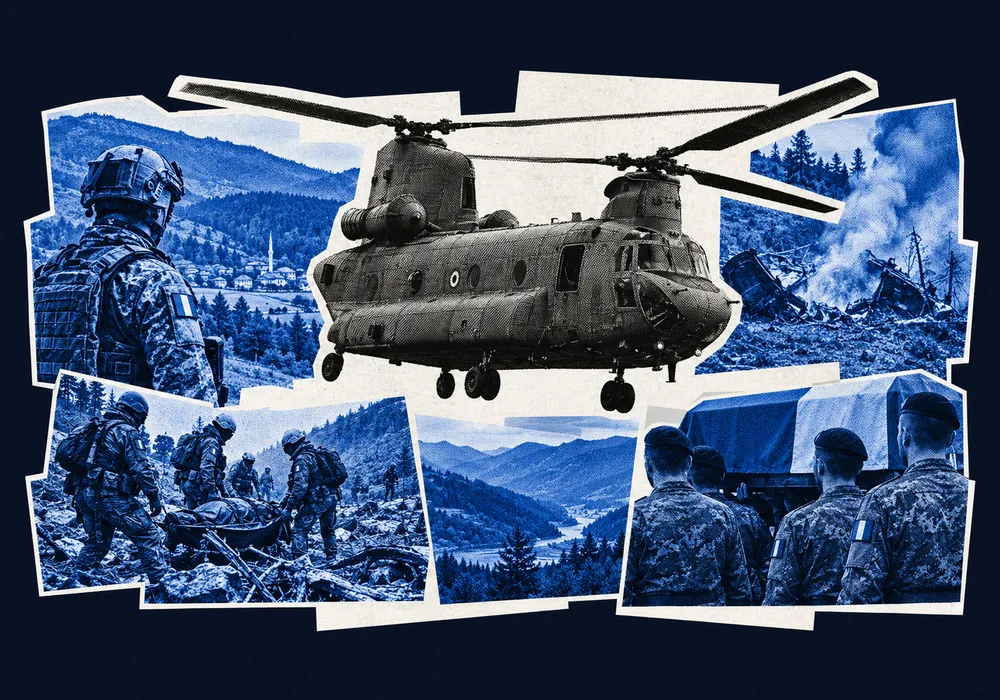
Four people have been killed and 11 injured after an Italian CH-47 Chinook helicopter operating under the EUFOR Althea mission crashed during a routine training flight in northeastern Bosnia and Herzegovina. The accident has prompted investigations by Italian authorities and the EU military operation, raising questions about the circumstances of the incident during a mission responsible for maintaining stability in the Western Balkans.
An Italian military helicopter assigned to the European Union's EUFOR Althea operation crashed in Bosnia and Herzegovina on 29 October, killing four people and injuring another 11. The aircraft, a CH-47 Chinook transport helicopter, went down near Gorice in the Brčko District in the northeastern part of the country. There were 15 people on board at the time of the accident, including Italian military personnel and members of the Italian Red Cross Voluntary Military Corps.
The four fatalities included two Italian Army servicemen and two members of the Red Cross Military Volunteer Corps. Italy's Defence Ministry confirmed the deaths, while the injured personnel were taken for medical treatment. According to the initial information released by the authorities, none of the 11 injured was in a life-threatening condition. Italian medical personnel were also deployed to Bosnia and Herzegovina to assist with the response and treatment of those affected.
The helicopter was reportedly involved in routine training activities when the accident occurred. However, the precise circumstances surrounding the crash have not yet been established. Italian authorities and EUFOR have launched investigations to determine what caused the aircraft to go down and whether technical or operational factors contributed to the incident. No evidence has so far indicated that the crash was connected to hostile activity.
Investigation into the circumstances of the accident
The investigation is expected to examine the helicopter's technical condition, flight operations and the circumstances immediately preceding the crash. The CH-47 Chinook is a heavy-lift transport helicopter used by several NATO and European armed forces for troop transportation, logistical support and other military tasks. Its ability to carry personnel and equipment makes it particularly important for operations requiring mobility across difficult terrain.
EUFOR confirmed that the aircraft was participating in training activity and that emergency procedures had been activated following the crash. The operation also stated that no civilians were injured and that there was no damage to civilian infrastructure, property or vehicles. The incident has nevertheless raised questions about the operational risks associated with maintaining military aviation capabilities during international deployments.
The findings of the investigation will be relevant to both the Italian armed forces and the wider EU mission. Establishing whether the crash resulted from a technical malfunction, human factors or other operational circumstances will determine whether additional safety measures or changes to training procedures are necessary. Until the investigation is completed, however, any conclusions about the cause would be premature.
EUFOR's role in maintaining stability in Bosnia
The helicopter was operating in support of EUFOR Althea, the European Union's military mission in Bosnia and Herzegovina. Established in December 2004, the operation took over peacekeeping responsibilities from NATO's Stabilisation Force following the conclusion of the NATO-led mission. Its mandate is based on the Dayton Peace Agreement, which ended the Bosnian war in 1995, and subsequent United Nations Security Council resolutions.
EUFOR's primary responsibility is to maintain a safe and secure environment in the country while supporting local authorities in preserving stability. The mission also contributes to the development of Bosnia and Herzegovina's defence capabilities through training and cooperation with national institutions. Its presence remains particularly significant given the country's complex political structure, persistent disagreements between its political entities and recurring tensions over the distribution of constitutional powers.
The operation forms part of the EU's broader security engagement in the Western Balkans, a region where political instability and unresolved institutional disputes continue to present challenges. Although Bosnia and Herzegovina has made progress towards European integration, its internal political divisions have repeatedly complicated reforms and raised concerns about the durability of the post-war settlement. EUFOR therefore serves not only as a military presence but also as an international security mechanism intended to deter developments that could threaten the country's stability.
Implications for Italy and the European mission
For Italy, the deaths of four personnel represent a significant loss within its contribution to the international operation. The incident has prompted condolences from Italian political and military leaders, while Defence Minister Guido Crosetto expressed solidarity with the victims' families and the injured. The Italian government is expected to remain closely involved in the investigation and the provision of assistance to those affected.
The crash also highlights the practical demands of sustaining European military operations abroad. Transport helicopters are essential for moving personnel, equipment and supplies, particularly in multinational missions where forces operate across different locations and rely on shared logistical capabilities. Any disruption to these assets can affect operational planning, even when the mission's broader mandate remains unchanged.
There has been no indication that EUFOR intends to suspend its activities following the accident. Its mandate and presence in Bosnia and Herzegovina remain in place, while the immediate priority is to establish the cause of the crash and assess whether additional precautions are required. The investigation's conclusions will be important for determining the circumstances of the deaths and preventing similar incidents during future European military deployments.