
Europe’s Rearmament May Be Missing the Lessons of Ukraine

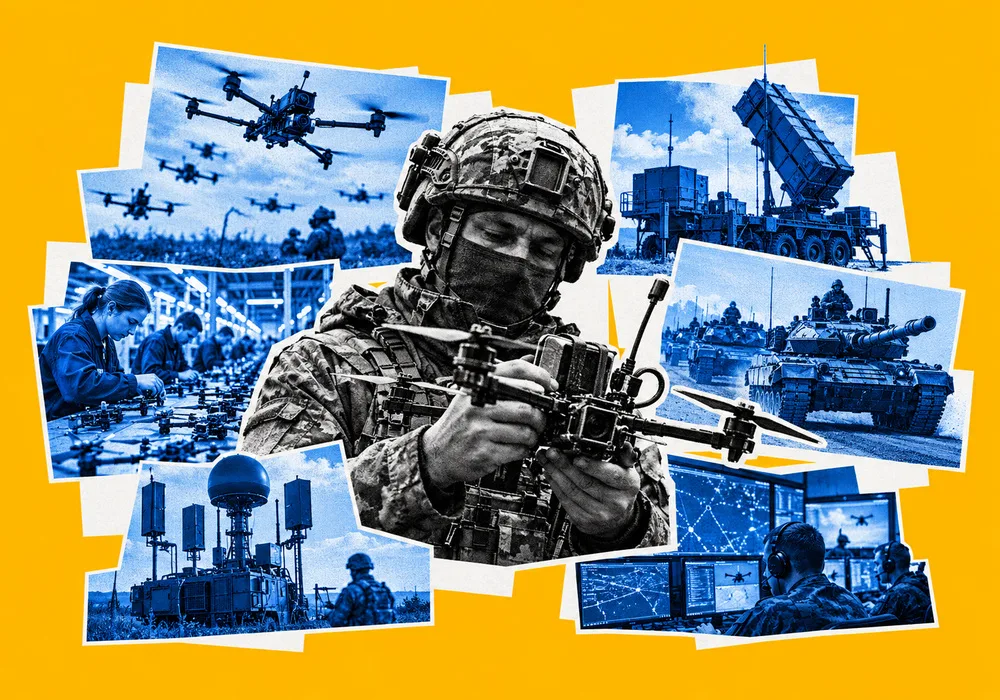
Europe’s rearmament increasingly focuses on drones, electronic warfare and battlefield software, but its ability to sustain production, replenish losses and adapt at the pace of modern warfare remains uncertain. Ukraine’s experience highlights the need for resilient supply chains, faster defence procurement and closer European cooperation to ensure that rising military spending translates into lasting operational readiness.
Europe’s rearmament debate increasingly recognises the role of drones, electronic warfare and battlefield software. The harder question is whether European states can deploy these capabilities at the scale and speed required by a prolonged war. Ukraine has shown that the advantage often belongs to the side that can replace losses, adapt equipment and introduce new tactics faster than its opponent can respond.
In January 2026, Ukraine’s National Security and Defence Council reported that the country had developed production capacity for more than eight million FPV drones annually, reflecting the scale of its wartime industrial expansion. This figure represents potential capacity rather than confirmed annual output, but it illustrates how quickly military production can be reorganised under pressure. For European governments, the lesson is not simply to purchase more drones. It is to build procurement and manufacturing systems capable of responding to rapidly changing battlefield requirements.
NATO has also moved to strengthen this area. In July 2026, the alliance announced more than $40 billion in investment in counter-drone capabilities and a target of training five times as many drone operators by the end of 2027. The scale of the commitment matters, but its military value will depend on delivery schedules, interoperability and whether new capabilities can be integrated into existing forces before a crisis begins.
The Economics of Defence Are Becoming a Battlefield Vulnerability
The growing use of inexpensive drones has exposed a cost imbalance in modern air defence. A relatively cheap unmanned aircraft can force a defender to expend a missile or other interceptor worth many times more. Repeated across a large attack, this exchange can put pressure on even well-funded militaries by draining stocks that are difficult and expensive to replenish.
Europe therefore needs a layered approach to counter-drone defence. Electronic disruption, guns, lower-cost interceptors and other systems should be used where they are effective, while high-end missiles remain available for threats that justify their cost. The objective is not to eliminate expensive systems from the battlefield, but to prevent an adversary from exploiting the price difference between an attack and its defence.
The problem extends beyond the cost of the weapon itself. Ukraine’s experience has demonstrated how vulnerable drone production can be to restrictions on foreign components and commercial technology. An Associated Press report on Chinese technology and Ukraine’s drone supply chains highlighted the risks created when military production depends on components sourced from a narrow range of external suppliers. European procurement plans that count finished systems without assessing their underlying dependencies may overestimate how much equipment could actually be delivered during a prolonged crisis.
Europe’s Defence Industry Must Learn to Produce for a Long War
European defence industries have traditionally operated around long development cycles, complex platforms and procurement contracts planned years in advance. These arrangements can deliver sophisticated aircraft, ships and missile systems, but they are less suited to a war in which equipment is destroyed, tactics change rapidly and replacement stocks are consumed continuously.
A credible rearmament strategy must therefore distinguish between buying equipment and sustaining combat power. Governments need contracts that support higher output, suppliers able to expand production, and maintenance systems that return damaged equipment to service quickly. They also need to shorten the path from battlefield feedback to redesigned or upgraded equipment, particularly in drone technology and electronic warfare.
This does not mean abandoning advanced platforms in favour of disposable systems. It means preparing for both the initial exchange of fire and the months that follow. A military may enter a war with highly capable equipment yet lose operational effectiveness if ammunition, spare parts, repair capacity and trained personnel cannot keep pace with attrition. Industrial endurance should be treated as a core measure of military readiness rather than a separate economic concern.
Applying Ukraine's experience of rapid production scaling to European soil requires preparing the legal framework in advance. Europe cannot operate under a war economy today, but governments must develop comprehensive "crisis protocols". Rather than relying on extrajudicial measures or the sudden forced repurposing of civilian facilities, these pre-prepared legal frameworks for industrial mobilization must include clear thresholds for activation, democratic and judicial oversight, and guaranteed financial compensation for civilian industries pivoting to military production. Temporary waivers for certain environmental or administrative restrictions must be strictly time-bound and legally defined. Having these carefully regulated contingency laws in place ensures that if a crisis hits, Europe can adapt with the speed demonstrated by Ukraine, but entirely within the boundaries of the rule of law and the EU legal system.

The Supply Chain Is Part of the Front Line
Modern weapons depend on a network of commercial electronics, communications systems, sensors, software and specialised components. Some of these inputs are produced by a small number of manufacturers outside Europe, leaving defence programmes exposed to export restrictions, transport disruptions or political pressure. Such dependencies can become decisive when demand rises suddenly and suppliers cannot meet the needs of multiple countries at once.
The Royal United Services Institute’s analysis, Drones Win Battles, Components Win Wars, underlines a central lesson of the war in Ukraine. The availability of components can be as important as the design of the weapon that uses them. A drone fleet cannot remain operational if essential electronics, batteries or communications equipment are unavailable, regardless of how large its initial inventory was.
For Europe, strategic autonomy should not mean producing every component domestically. That would be expensive and, in some sectors, unrealistic. The more practical task is to identify critical dependencies, diversify suppliers, establish reserves where necessary and ensure that alternative components can be integrated without lengthy redesigns.

Identifying these dependencies is only the first step. Since Europe cannot quickly establish a full cycle of microelectronics production or rare-earth metal extraction, it needs a comprehensive strategy of "friend-shoring"—relocating supply chains to politically reliable allied countries. Furthermore, the current European Chips Act, as well as initiatives for a future Chips Act 2.0, must be more deeply integrated with defence industrial policy. Assuming that new commercial semiconductor fabrication plants can be "quickly repurposed" for military electronics is technologically unrealistic due to highly specialized tooling, specific node requirements, and intellectual property constraints. Instead, European strategy should focus on subsidizing dedicated production lines for dual-use and military-grade legacy chips, securing priority-access agreements for defence contractors during crises, and establishing deep, supranationally funded strategic reserves of critical electronics that cannot be easily manufactured domestically.
Electronic Warfare Could Undermine Europe’s Technological Advantage
The performance of drones and precision weapons depends on communications, navigation and the ability to transmit information across the battlefield. Electronic warfare can disrupt those functions, turning an advanced system into an unreliable one. In Ukraine, both sides have repeatedly adapted their jamming and counter-jamming methods, forcing manufacturers and operators to revise equipment and tactics.
The RUSI study Electromagnetic Operations in Ukraine examines the central role of the electromagnetic spectrum in modern combat. Its implications extend beyond specialist electronic-warfare units. Forces need to operate when satellite navigation is degraded, communications are interrupted or familiar drone frequencies become unusable. They must also be able to restore connectivity and change operating methods without waiting for a lengthy procurement cycle.
European readiness will depend on training as much as equipment. Exercises should test how units perform when digital networks are disrupted, not only when systems function under ideal conditions. If a force depends on uninterrupted connectivity to coordinate fires, move supplies or maintain situational awareness, an adversary may be able to weaken it without destroying its most expensive platforms.
Software May Determine How Quickly Europe Can Fight Back
The speed of software updates and the movement of information between frontline units, engineers and manufacturers have become important sources of military advantage. When an adversary changes its jamming methods or develops a new countermeasure, the ability to revise software and distribute an effective response can determine how long a weapon remains useful.
Ukraine’s experience points to the value of short feedback loops between operational units and industry. European defence programmes often separate development, testing and procurement into lengthy stages. That approach can struggle to keep pace with systems whose effectiveness may change within weeks.
To shorten the path from the battlefield to production in peacetime, European bureaucracies need new legal mechanisms. Standard public procurement procedures are simply unsuitable for technologies that become obsolete in months. The EU Council's final approval of the Defence Readiness Omnibus legislative package on 9 October 2026 marks an important step towards accelerating defence procurement and reducing administrative bottlenecks. Building on this, the EU Council approved the AGILE programme on 12 October 2026 to speed up defence innovation. AGILE provides a €115 million budget, targets four-month grant decisions, and supports faster access to testing facilities for startups, with the first call expected in early 2027.
While AGILE accelerates funding and facility access, it does not fully substitute the need for "regulatory sandboxes." Armed forces still require special legal regimes allowing engineers and military personnel to jointly iterate new equipment and software updates rapidly without navigating the full peacetime safety certification cycle, while still maintaining fundamental safety controls.
In July 2026, the European Commission launched the EU–Ukraine Drone Alliance, intended to strengthen cooperation on drone and counter-drone technology. Its significance will depend on whether cooperation produces practical outcomes such as joint development, faster testing, reliable production and systems that can be used across different European forces. Ukraine’s battlefield experience offers Europe a valuable source of operational knowledge, but that knowledge must be translated into procurement decisions and deployable capabilities.
NATO’s Eastern Flank Is a Test of European Readiness
The countries closest to Russia and Belarus face the most immediate pressure to turn defence commitments into operational capacity. Poland and the Baltic states must prepare for conventional military threats alongside sabotage, cyberattacks, pressure on critical infrastructure and the possibility of coordinated drone incursions. These risks make early warning, air defence and resilient communications essential parts of national security.
The challenge is also geographical. Reinforcements, ammunition and replacement equipment would have to move across borders under conditions in which transport links, energy infrastructure and communications could be disrupted. Plans that work on paper may falter if countries use incompatible systems, lack shared procedures or cannot coordinate decisions quickly.
The eastern flank is therefore a test not only of national defence spending but of NATO’s ability to connect national capabilities into a functioning regional system. Joint exercises should assess how forces maintain logistics, share intelligence and protect infrastructure during sustained disruption. The objective is to ensure that an attack on one part of the alliance does not expose weaknesses elsewhere in the reinforcement network.
Germany, France and Poland Face Different Parts of the Same Problem
Europe’s larger defence powers bring different strengths to rearmament. Germany has a significant industrial base and a central role in European logistics; France maintains a broad defence industry and capabilities across several military domains; Poland is expanding its forces while preparing for the immediate security demands of the eastern flank. Their priorities are not identical, but their military effectiveness will increasingly depend on how well they work together.
A larger national inventory does not automatically create a stronger European defence posture. If equipment, ammunition and communications systems cannot operate together, multinational forces may lose time at precisely the moment when speed is critical. The same applies to maintenance, spare parts and training. Systems that are difficult to support across borders can reduce the practical value of otherwise substantial investments.
European rearmament will require national programmes to reinforce one another rather than develop in isolation. Common standards and coordinated procurement can help reduce fragmentation, while countries can specialise in areas where they have industrial or operational advantages. The aim should be to preserve national capabilities while making them usable as part of a wider European force.
However, coordination between European states historically faces the serious obstacle of national protectionism. Governments often favor their own defence contractors to preserve jobs and technological sovereignty, even if this leads to duplicated efforts and incompatible systems. While the European Defence Fund (EDF) Regulation 2021/697 already requires the participation of at least three legal entities from different member states, this mechanism frequently generates artificial consortia designed primarily to secure funding. A 2025 European Commission evaluation of the EDF confirms this, noting that some consortia exceed 50 members. This scale causes excessive funds to be spent on coordination without delivering proportional added value.

To improve this, the EU and NATO must enforce stricter qualitative criteria. Access to funding should depend on cross-border participation alongside binding commitments to common procurement, joint lifecycle maintenance, and verifiable interoperability standards for the produced platforms. Europe needs a model of specialization where funding supports true centers of excellence rather than fragmented national champions.
A Mass Drone Attack Would Test the Whole Defence System
A large drone attack would place simultaneous pressure on detection systems, command structures, interceptors, air bases and critical infrastructure. Even if most incoming drones were intercepted, the volume of targets could strain ammunition stocks and force commanders to decide which sites receive priority protection. Repeated attacks could make those decisions more difficult by combining military targets with energy facilities, transport links and other infrastructure essential to civilian life.
The outcome would depend on more than the performance of individual air-defence systems. Authorities would need to share warning information, distinguish between different threats, allocate scarce interceptors and maintain communications as the attack unfolded. They would also need to repair damage and restore services quickly enough to prevent disruption from spreading through the wider economy.
For European governments, this means testing endurance rather than measuring readiness through equipment inventories alone. Exercises should examine what happens after the first wave, when stocks have fallen, personnel are tired and infrastructure has sustained damage. The ability to absorb an attack and continue operating would be a more meaningful measure of resilience than the number of systems deployed before hostilities begin.
The Danger of Overcorrecting Towards Drone Warfare
Ukraine’s experience has demonstrated the importance of unmanned systems, but it has not made conventional firepower obsolete. Drones can improve surveillance, target enemy positions and strike at relatively low cost, yet their effectiveness depends on communications, weather, electronic conditions and the availability of supporting capabilities. They cannot independently fulfil every task required to hold territory, protect forces or sustain a large-scale military campaign.
The Royal United Services Institute’s warning against replacing traditional firepower with drones points to the risk of drawing too narrow a lesson from the war. An army that invests heavily in unmanned systems while neglecting artillery, air defence, engineering, logistics and ammunition reserves could create new vulnerabilities even as it addresses others.
The practical lesson is to integrate drones into a balanced force. Their value is greatest when they complement conventional weapons, improve situational awareness and reduce risks to personnel. Europe needs to adapt its military model to the changing character of warfare without assuming that one technology can replace the wider capabilities needed to fight and sustain a war.
European Cooperation Must Produce Capabilities, Not Just Commitments
European institutions have increasingly acknowledged the need to adapt defence planning to new systems of warfare. The European Parliament’s resolution on drones and new systems of warfare reflects the growing political attention to these capabilities. The broader challenge is to ensure that policy commitments lead to equipment, common standards, production capacity and forces that can operate together.
Joint procurement can help create more predictable demand for manufacturers and reduce fragmentation across national markets. But cooperation will have limited effect if projects move slowly, requirements remain incompatible or deliveries arrive after the capabilities are needed. European states should assess programmes against practical measures. They must evaluate how quickly equipment can be delivered, how easily it can be maintained, whether supplies can be replenished and whether units can use it alongside their allies.
The European Council’s June 2026 conclusions on Ukraine and European defence and security provide a wider political framework for strengthening Europe’s security. The next step is implementation. Defence cooperation must be judged by whether it improves the ability to deter an attack and sustain military operations, not by the number of declarations or initiatives adopted.
Europe’s Strategic Advantage Will Depend on Adaptation
Europe’s rearmament is taking place under pressure from Russia’s war against Ukraine and uncertainty over the future distribution of responsibilities within NATO. Higher spending is necessary, but it cannot guarantee deterrence if forces lack ammunition, repair capacity, resilient supply chains or the ability to respond to new battlefield methods. The central test is whether European militaries can maintain their effectiveness after initial stocks are depleted and established systems come under sustained pressure.
Ukraine has shown that industrial output, component access, electronic warfare, software and operational feedback are interconnected parts of military power. Europe does not need a wartime economy today, but it must develop the industrial agility and legal frameworks to sustain one tomorrow.
Sources: National Security and Defense Council of Ukraine, NATO, RUSI, European Commission,