
Russia’s Record Military Budget Triggers Regional Cuts to War Benefits

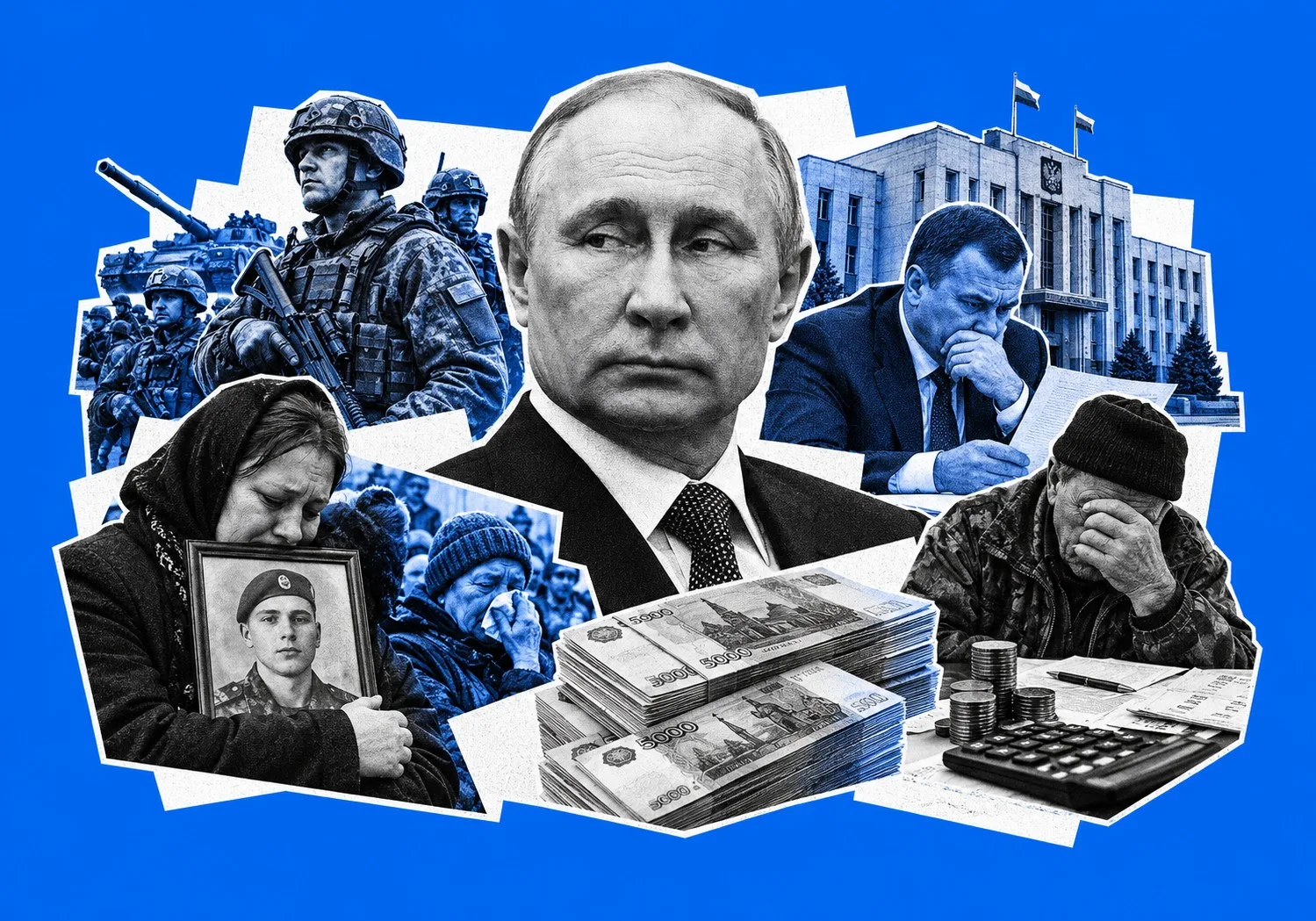
Russia is raising its 2025–2026 federal defence spending to a record 17.15 trillion rubles (€181.7 billion)—35 per cent of its entire budget. But behind the headline figures, the Kremlin’s war economy is reaching its physical limits. Across the country, regional governments are being forced to slash compensation for killed soldiers by up to 90 per cent to fund spiralling enlistment bonuses for new recruits.
In Saratov Oblast, a regional government decree signed in late September by deputy governor Mikhail Isayev cut lump-sum compensation paid to families of local soldiers killed in Ukraine from 1 million rubles to just 100,000 rubles (€947), effective 1 November. Saratov is no isolated case of local belt-tightening. Across the Russian Federation, regional governors are quietly abandoning the implicit financial deal that has bought public quiet through five years of full-scale war. Ulyanovsk Oblast cut its death benefits twentyfold between February and April, down to a nominal 50,000 rubles. In Kemerovo, the figure was chopped to 1 million rubles; in Omsk, halved to 500,000; in Bashkortostan, reduced to a fifth of its former value.
Set side by side, the massive federal build-up and the regional austerity signal a grim turning point for Vladimir Putin’s war economy. Moscow can no longer fund massive front-line procurement, keep domestic services afloat, and pay out for its mounting casualties all at once. Pushed into a corner by finite revenues, the state has made its choice. Cash is being pulled from the families of the dead to buy fresh bodies for the front.
Gutting the Civil State
During the first two years of the invasion, the Kremlin relied heavily on cash to keep the war politically invisible. Federal statutory compensation was bolstered by generous regional top-ups—known locally as grosoviye, or "coffin payments". In stagnant industrial towns and rural provinces, these lump sums offered families sums of money they could otherwise only dream of. It was a straightforward transaction: quiet acquiescence in exchange for social mobility.
Five years in, that model has run out of money. Cumulative military expenditures since 2022 have reached 58.3 trillion rubles (€618 billion). Official projections through 2028 put total defence outlays at 75.5 trillion rubles (€800.1 billion). That comfortably exceeds the Russian Central Bank’s entire foreign exchange reserves, which stand at €663.2 billion. Look further out to 2029, and the cumulative bill crosses 92.1 trillion rubles.
To keep arms production lines moving at this scale, the peacetime state is being cannibalised. The new draft budget trims social support programmes by 453 billion rubles, down to 6.65 trillion. Funding for housing and municipal utilities drops by 167 billion rubles, leaving the sector with 1.839 trillion. Broad economic support measures lose 148 billion rubles, while national healthcare is quietly shaved by 59 billion.
Tax collectors are hunting for whatever remains in private hands. The top rate of personal income tax on passive earnings—including interest on bank deposits—will rise to 22 per cent. The treasury expects this measure alone to bring in an extra 3.7 trillion rubles (€39.6 billion). Where taxation falls short, expropriation fills the gap: federal authorities have seized over 7 trillion rubles in private assets through state-directed court rulings over recent months.
Even with these clawbacks, the central government is shifting its deficit burdens onto regional balance sheets. In Saratov Oblast—where independent tallying by Idel.Realities has confirmed at least 6,277 war dead—the planned regional deficit expanded by 4.2 billion rubles in late September, reaching 29.2 billion rubles. Governors across Russia simply lack the liquidity to honour old obligations.
Out with the Dead, In with the Convicts
Trapped between rising regional deficits and strict recruitment quotas from the Ministry of Defence, regional administrations have altered their spending strategy. Money previously reserved for grieving dependents is being redirected into sign-on bonuses for new enlistees.
Saratov’s recent decree makes this priority explicit. While cutting compensation for fallen soldiers tenfold, the regional government extended a 2 million ruble sign-on bonus for new volunteers through October, alongside a 300,000 ruble bounty for recruiters who bring in fresh recruits. Though these rates drop to 1 million and 150,000 rubles respectively in November, regional officials introduced a new 450,000 ruble payout specifically targeted at criminal defendants and prison inmates who agree to sign military contracts before the end of the year.
The logic is brutally practical. A dead soldier is a financial liability that offers no further utility on the battlefield. A fresh recruit—even one drawn from a remand centre—offers immediate infantry manpower capable of holding a trench line.
By placing recruitment incentives above post-mortem compensation, regional authorities treat soldiers as short-term consumables. The state's financial pledge to a family lasts only as long as the soldier remains operational.
The Late-Soviet Pattern Returns
The economic trajectory taking shape in Moscow shares obvious traits with the decline of the late Soviet Union. In its final decade, the Soviet leadership poured resources into military-industrial plants at the expense of civilian infrastructure, public health, and basic consumer goods, steadily degrading the social fabric beneath.
Western observers spent years debating how long Russia’s sovereign wealth funds and energy revenues could shield ordinary citizens from the costs of war. The draft budget offers an answer: that buffer is spent.
The shift from a rent-distributed welfare system to a war economy marks a permanent breakdown in Russia's domestic political contract. Citizens are being asked to absorb higher taxes on their savings, failing municipal heating systems, reduced healthcare access, and the cancellation of state insurance for their relatives killed in action.
The beneficiaries of this system are few: security officials, defence contractors with guaranteed multi-year orders, and criminal suspects who can trade front-line service for legal immunity. On the losing side sits the broader civilian population, alongside regional administrations facing mounting debts and millions of military dependents whose sacrifices have been written off by administrative order.
Moscow’s multi-year budget plan signals clearly enough to European capitals that the Kremlin intends to continue its war of attrition through at least 2028. But the internal price of that ambition is a default on the state’s core promises to its own people. By converting social protection directly into munitions and recruitment incentives, Russia is paying for today’s war by eroding the foundations of its future stability.
Sources: Meduza, Radio Free Europe/Radio Liberty