
NATO Optimises KFOR Footprint in Kosovo as Italy’s General Vergori Takes Command

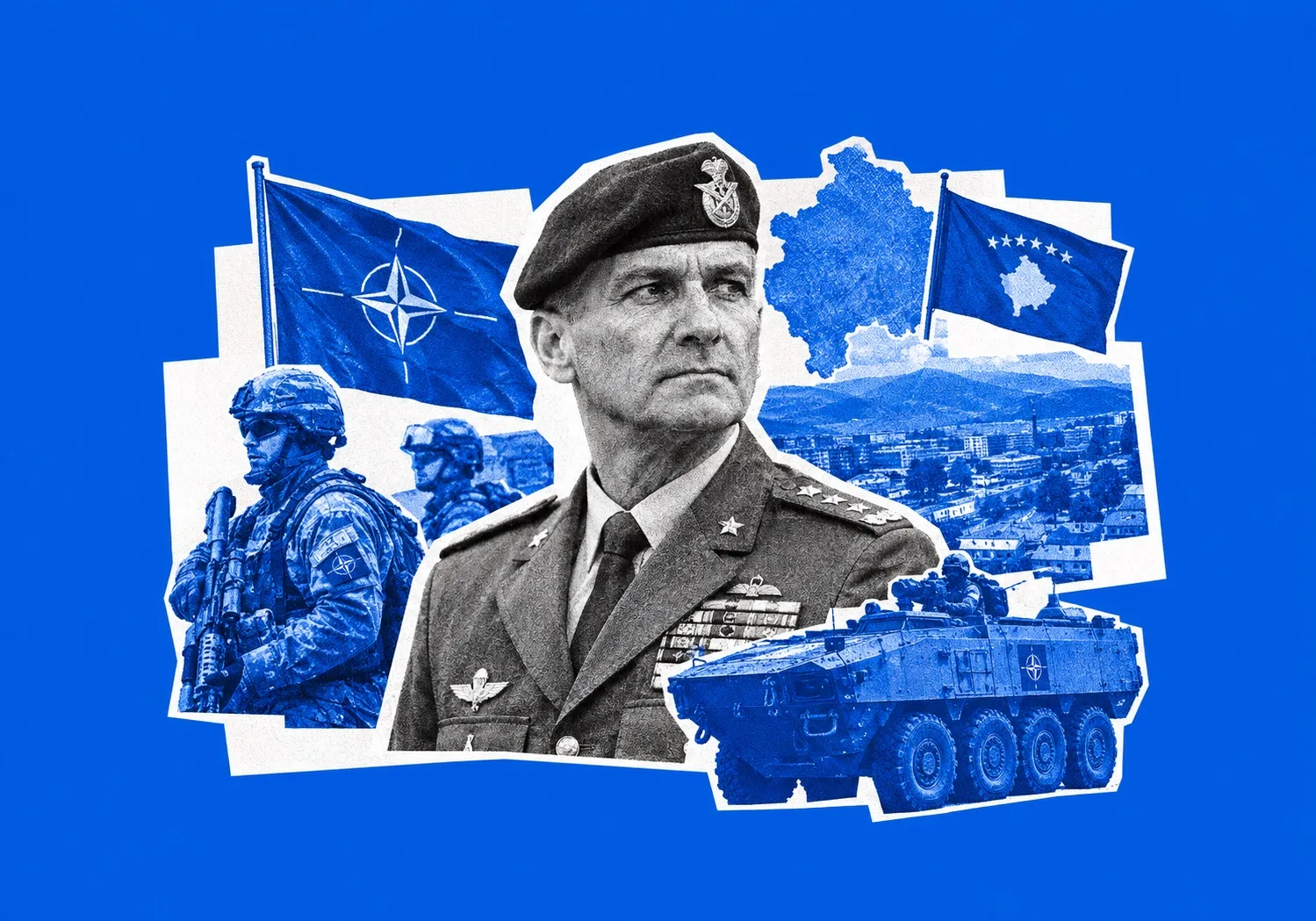
As Major General Roberto Vergori assumes command of NATO’s KFOR mission in Pristina, the alliance is pushing ahead with plans to scale back its troop presence in Kosovo. While NATO cites an improving security environment, unresolved political deadlocks between Belgrade and Pristina mean a leaner military footprint carries calculated diplomatic and security risks.
Vergori succeeds Turkey’s Major General Özkan Ulutaş, who served two separate terms in command. The handover took place at KFOR headquarters on 14 October, with Admiral George M. Wikoff, commander of Allied Joint Force Command Naples, presiding. Italian Defence Minister Guido Crosetto also attended, a reminder that Rome regards the Western Balkans as a matter of national security, not just another NATO commitment.
The ceremony was straightforward. The timing was more complicated.
A security improvement with limits
NATO announced its plans to optimise KFOR in June 2026. The changes are expected to unfold gradually over a year, with troop numbers and force configurations adjusted according to conditions on the ground. The alliance has been careful to distinguish this process from a withdrawal. If the security situation deteriorates, the adjustments can be reversed.
That qualification matters. KFOR was established in 1999 under UN Security Council Resolution 1244, following the Kosovo War. Its purpose is to maintain a safe environment and freedom of movement for all communities. The mission has changed considerably over the years, but the political disputes that make its presence necessary have proved much harder to resolve.

KFOR currently has roughly 4,600 to 4,700 personnel from more than 30 countries. Italy contributes the largest contingent, with more than 900 troops, followed by the United States, Hungary, Turkey and Germany.
Reducing the force is not necessarily a sign that NATO is losing interest in Kosovo. Military resources have to be allocated across competing demands, and a deployment should reflect the risks it is expected to manage. A force that can adapt to changing circumstances may be more useful than one whose size remains largely unchanged.
But the calculation depends on the quality of the security assessment. A generally stable environment is not the same as a settled one. Nor does the absence of sustained fighting mean that the conditions for renewed violence have disappeared.
NATO says it will retain the ability to respond if circumstances change. What remains unclear is how quickly additional forces could be brought back, or precisely what developments would trigger a reversal. Those details matter when judging whether a smaller deployment offers greater efficiency without sacrificing the ability to contain a crisis.
In the north, even routine police operations can become political
Northern Kosovo is where NATO’s assumptions will face their hardest test.
The region’s Serb-majority municipalities remain a source of tension between the authorities in Pristina and the local population. Disputes over administration and policing are difficult to separate from the wider disagreement between Kosovo and Serbia, and confidence in security institutions is not uniform across communities.
Recent incidents offer little reason to assume that these problems are fading. In late September, police raided a Serbian medical facility in North Mitrovica. Medical staff subsequently held peaceful protests. On 10 October, police arrested suspects following an attempted abduction of a minor in Zvečan. Weapons seizures have also continued, while the armed clash in Banjska in September 2023 remains part of the region’s recent security history.
These incidents are different in nature and should not be treated as evidence of an imminent wider conflict. What they have in common is that each unfolds in an environment where local events can quickly acquire an ethnic or political dimension.
A police operation may be presented as an ordinary law-enforcement measure by the authorities and viewed with suspicion by part of the population. A dispute over a public facility can become another argument about the treatment of Kosovo’s Serbs. Once an incident is interpreted through those competing narratives, containing it becomes more difficult.
KFOR cannot resolve every such dispute. But its presence provides an additional layer of security at moments when local trust is limited.
That is why a reduction in troops could have consequences beyond the mission’s immediate operational capacity. For Serb communities in the north, fewer international soldiers may look like a weakening of protection, regardless of NATO’s assurances that its mandate remains unchanged. For Pristina, greater reliance on domestic security institutions may be a necessary step towards stronger state capacity.
Neither perspective can simply be dismissed. Kosovo needs institutions capable of maintaining public order across its territory. Those institutions also need to be trusted by the communities they serve.
The police cannot replace a political settlement
KFOR works alongside the Kosovo Police and the EU Rule of Law Mission, known as EULEX. Their responsibilities differ, but their cooperation is central to Kosovo's security arrangements. As NATO adjusts its deployment, the work of local law enforcement becomes more important.
That does not mean responsibility can be transferred from one institution to another by reducing troop numbers. Domestic police can respond to crime and maintain public order, but they cannot by themselves settle the political dispute between Kosovo and Serbia. Nor can an international military presence substitute indefinitely for progress in negotiations.
The EU-facilitated dialogue, overseen by special representative Peter Sørensen, remains stuck on fundamental disagreements. Serbia continues to demand the establishment of the Community of Serb Municipalities and rejects mutual-recognition frameworks. Kosovo, meanwhile, faces pressure from Western partners to fulfil its commitments on minority rights.
The result is an awkward division of labour. NATO helps prevent security tensions from escalating, while European diplomacy tries to address the disputes that keep generating them. Neither process has delivered a lasting resolution.
A smaller KFOR deployment will make the relationship between the two more consequential. If political progress remains limited, the mission will still have to manage the consequences of disagreements over local authority, minority rights and policing. The alliance may be able to contain individual incidents with fewer troops, but repeated confrontations could place increasing demands on its ability to respond.
There is no guarantee that diplomatic stagnation will lead to renewed violence. Equally, there is little basis for assuming that a lack of progress in negotiations carries no security cost.
Italy takes the lead at a sensitive moment
Vergori’s appointment gives Italy a more visible role in managing these risks. Rome already provides the largest national contingent to KFOR, and Crosetto has described the Western Balkans as an important pillar of Italian national security.
Command of the mission strengthens Italy’s position within NATO’s engagement in the region. It also places Rome closer to the decisions that will determine how the alliance balances military resources with its commitments to regional stability.
The interests extend beyond Kosovo itself. The Western Balkans form part of the wider European security environment, with implications for southern Europe and the Mediterranean. For Italy, maintaining influence in the region is therefore both an alliance responsibility and a strategic priority.
Yet the appointment should not be mistaken for a change in the mission’s basic purpose. KFOR remains a multinational force operating under its existing mandate. Italy’s leadership cannot, on its own, overcome the political impasse between Belgrade and Pristina, and Rome will depend on the wider alliance to maintain the resources and coordination needed for an effective response.
The experience of Ulutaş, whose tenure included sustained engagement with local communities and cooperation with Kosovo’s police and EULEX, also points to an aspect of the mission that cannot be measured by troop numbers alone. Relations with local institutions and an understanding of conditions on the ground become especially valuable when fewer forces are available for routine deployment.
What happens if the situation turns?
The success of NATO’s optimisation will depend on whether it can distinguish a genuinely improving security environment from one in which tensions remain contained but unresolved.
The alliance has said that force adjustments will be conditional and reversible. That gives it room to respond to deteriorating conditions, but the safeguard's practical value depends on how quickly warnings are recognised, and action follows. A promise to restore forces is less reassuring if a crisis develops faster than the necessary response.
For communities in northern Kosovo, the credibility of international protection will be judged less by statements at headquarters than by what happens during the next confrontation. For NATO, the challenge is to ensure that a leaner deployment does not leave local institutions struggling to contain an incident that quickly spreads beyond their control.
Vergori has reaffirmed KFOR’s commitment to maintaining a safe environment, ensuring freedom of movement and supporting the EU-led dialogue. Those commitments remain unchanged on paper. The harder question is how much strain the mission can absorb as its footprint shrinks, while the political disputes that brought international forces to Kosovo in the first place remain unresolved.
Sources: NATO, EWB, The Brussels Times