
EU Deepens Western Balkans Security Integration Through Regional Military Medical Cooperation

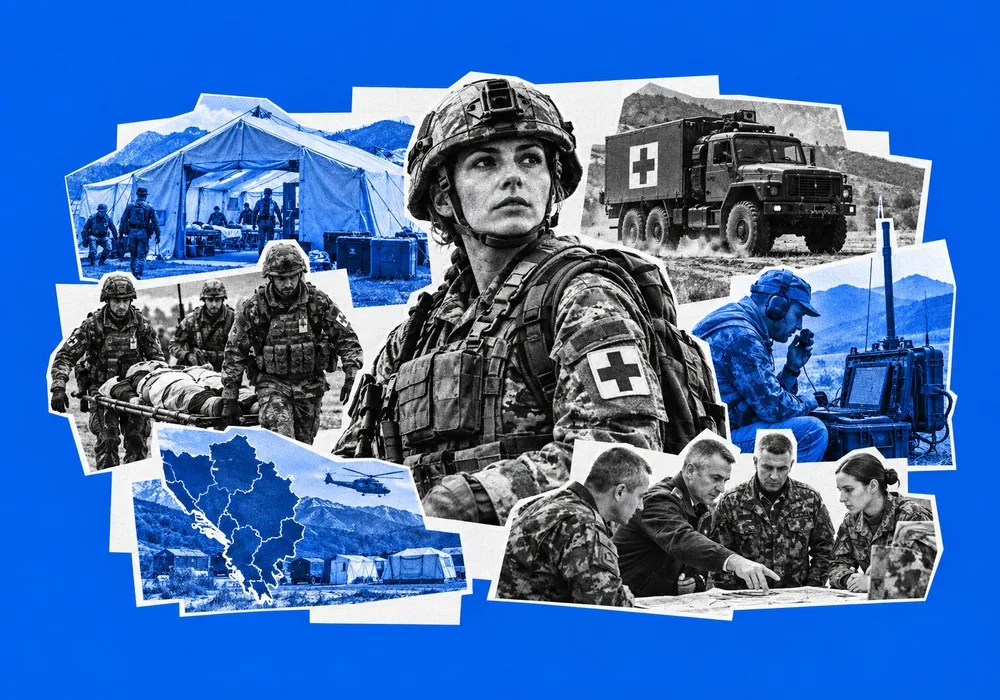
The EU has approved €10 million in new European Peace Facility support for the Balkan Medical Task Force, strengthening a joint military medical capability involving six Western Balkan countries. Beyond medical equipment, the programme is building regional interoperability, disaster-response capacity and practical security cooperation between EU and non-EU states.
The European Union is expanding its security engagement in the Western Balkans through a new €10 million package for the Balkan Medical Task Force (BMTF), using the European Peace Facility to strengthen a regional military capability that brings together Albania, Bosnia and Herzegovina, Montenegro, North Macedonia, Serbia and Slovenia. Approved by the Council of the EU on 2 October, the assistance will finance field hospitals, military medical vehicles, communications and information systems, as well as related technical support and maintenance. It brings the EU’s total support for the BMTF through the European Peace Facility to €16 million.
The significance of the decision extends beyond military medicine. The BMTF is designed to combine national capabilities into a deployable regional structure that can respond to military operations, humanitarian emergencies and major natural or man-made disasters. By investing in equipment that can be used jointly, the EU is strengthening not only individual armed forces but also the ability of countries across the region to operate under common procedures and standards. This makes the programme part of a broader effort to build practical interoperability in a region where security cooperation has traditionally been constrained by political divisions.
Building regional capabilities rather than isolated national assets
The latest funding continues a process that has been developing over several years. Previous European Peace Facility assistance provided the BMTF with communications equipment, medical capabilities, transport and field-hospital infrastructure. The EU has therefore not created a new mechanism through the latest decision but is expanding an existing regional capability that is increasingly able to operate across national borders.
That distinction matters for the Western Balkans. Individual states in the region have limited defence resources, while large-scale emergencies can quickly exceed national capacities. A shared medical structure allows equipment, personnel and expertise to be pooled rather than duplicated across six separate systems. The same principle applies to training and command procedures: the more the participating militaries practise operating together, the easier it becomes to deploy a coordinated response when a crisis crosses borders.
The BMTF also connects military preparedness with civilian resilience. Its capabilities can be used during natural disasters and other emergencies in which military medical infrastructure may be required to supplement civilian services. The result is a form of security investment that serves several purposes simultaneously: strengthening armed forces, improving emergency response and creating permanent channels of regional cooperation.
A practical layer of European integration
Five of the six BMTF participants are outside the European Union, while Slovenia is an EU member. The new assistance is therefore another example of Brussels developing practical security links with candidate and partner countries before formal accession takes place. The European Peace Facility has increasingly become one of the instruments through which the EU can build those links, providing equipment and training while encouraging partner countries to develop compatible capabilities.
This creates a parallel dimension to the enlargement process. Formal accession depends on political, institutional and economic reforms, but security cooperation can advance at a different pace. Joint exercises, compatible communications systems, common medical procedures and shared operational experience create forms of integration that do not require countries to wait for membership.
For the EU, this is particularly relevant in the Western Balkans because the region remains strategically connected to the Union even where accession negotiations are moving at different speeds. Strengthening practical cooperation allows Brussels to increase the resilience of the region without relying exclusively on the much slower political process of enlargement.
The Serbia factor
Serbia’s participation gives the BMTF an additional regional dimension. Belgrade remains outside the EU and maintains a foreign-policy position that differs in important respects from several other Western Balkan states. Yet Serbia participates in the same military medical structure alongside EU member Slovenia and countries pursuing closer Euro-Atlantic integration.
The BMTF therefore provides one of the relatively limited institutional spaces in which regional cooperation can continue despite wider political differences. Its focus on medical capabilities, disaster response and operational readiness makes it possible to develop practical cooperation without requiring the participating states to resolve their broader foreign-policy disagreements.
This does not remove the political divisions within the region. Instead, it creates a technical and operational layer in which cooperation can be maintained even when relations between governments remain complicated. For the EU, supporting such mechanisms provides an additional way of reinforcing regional connectivity without attempting to settle every political dispute through the same institutional process.
Connecting EU and NATO security structures
The development of the BMTF also reflects the growing overlap between EU-supported security initiatives and wider Euro-Atlantic standards. The task force has been developing its interoperability through joint exercises and medical training, including engagement with NATO standards and procedures. This matters because the ability of regional forces to operate alongside European and NATO partners increasingly depends on technical compatibility rather than simply political alignment.
Military medical capabilities are particularly suited to this approach. Field hospitals, evacuation procedures, communications systems and medical logistics can be standardised and tested through exercises, creating capabilities that can be integrated into larger international operations when required. The €10 million package therefore contributes to a wider infrastructure of interoperability rather than simply adding equipment to national inventories.
The Western Balkans are consequently becoming part of a more interconnected European security system in which the boundaries between national defence, regional crisis response and broader Euro-Atlantic cooperation are becoming less distinct. The BMTF is a relatively small component of that system, but it illustrates how integration can be built through practical capabilities rather than political declarations alone.
The European Peace Facility as a long-term security instrument
The decision also highlights the changing role of the European Peace Facility itself. Established as an instrument of the EU’s external security and defence policy, the mechanism has become a major channel for strengthening the military capabilities of partner countries. Its role is not limited to major weapons deliveries: investments in communications, mobility, medical infrastructure and training can be equally important for creating forces that are capable of sustained operations.
For the Western Balkans, this approach is particularly relevant because defence capacity remains uneven across the region. Supporting a multinational structure allows the EU to achieve a regional effect from relatively targeted investments. Instead of financing six entirely separate national systems, Brussels is helping create a capability that can be shared and deployed collectively.
This also fits a broader European shift towards resilience. The security environment surrounding the EU increasingly requires governments to prepare not only for conventional military threats but also for disasters, infrastructure disruptions, mass-casualty events and other emergencies that can overwhelm individual national systems. Military medical capacity sits directly at the intersection of these requirements.
From security recipient to regional security contributor
The longer-term significance of the BMTF lies in its potential to change how the Western Balkans participate in European security. Rather than treating the region solely as a recipient of external assistance, the model seeks to build capabilities that allow its countries to contribute to international missions, humanitarian operations and regional crisis response.
That shift is important for the EU’s broader approach to the region. A more capable Western Balkans reduces reliance on external emergency assistance while giving European institutions additional partners with which to manage crises. The objective is therefore not simply to make individual militaries better equipped, but to create a regional network capable of generating security capacity itself.
The new €10 million package should consequently be viewed as part of a longer-term process rather than as a standalone funding decision. By supporting shared infrastructure, common standards and multinational training, the EU is embedding practical security cooperation into a region where political integration remains incomplete.
The Western Balkans are thus becoming increasingly integrated into Europe’s security architecture through mechanisms that operate alongside, rather than entirely through, the formal enlargement process. The BMTF illustrates this approach particularly clearly: a military medical initiative is being used to build interoperability, strengthen disaster resilience and maintain cooperation across political boundaries. For Brussels, that makes regional security cooperation another pathway through which European integration can advance before the institutional map of the Union itself changes.
Sources: Council of the EU, Balkan Medical Task Force