
French Navy Seizes More Than 8.6 Tonnes of Drugs in Caribbean and Atlantic Operations

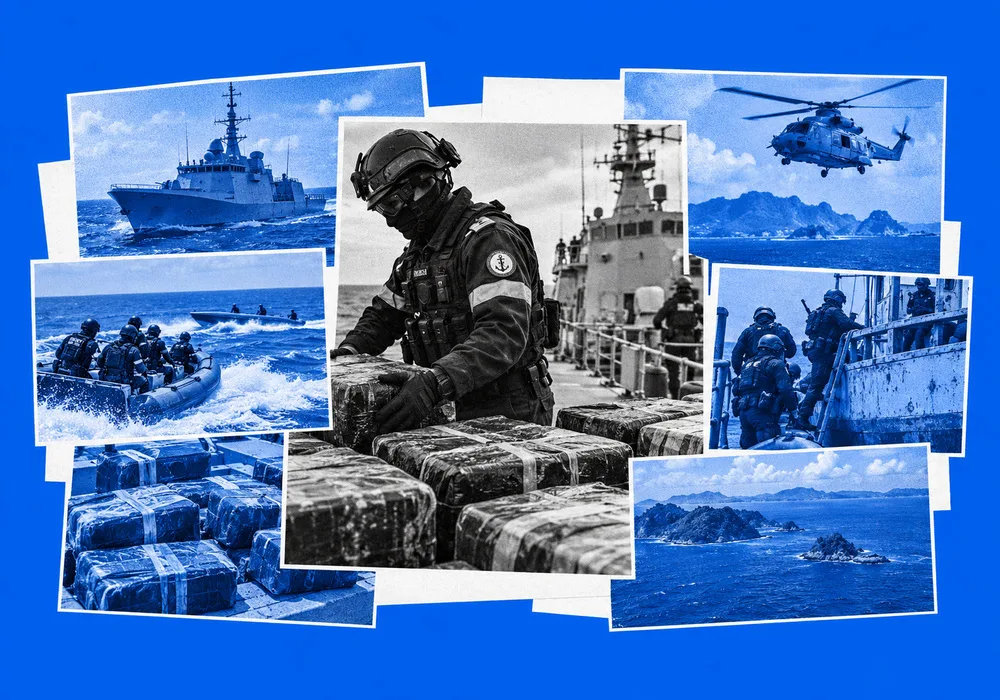
French naval forces intercepted more than 8.6 tonnes of narcotics during three operations conducted in the Caribbean Sea and Atlantic Ocean in early October. The seizures, carried out in coordination with international partners, included nearly 6.9 tonnes of cocaine and 1.7 tonnes of marijuana, highlighting the scale of maritime drug trafficking across routes connecting the Americas and the Atlantic.
The French Navy seized more than 8.6 tonnes of narcotics during three operations in the Caribbean Sea and Atlantic Ocean between 4 and 13 October. The seizures comprised approximately 6.9 tonnes of cocaine and 1.7 tonnes of marijuana. Conducted by two French naval vessels in coordination with partner countries and French law-enforcement services, the operations targeted three different vessels: a high-speed boat, an unflagged fishing vessel making a transatlantic crossing and a Venezuelan fishing boat.
The largest interception took place on 8 October in the Atlantic Ocean, where a French naval vessel stopped an unflagged fishing boat beginning a transatlantic journey. A boarding team discovered 150 bales containing approximately 5,292 kilograms of cocaine. The crew and cargo were subsequently transferred to Fort-de-France, the capital of Martinique, at the request of the public prosecutor. Five people were placed in police custody, and the investigation was entrusted to the Caribbean branch of France’s Office for Combating Narcotics Trafficking (OFAST).
The other two operations took place in the Caribbean. On 4 October, a French frigate, supported by its onboard helicopter and working with the Colombian Navy, intercepted a high-speed vessel travelling without a flag. Sixteen bales of cocaine were discovered on board. On 13 October, French forces intercepted a Venezuelan fishing vessel carrying 166 bales containing cocaine and marijuana. Together, these two operations accounted for 1,589 kilograms of cocaine and 1,727 kilograms of marijuana. The vessels, crews and seized cargo were handed over to the competent Colombian and Venezuelan authorities for further legal proceedings.
The three interceptions demonstrate how maritime trafficking can involve different types of vessels and operating methods within the same geographical corridor. Speedboats can be used for rapid transport over shorter distances, while fishing vessels can carry larger consignments across longer routes. The Atlantic interception was particularly significant because the vessel was preparing to cross the ocean, illustrating the potential for maritime shipments to connect the production areas of Latin America with markets farther afield.
Why the Caribbean and Atlantic Matter to European Security
The Caribbean and Atlantic occupy an important position in international cocaine trafficking because they connect major production areas in South America with transit points in the Caribbean, West Africa and Europe. Cocaine produced in Colombia, Peru and Bolivia can move through complex supply chains involving intermediaries, maritime transport and distribution networks operating in multiple countries. The routes are not fixed: traffickers can change departure points, vessels and transit locations in response to enforcement activity.
The Atlantic presents a particular challenge for maritime surveillance. Its vast distances make it difficult to monitor every vessel continuously, and enforcement agencies must combine intelligence gathering, patrols, aerial surveillance and cooperation with other countries to identify suspicious shipments. A vessel may travel through waters where several jurisdictions or legal frameworks are relevant, making the authority to board, search and detain it an important part of an operation.
The interception of the unflagged fishing boat on 8 October illustrates this legal dimension. Under Article 110 of the United Nations Convention on the Law of the Sea, warships may exercise a right of visit in specified circumstances, including when there are reasonable grounds to suspect that a vessel is without nationality. The two Caribbean operations involved different legal arrangements and cooperation with the countries concerned. In the case of the Venezuelan vessel, the inspection was conducted with the flag state's agreement. These distinctions matter because maritime interdiction depends not only on operational capacity but also on compliance with international law.
France's position in the region gives its naval forces a continuing role in these efforts. Martinique and Guadeloupe are French overseas territories in the Caribbean, while French military and state services operate across a wider maritime area. This presence enables France to contribute to regional enforcement and coordinate with neighbouring states. It also means that trafficking routes in the Caribbean are not solely a distant foreign-policy concern: they intersect with France's own maritime responsibilities and the security of its overseas territories.
International Cooperation Is Central to Interdiction
The French authorities said the October seizures were made possible through coordination with Colombia, the United States, the Netherlands, the United Kingdom and Venezuela. The range of partners reflects the transnational character of the trafficking networks and the need to connect maritime enforcement with information and legal authority across national borders.
No single country can effectively monitor the entire route from South American departure points to destinations across the Atlantic. A successful interception may depend on intelligence collected in one country, surveillance provided by another and a naval vessel positioned to stop the suspected shipment. Once a vessel has been boarded, investigators must also determine which authorities have jurisdiction, where the suspects should be prosecuted and how evidence can be preserved for legal proceedings.
The October operations show the different forms this cooperation can take. The French frigate's interception of the high-speed vessel involved direct assistance from Colombia's Navy, while the Venezuelan fishing boat was transferred to the relevant national authorities after inspection. The larger Atlantic seizure, by contrast, resulted in the crew and cargo being brought to Martinique, where French investigators took charge of the case.
This division of responsibilities is important because seizing narcotics is only one stage in disrupting trafficking. Investigators need to establish who organised the shipment, who financed it, where the drugs originated and which networks were expected to receive the cargo. The detention of five crew members after the Atlantic interception provides a starting point for a judicial investigation, but the available information does not establish their roles within any wider criminal organisation or the eventual outcome of the case.
Seizures Disrupt Supply, but Do Not Measure the Entire Market
The confiscation of more than eight tonnes of narcotics represents a substantial disruption to the shipments involved. Removing such cargo from circulation prevents those particular consignments from reaching their intended destinations and gives law-enforcement agencies an opportunity to investigate the people and logistics behind them. Large seizures can also provide evidence about trafficking methods, including the vessels used and the way cargo is transported.
However, the volume seized in a particular operation should not be treated as a direct measure of the total quantity moving through a region. Seizure figures reflect the cargo that authorities successfully intercept, not all shipments that pass through maritime routes. They cannot, on their own, establish whether overall trafficking is increasing or decreasing, how much reaches European markets or what proportion of the trade has been disrupted.
The distinction is important when assessing the wider significance of the French operations. Three successful interceptions within ten days demonstrate that naval forces and their partners were able to detect and stop several shipments, including one carrying more than five tonnes of cocaine. They do not establish the total scale of undetected trafficking or the long-term effect on criminal networks.
The operations nevertheless illustrate why maritime enforcement remains an important component of Europe's wider response to organised crime. Cocaine trafficking is sustained by interconnected production, transport, wholesale distribution and financial networks. Naval patrols can disrupt the transport stage, while police investigations, customs enforcement and financial inquiries are needed to pursue the organisations that arrange shipments and convert criminal proceeds into assets.
France's Maritime Role Extends Beyond the Caribbean
France's October seizures fit into a broader pattern of naval activity against drug trafficking across the Atlantic. French military forces have repeatedly participated in operations targeting vessels suspected of carrying cocaine, supported by intelligence and cooperation with other countries. In August 2026, Le Monde described French naval patrols in the Atlantic as part of efforts to intercept drug shipments travelling between Latin America and Europe, highlighting the importance of surveillance and intelligence in identifying vessels far from shore.
For France, these operations combine several responsibilities: protecting its maritime approaches, supporting law enforcement in its overseas territories and contributing to international efforts against organised criminal activity. They also demonstrate the practical role of naval assets outside conventional military missions. Frigates, helicopters, patrols and trained boarding teams can be deployed to identify and inspect suspected trafficking vessels, while civilian authorities handle the subsequent investigation and judicial process.
The broader European implications lie in the connection between overseas maritime routes and security on the continent. Drugs intercepted before reaching destination markets cannot enter the next stages of the distribution chain through those shipments. Yet sustained pressure on trafficking networks requires more than isolated seizures. Cooperation between naval forces, police, customs authorities and prosecutors must continue across the jurisdictions through which the drugs and the people moving them travel.
The three operations in October demonstrate the value of that coordinated approach. The French Navy removed more than 8.6 tonnes of narcotics from vessels operating across the Caribbean and Atlantic, with partner countries helping to support the interceptions and subsequent legal proceedings. The longer-term impact will depend on whether the investigations can identify the networks behind the cargo and whether continued international enforcement can make maritime trafficking more difficult, costly and vulnerable to disruption.
Sources: TF1 Info, Mer et Marine