
Ukraine and Moldova’s EU Accession Timelines Diverge: Key Takeaways from the 2026 Enlargement Package

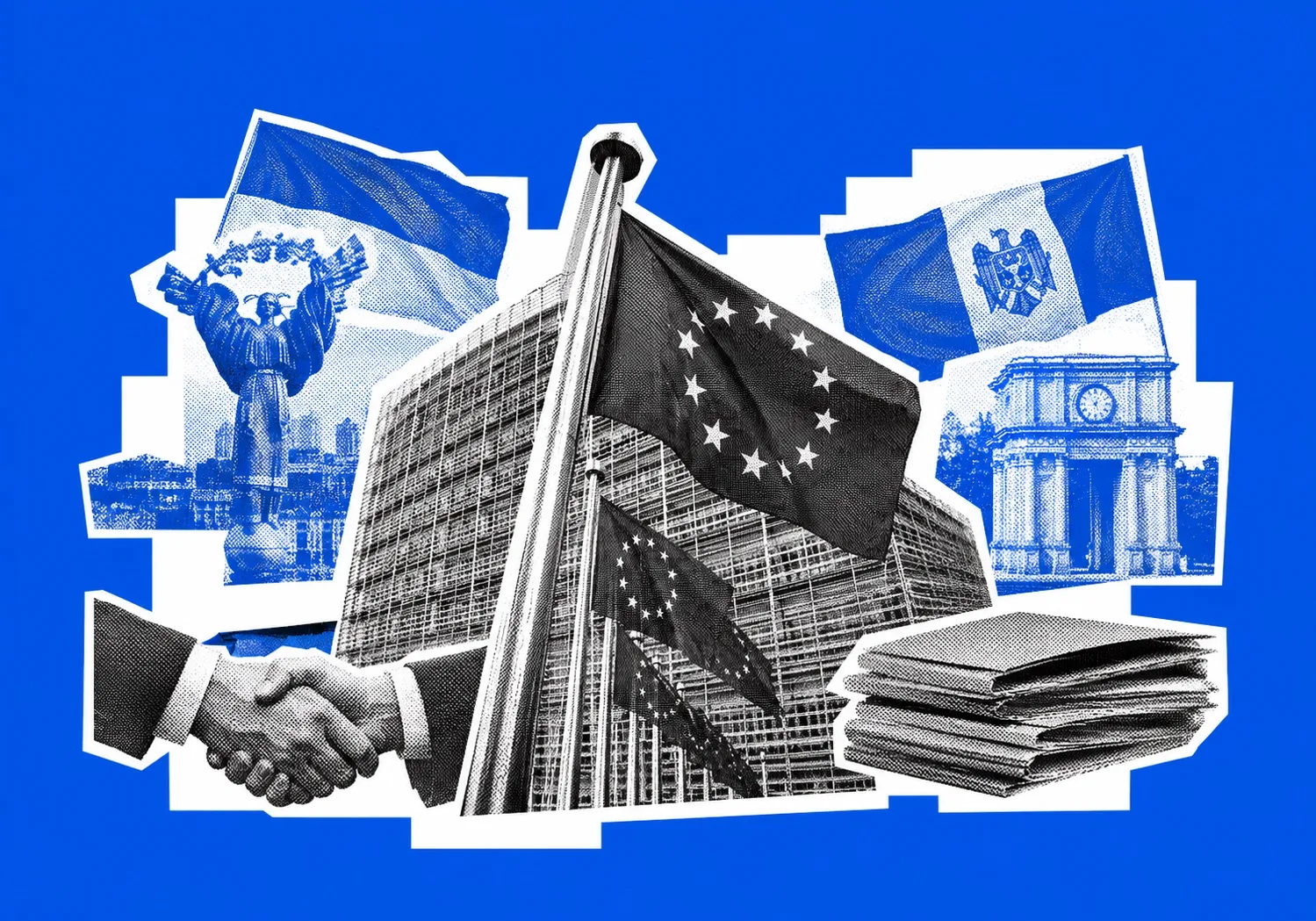
The European Commission’s 2026 enlargement package sets contrasting roadmaps for Ukraine and Moldova, targeting over 20 negotiating chapters for Chisinau compared to seven for Kyiv by 2027. Here is why Brussels is taking a performance-based approach to Ukraine’s EU membership timelines rather than offering a fixed accession date.
According to Politico’s reporting on the Commission’s roadmap, Brussels has avoided committing to a specific date for Ukrainian membership. Instead, the document establishes measurable targets, placing particular emphasis on judicial standards, democratic institutions and the rule of law.
The approach creates a delicate balance. European leaders regard Ukraine’s integration as part of the continent’s long-term security architecture, but accession cannot be delivered through political declarations alone. It requires extensive legislative changes, institutional safeguards and agreement among existing member states.
For Kyiv, the immediate challenge is therefore no longer simply demonstrating its European ambitions. It is translating those ambitions into reforms that can withstand detailed scrutiny.
Seven chapters, no membership deadline
The Commission’s proposed roadmap identifies seven areas in which Ukraine could provisionally conclude negotiations during 2027.
Education and culture are targeted for the first half of the year. The second half would cover intellectual property, employment and social policy, industrial policy, scientific research, external relations, and foreign and security policy.
These targets represent intermediate stages rather than a promise of membership.
The distinction matters because EU accession negotiations involve extensive examination of a candidate’s legislation, administrative capacity and ability to implement European rules. Closing individual chapters does not automatically resolve outstanding requirements elsewhere.
The Commission has also established a more immediate condition: Ukraine must substantially accelerate reforms related to the rule of law.
According to the roadmap details reported by Hromadske, key requirements in this area must be fulfilled during the first half of 2027 to enable the provisional closure of individual chapters.
This places judicial independence, anti-corruption safeguards and the functioning of democratic institutions at the centre of the process.
The Commission’s official 2026 enlargement assessment acknowledges that Ukraine has continued implementing sectoral reforms despite Russia’s invasion. It also describes the country’s specialised anti-corruption institutions as generally operating independently and effectively.
Nevertheless, Brussels is demanding faster progress on outstanding requirements.
The Commission recognises Ukraine’s ambition to conclude accession negotiations by the end of 2028, but considers further acceleration necessary to make that objective achievable. It has not committed the EU to admitting Ukraine in that year.
The absence of a fixed accession date is therefore not equivalent to abandoning the membership process. It preserves the principle that progress depends on meeting agreed conditions rather than following a predetermined political timetable.
Moldova’s faster track changes the political equation
One of the most consequential aspects of the roadmap is the growing difference between Ukraine and Moldova.
Both countries received EU candidate status in June 2022 and formally began accession negotiations in June 2024. Their applications subsequently advanced through several major stages in parallel.
That shared trajectory remained visible as recently as October 13, 2026, when the Council of the European Union confirmed that both countries had opened negotiations on two additional clusters covering 17 chapters.
The latest roadmap, however, suggests that their progress may become increasingly differentiated.
While Ukraine has been assigned seven potential chapter closures for 2027, Moldova could provisionally conclude negotiations in more than 20 areas, according to the Commission document cited by Politico.
The Commission’s official assessment also states that Moldova has intensified its alignment with EU legislation and made substantial progress towards meeting the interim benchmarks under the fundamentals cluster.
Brussels considers Moldova’s objective of concluding accession negotiations by early 2028 ambitious but achievable, provided its reform momentum continues.
This does not mean Moldova has secured an accession date or that its membership is guaranteed to precede Ukraine’s. Negotiation targets are not final decisions, and each candidate must still satisfy the relevant conditions.
However, the divergence has political implications.
For years, the two countries’ accession journeys have been closely associated with the EU’s response to Russian aggression and pressure in Eastern Europe. Allowing them to advance at different speeds would demonstrate that their applications are being assessed increasingly on individual performance.
Such an approach could strengthen the credibility of the accession process by rewarding demonstrable reforms. At the same time, it risks creating political frustration in Ukraine if the country’s wartime circumstances are perceived as slowing its European integration.
Brussels must therefore distinguish between recognising Ukraine’s exceptional security challenges and relaxing the institutional requirements expected of future members.
What Europe expects to gain from Ukraine’s membership
The European Union’s interest in Ukrainian accession extends beyond the question of solidarity with a country resisting Russian aggression.
In its 2026 enlargement package, the European Commission explicitly presents enlargement as an investment in collective security, political stability and economic prosperity.
For Europe, Ukraine’s eventual membership could serve several strategic purposes.
The first is security. Integrating Ukraine into European political and economic institutions would strengthen its long-term connections with the EU and potentially reduce the space for renewed Russian influence.
Ukraine also brings substantial experience in defending against conventional military attacks, drone warfare and other security threats. Closer institutional cooperation could allow European governments to draw more systematically on that experience, particularly as they reassess their own defence capabilities.
However, EU membership and NATO membership are fundamentally different arrangements. Joining the Union would not automatically provide Ukraine with NATO-style collective defence guarantees.
The second consideration is economic.
Ukraine possesses significant agricultural resources, industrial capacity and opportunities for post-war reconstruction. Its eventual participation in the single market could create new possibilities for European businesses, infrastructure investment and cross-border production.
At the same time, integration would require careful management.
Ukraine’s agricultural sector, for example, could affect competition within the EU’s existing market. Its reconstruction needs and potential eligibility for European funding would also raise questions about future spending priorities and the distribution of financial resources.
For Brussels, these are not arguments against enlargement. They are reasons to prepare the Union’s policies and budget before accession takes place.
A third consideration concerns Europe’s geopolitical influence.
Bringing Ukraine into the EU would extend the Union’s institutional reach across a strategically important part of Eastern Europe. It would also demonstrate that European integration remains possible despite sustained military and political pressure from Russia.
Yet this geopolitical ambition creates a tension: the EU wants enlargement to reinforce its security, but it must also ensure that new members can participate effectively in its institutions.
Why Brussels is reluctant to promise a date
The Commission’s caution reflects the complexity of enlargement itself.
Ukraine must meet the requirements of the accession process, but the EU must also prepare for the consequences of admitting a large country whose economy, infrastructure and institutions have been affected by years of war.
Questions surrounding agricultural policy, regional development funding, institutional representation and future budget allocations will require negotiations among existing members.
There is also the issue of political consent.
Even if Ukraine completes its technical negotiations, accession would still require an agreement approved and ratified through the EU’s established procedures.
That means progress in Kyiv cannot independently determine the final date of membership.
The Commission’s refusal to establish a binding deadline therefore protects against a potential mismatch between political expectations and institutional readiness.
It also preserves flexibility. The roadmap is designed to be updated as reforms advance, allowing Ukraine to complete negotiations in additional areas earlier if the necessary conditions are met.
Brussels has already indicated that Ukraine meets the requirements for opening its remaining negotiating clusters, covering the green agenda and sustainable connectivity, as well as resources, agriculture and cohesion.
Opening those clusters would expand the scope of negotiations, although it would not remove the need to satisfy the benchmarks required for their eventual closure.
The next test for Kyiv and Brussels
The immediate focus now shifts towards the first half of 2027.
Ukraine will need to demonstrate measurable progress on the rule of law while continuing to align its legislation with European standards across multiple policy areas.
The Commission has established a dedicated task force to provide additional support to Ukrainian authorities, acknowledging the exceptional administrative and political pressures created by the war.
For Kyiv, this assistance creates an opportunity to accelerate reform implementation without waiting for the end of hostilities.
For Brussels, the challenge is different: maintaining a credible, rules-based accession process while ensuring that enlargement continues to serve Europe’s strategic interests.
The contrasting roadmaps for Ukraine and Moldova illustrate how these priorities are beginning to shape practical decisions.
Moldova’s faster projected progress does not necessarily diminish Ukraine’s prospects. But it demonstrates that political alignment with Europe, however significant, is not sufficient to determine the speed of accession.
The next year will test whether the EU can combine differentiated reform requirements with a coherent regional strategy – and whether Ukraine can turn its geopolitical importance into sustained institutional progress.
The Commission’s roadmap leaves the ultimate membership timetable open. What it makes increasingly clear is that the future of enlargement will depend not only on how quickly candidate countries adapt to the European Union, but also on how effectively the Union prepares to accommodate them.
Sources: Politico, Hromadske, European Commission, Council of the European Union