
Kyrgyzstan Threatens to Nationalize Gazprom Assets as Russia’s Grip on Central Asia Weakens

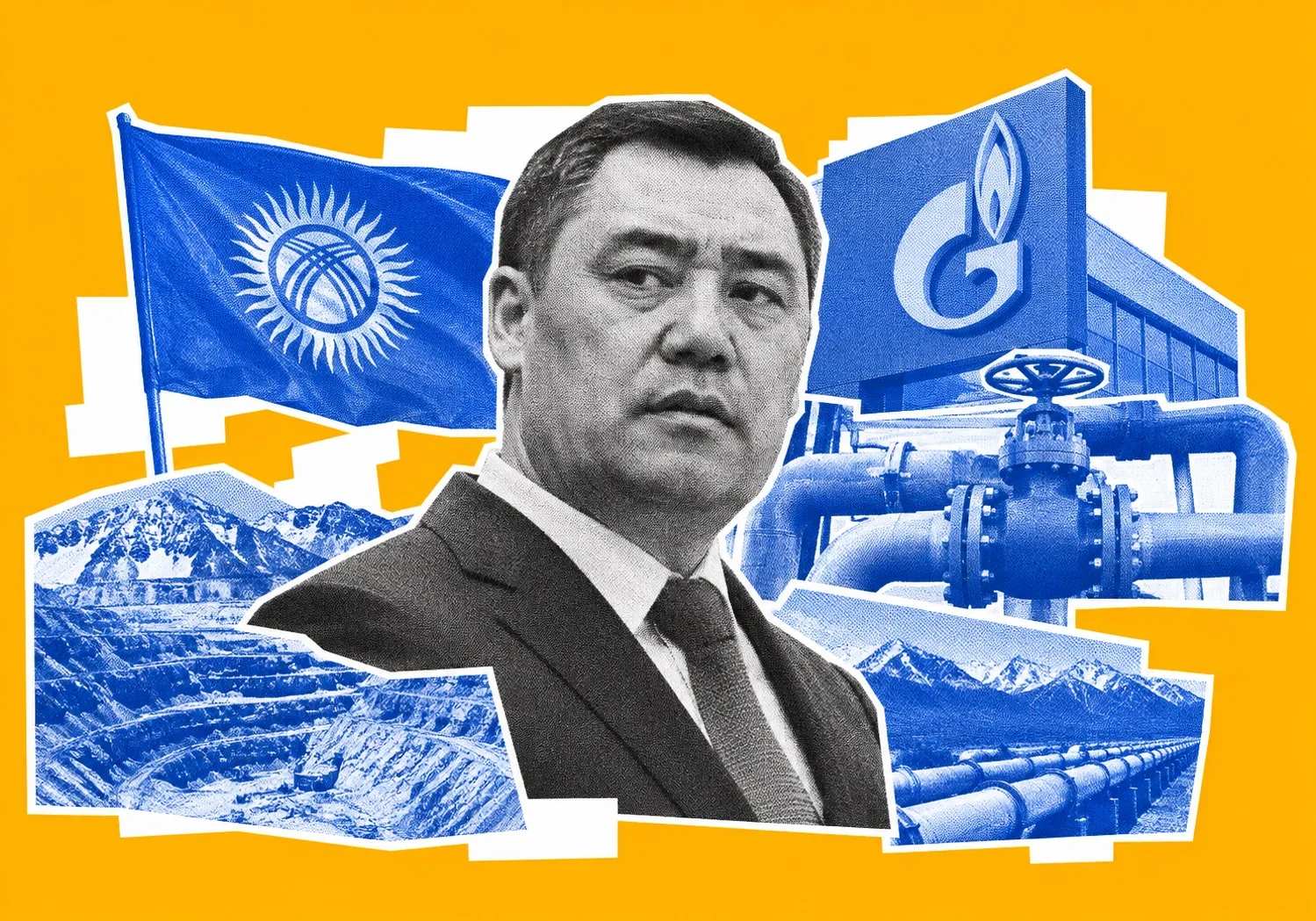
President Sadyr Japarov has warned that Kyrgyzstan could reclaim its natural gas grid from Russia’s state-owned Gazprom. The move signals growing friction between Moscow and Central Asian states over sovereign control of critical energy infrastructure.
The warning, delivered on 3 November during a meeting with residents of the Talas region, directly challenges an arrangement that has given the Russian energy company control over Kyrgyzstan's gas transmission and distribution infrastructure for more than a decade.
It also invokes a precedent that foreign investors in the country know well: Kumtor, the major gold mine that passed into Kyrgyz state ownership following a confrontation with its Canadian operator.
For Moscow, the dispute raises a broader question. Can Russia continue to exercise influence through strategic infrastructure ownership when the governments hosting those assets begin demanding greater control over their economic development?
A Local Gas Complaint Becomes a National Ownership Dispute
The confrontation began with an ordinary request from a resident.
During Japarov's meeting with communities in the Aitmatov and Manas districts, Kurmanbek Takeev, from the village of Semetey, asked the president to extend natural gas supplies to the border district of Manas.
Japarov's response was unusually explicit about the limits of his government's authority.
As reported by Kaktus Media, the president explained that Kyrgyzstan could not independently decide where to build new gas networks because Gazprom owned the infrastructure.
The arrangement dates back to an agreement negotiated in 2013 and implemented the following year, when the Russian company acquired the country's national gas operator for a symbolic $1.
At the time, the transaction was presented as a solution to Kyrgyzstan's ageing infrastructure, accumulated debts and need for investment.
But Japarov now argues that the Russian company has not fulfilled the gasification commitments attached to the agreement.
He said he had been raising the issue with Gazprom for two or three years, warning that continued inaction could result in the state reclaiming the network.
The president compared his proposed response to the government's handling of the Kumtor gold mine, signalling that the threat was not merely about negotiating a new construction timetable.
However, no formal decision to nationalise Gazprom's Kyrgyz assets was announced. The president also acknowledged that, while the infrastructure remains under the company's control, he cannot independently promise residents new gas connections.
The $1 Agreement That Gave Gazprom Control
The roots of the dispute lie in one of the most consequential energy agreements between Russia and Kyrgyzstan.
In July 2013, the two governments signed an agreement covering cooperation in natural gas transportation, distribution and sales. The transfer of the Kyrgyz gas operator was completed in April 2014.
Gazprom acquired the company that became Gazprom Kyrgyzstan, gaining control of the country's gas transmission and distribution networks.
The purchase price was just $1, but the nominal figure concealed a much larger set of financial commitments.
According to the Kyrgyz government's official account of the transaction, Gazprom guaranteed at least 20 billion roubles in infrastructure modernisation investment over five years.
The company also agreed to assume debts of approximately $40 million.
In return, Kyrgyzstan granted Gazprom exclusive rights to import natural gas and provided contractual protections against expropriation and nationalisation.
The agreement was established for 25 years, making 2039 an important endpoint for the original arrangement.
These terms are central to the current confrontation.
For Kyrgyzstan, the original bargain exchanged control over strategic assets for the expectation of infrastructure development and reliable energy supplies.
For Gazprom, it secured a long-term position in a national energy market with substantial legal protections.
Japarov's warning suggests that the Kyrgyz government is increasingly questioning whether the benefits of that exchange justify its continued restrictions on domestic decision-making.
Yet the investment record is more complicated than a simple claim that nothing has been delivered.
The International Energy Agency's 2022 review of Kyrgyzstan found that national gasification had increased from 22% in 2014 to 35% by the end of 2020. Gazprom Kyrgyzstan was targeting 60% coverage by 2030.
Those figures show that the network had expanded after the takeover, even though substantial parts of the country remained without gas connections.
They do not, however, establish whether Gazprom has met every financial and construction obligation under its agreements. That distinction matters: Japarov's accusation concerns the fulfilment of contractual commitments, not necessarily the complete absence of investment.
Why the Kumtor Precedent Matters
Japarov's reference to Kumtor gives his warning particular significance.
The gold mine was one of Kyrgyzstan's largest industrial assets and had been operated by Canadian companies, initially Cameco and subsequently Centerra Gold.
In May 2021, Kyrgyz authorities introduced temporary external management at the mine after accusing its operator of environmental violations and unpaid taxes.
The dispute escalated into legal proceedings, with a court in Bishkek ordering compensation of approximately $3.1 billion for environmental damage.
Centerra challenged the government's actions through international arbitration.
In April 2022, the parties reached a settlement under which Centerra transferred its interests in Kumtor Gold Company and Kumtor Operating Company to Kyrgyz state-owned Kyrgyzaltyn, while the parties agreed to resolve their outstanding claims.
The transaction brought the strategically important mine under national control.
By invoking Kumtor, Japarov is reminding Gazprom that his government has previously pursued the recovery of a major foreign-operated asset.
But the comparison has limitations.
The Kumtor settlement emerged from a specific combination of environmental allegations, litigation, arbitration and negotiated ownership transfers. Gazprom's position is governed by a separate bilateral energy agreement containing protections against nationalisation.
Any attempt to reclaim its assets could therefore raise different legal and diplomatic questions.
The central uncertainty is whether Japarov intends to use the threat as leverage to accelerate investment or is prepared to pursue an actual change of ownership.
A Test of Russia's Infrastructure Influence in Central Asia
The dispute extends beyond Kyrgyzstan's domestic gas supply.
For decades, Russia has maintained economic influence across Central Asia through energy infrastructure, commercial agreements and long-standing institutional relationships.
Control of transmission networks can be particularly significant because it affects more than the purchase and sale of fuel. It also determines who makes investment decisions, which communities receive connections and how quickly infrastructure expands.
Gazprom's position in Kyrgyzstan illustrates that relationship.
Although Kyrgyz authorities retain regulatory responsibilities, ownership of the network places major infrastructure decisions in the hands of the Russian company.
The IEA's assessment of the country's energy sector describes Gazprom Kyrgyzstan as both the owner and operator of the gas transmission and distribution system and identifies the company as a regulated natural monopoly.
The same review explains that natural gas tariffs are governed by a framework linked to the bilateral agreement with Russia.
Consequently, a dispute over gasification also becomes a dispute over economic sovereignty: the ability of a government to determine how essential infrastructure is developed within its territory.
That does not automatically mean Kyrgyzstan is moving away from Russia politically.
The two countries retain extensive economic relationships, and Japarov has not announced a broader change in foreign policy.
Nevertheless, the willingness to publicly threaten a major Russian state-controlled company shows that strategic ownership does not necessarily protect an investor from growing demands by its host government.
What Would Happen if Kyrgyzstan Reclaimed the Network?
Reclaiming the gas infrastructure would create several immediate challenges.
The first is legal. Kyrgyzstan's agreement with Russia includes provisions intended to protect Gazprom's investment from expropriation and nationalisation. Any unilateral transfer could generate a dispute over treaty obligations, compensation and the terms of the original transaction.
The second is financial.
Ownership alone would not deliver new pipelines to communities still waiting for gas. The government would need to secure funding, organise construction, maintain existing networks and ensure reliable imports.
The third is operational.
Gazprom's role as infrastructure owner and exclusive gas importer means that changing ownership would require more than replacing the company's name on official documents. It could also require renegotiating the arrangements through which gas enters and moves around the country.
A negotiated solution might allow the government to obtain stronger investment commitments without immediately assuming these responsibilities.
An adversarial transfer, by contrast, could introduce uncertainty into infrastructure operations and future financing.
There is also a wider question for foreign investors.
The Kumtor experience demonstrated that the Kyrgyz government was willing to confront a major international operator over a strategic asset. A similar dispute involving Gazprom would concern a company closely associated with Russia's economic interests, adding a significant diplomatic dimension.
A Warning Moscow Cannot Ignore
For now, Japarov has issued a conditional warning rather than launched a formal nationalisation process.
There is no announced timetable for reclaiming the network, no publicly identified mechanism for transferring ownership and no confirmed settlement proposal.
The immediate dispute remains centred on gasification, particularly the communities that have waited for infrastructure promised under the original agreement.
But the political significance lies in the change of language.
An arrangement once promoted as a way to secure investment and energy stability is now being openly questioned by the president of the country that signed it.
The $1 acquisition gave Gazprom a powerful position in Kyrgyzstan's energy sector. Twelve years later, that position is being challenged over the obligations that made the original bargain acceptable.
Whether the confrontation leads to faster construction, renegotiated terms or a battle over ownership will depend on decisions that have yet to be announced.
For Russia, the immediate issue is a dispute involving one subsidiary and one national gas network. For the wider region, it raises a more enduring question about the balance between foreign infrastructure ownership and the right of Central Asian governments to set their own development priorities.
Sources: Kaktus Media, GK, International Energy Agency, IEA, Centerra Gold / SEC, Radio Free Europe/Radio Liberty