
Europe’s Direct Talks With Putin: Why Ukraine Faces an Impossible Choice

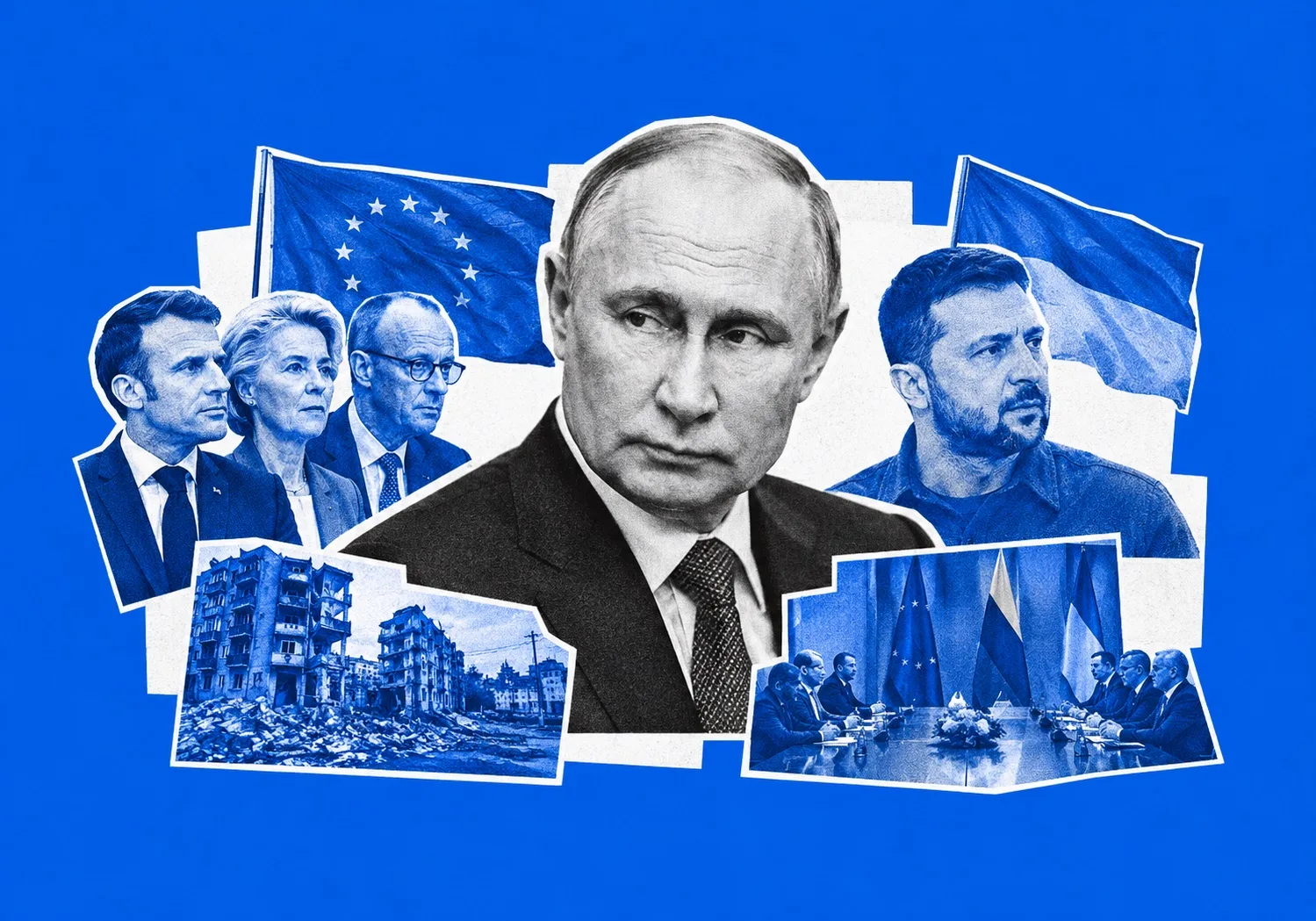
European capitals are weighing direct negotiations with Vladimir Putin amidst growing doubts over US strategy in Ukraine. As Europe prepares to negotiate and sustain a settlement on its own, Kyiv faces a dangerous dilemma: accepting territorial concessions or risking a peace without real security guarantees.
The discussions have exposed an uncomfortable question. If Ukraine cannot recover all its territory by military means, what price would Europe be prepared to accept for ending the fighting, and what security guarantees could make that price tolerable for Kyiv?
Two possible arrangements have entered the debate. One would freeze the front line in exchange for a binding commitment that Ukraine would never join NATO. The other would transfer the remaining Ukrainian-controlled parts of the Donbas to Russia in exchange for accelerated NATO membership.
Neither is an agreed European proposal, and there is no indication that Moscow would accept either. Their significance lies elsewhere: they reveal how far the debate is moving towards managing the limits of Western power rather than assuming that the war must end with the restoration of Ukraine’s 1991 borders.
Europe is preparing for an American retreat
The immediate driver is uncertainty in Washington. Under Donald Trump, American foreign policy has become harder for European governments to treat as a stable foundation for long-term security planning. Domestic political priorities, including the midterm elections, compete for attention, while transactional deal-making risks producing arrangements that serve short-term political objectives without resolving the underlying security problem.
For Kyiv’s European partners, the consequences are particularly serious. European financial and material assistance has increasingly become essential to sustaining Ukraine’s state and military as American support falters. The governments carrying more of the financial burden have stronger reasons to seek influence over the diplomatic outcome.
This creates a paradox. Europe has acquired greater responsibility for Ukraine’s survival, but that responsibility does not automatically translate into the military and political leverage required to determine the terms of peace.
Direct communication with Moscow offers a way to reduce dependence on Washington as the sole channel through which a settlement might be negotiated. It could allow European leaders to establish their own red lines, test Russia’s intentions, and prepare for the possibility that Trump pursues an agreement on terms that leave European security interests exposed.
Yet opening a channel is not the same as controlling the negotiations. Russia could exploit divisions between Washington and European capitals, encouraging each to compete for influence while offering little in return.
Moscow’s reported interest in a separate summit involving Trump and Chinese President Xi Jinping illustrates the broader contest over diplomatic status. Such a format could reinforce Russia’s claim to great-power standing while leaving both Ukraine and its European supporters outside the room. The summit remains speculative, but the underlying incentive is clear: the Kremlin benefits when the war is discussed as a dispute among major powers rather than an invasion of a sovereign state.
Europe’s challenge is therefore not simply to get a seat at the negotiating table. It is to prevent diplomatic participation from becoming an alternative to meaningful influence over the outcome.
The problem with trading territory for security
The proposed Donbas-for-NATO arrangement appears, at first glance, to offer a solution to the conflict’s central contradiction. Ukraine would surrender territory it has been unable to recover, while receiving the protection of an alliance whose collective defence commitment could deter another Russian attack.
But the formula assumes that the two sides value the same outcome differently enough to make a bargain possible. The available evidence points in the opposite direction.
Russia continues to demand that Ukraine withdraw completely from the Donbas and abandon its ambition of joining NATO. Its stated objectives therefore conflict with both European compromise scenarios. A territorial concession would not necessarily satisfy Moscow if the Kremlin continued to regard Ukraine’s integration into Western security structures as unacceptable.
For Kyiv, the exchange would also involve a fundamental question of sovereignty. NATO membership is not merely a diplomatic prize. It represents an attempt to replace the uncertainty of external political support with a formal collective defence commitment.
Giving up territory in return for accession would make strategic sense only if the guarantee were credible, durable and capable of deterring renewed aggression. Otherwise, Ukraine could incur an irreversible territorial loss without obtaining the security arrangement intended to justify it.
The military and political asymmetry matters. Russia could retain territory acquired through force, while Ukraine would have to trust that future Western governments would honour the commitments made in exchange. The value of that promise would depend not only on the wording of an agreement but also on the willingness of NATO members to defend it when doing so became costly.
Nor is there evidence that Moscow would accept Ukrainian membership even after a territorial transfer. The proposal risks treating Russia’s demands as a negotiable price for peace when they may instead reflect a wider ambition to constrain Ukraine’s independent foreign policy.
Kyiv cannot negotiate away public opinion
Any European diplomatic initiative will encounter a political constraint that cannot be resolved in Brussels or Washington: Ukrainian society has its own limits on what constitutes an acceptable peace.
Recent surveys cited in the briefing indicate that between 62 and 68 per cent of Ukrainian respondents reject formally transferring the remaining Ukrainian-controlled parts of the Donbas to Russia, even in exchange for security guarantees. Support for freezing the conflict along the existing lines is considerably broader, at 69 per cent, but conditional on not legally recognising occupied territories as Russian and continuing Ukraine’s integration into the EU and NATO.
The distinction is crucial. A ceasefire that postpones the question of territorial status is politically different from a settlement that formally relinquishes sovereignty. The first can be presented as a means of stopping the killing without abandoning Ukraine’s territorial claims. The second would require Ukrainians to accept that military aggression has permanently changed their country’s borders.
President Volodymyr Zelenskyy would face substantial domestic resistance to any attempt to make that trade. A nationwide referendum would be necessary for a decision of this magnitude, according to the political constraints outlined in the briefing. Even then, a vote would not automatically resolve the problem of legitimacy or guarantee that the outcome would be accepted across a society shaped by years of war.
For European governments, this means that a settlement cannot be designed solely around what Moscow might accept or what Washington might be willing to broker. An agreement that Kyiv cannot credibly implement at home is unlikely to deliver lasting stability.
The territorial question also carries consequences beyond the immediate negotiations. If a state under military attack is pressured to surrender land as the price of retaining access to Western security structures, the distinction between ending a war and rewarding aggression becomes harder to maintain.
A ceasefire need not settle the border
There is a significant difference between accepting that a military front may remain frozen and recognising the territorial claims of the state that crossed it.
A ceasefire could halt fighting along the existing line of contact without requiring Ukraine or its partners to recognise occupied territory as Russian. Such an arrangement would leave the legal dispute unresolved while creating space for diplomatic negotiations and reconstruction.
That distinction would need to be explicit. A political declaration alone would not necessarily prevent a future settlement from normalising territorial changes achieved through force. European governments would have to decide how to preserve Ukraine’s legal claims, how to treat the occupied territories in their own policies, and how to ensure that a temporary military arrangement did not gradually become permanent diplomatic acceptance.
The central difficulty is enforcement. A frozen conflict is not necessarily a stable peace. If Russia retains the ability to resume its offensive when conditions become favourable, the pause could serve as an opportunity to rebuild military capacity rather than a transition towards a durable settlement.
Previous diplomatic frameworks, including the Minsk agreements, have failed to overcome fundamental disagreements over sovereignty and security. Any new arrangement would therefore need more than a ceasefire declaration and promises of restraint. It would require credible monitoring, clear procedures for responding to violations, and a security framework that does not depend entirely on the political goodwill of the parties.
These are not technical details to be settled after the political agreement. They determine whether the agreement is worth making in the first place.
Europe needs a security guarantee it can deliver
If NATO membership is delayed or excluded from negotiations, European governments will face pressure to offer Ukraine an alternative. One possibility under discussion is a coalition of willing countries providing bilateral military commitments or other forms of support outside NATO’s formal collective defence framework.
Such arrangements could help sustain Ukraine’s military capabilities and raise the potential cost of another Russian attack. They might also allow participating governments to act without waiting for a unanimous alliance decision.
But bilateral guarantees are not automatically equivalent to NATO membership. Article 5 provides a collective defence framework, whereas commitments made by individual states would depend on their precise terms, available military capabilities and political willingness to respond in a crisis.
A coalition could also be vulnerable to changes of government and differences among its members over how much risk they are prepared to accept. The credibility of a guarantee would depend on whether Russia believed that an attack on Ukraine would trigger a sufficiently strong and coordinated response.
Europe’s financial support already gives it a substantial stake in Ukraine’s future. Yet the ability to fund a war effort and the ability to deter another war are not interchangeable. European governments would need to translate their economic commitment into a coherent military posture, sustained industrial capacity and clear decisions about what they would do if an agreement were violated.
This is where the diplomatic debate meets the longer-term problem of European defence. Seeking autonomy from Washington means accepting responsibility not only for negotiating an agreement but also for maintaining the security conditions that make it viable.
The limits of a settlement imposed from outside
The emerging debate is not evidence that Europe has abandoned Ukraine’s territorial integrity, nor does it establish that a negotiated settlement is imminent. The two proposed formulas remain hypothetical, and Russia’s stated demands make both difficult to reconcile with Moscow’s current position.
Their appearance nevertheless reveals a growing tension within Western strategy. European governments must prepare for the possibility that continued military support will not restore all Ukrainian territory, while ensuring that the search for a diplomatic exit does not leave Ukraine exposed to another attack.
Washington’s choices will shape the available options. If the Trump administration pursues a rapid settlement, European leaders may have to decide whether to support an agreement they did not design or resist it without sufficient American backing. If negotiations stall, they will still have to finance and sustain Ukraine’s defence while developing a more independent approach to European security.
Kyiv faces the harder immediate choice: whether to accept a military reality that may persist for years without conceding legal sovereignty, or to consider territorial compromises in exchange for guarantees whose durability cannot be taken for granted.
The most consequential question is whether Europe can make those guarantees credible before a settlement is imposed by others. A ceasefire that leaves Ukraine outside NATO, with its territory unresolved and its security dependent on future political decisions in Washington and European capitals, could end one phase of the war without removing the conditions for the next.