
Peace Talks Compete With Energy Interests as Russia and Ukraine Remain Far Apart

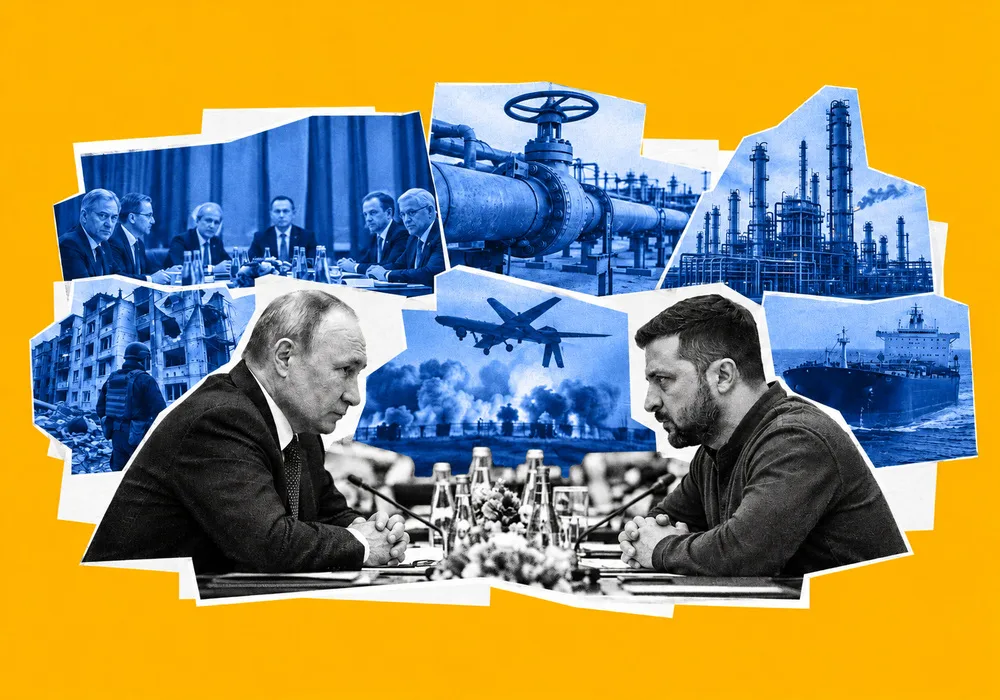
US-led negotiations in Miami have brought Ukrainian and European officials together to discuss security guarantees, reconstruction and a potential path towards ending Russia’s war. But Putin has questioned the immediate resumption of trilateral talks, while Washington’s decision to ease restrictions on Russian diesel supplies has raised concerns about the relationship between energy interests, sanctions and European security.
The United States has renewed diplomatic efforts to end Russia’s war against Ukraine, bringing Ukrainian and European representatives together in Miami while Moscow signals that an immediate resumption of trilateral negotiations is unlikely. The latest developments expose a central problem for the peace process: Washington is seeking a negotiated settlement, but disagreements over security, territory and the economic costs of the war continue to complicate the prospect of an agreement.
The diplomatic push has also coincided with a controversial US decision to ease restrictions on Russian diesel supplies, linking negotiations over European security with Washington’s efforts to address energy prices. At the same time, Ukraine’s long-range drone campaign against Russian targets continues, underscoring how military pressure and diplomacy are advancing in parallel rather than creating a clear path towards a ceasefire.
Miami Talks Focus on Security and Ukraine’s Postwar Future
US, Ukrainian and European officials met in Miami on 9 October to discuss proposals for ending the war. US special envoy Steve Witkoff described the discussions as constructive, with participants considering energy resilience, grain exports, security guarantees and longer-term arrangements intended to protect Ukraine and European security.
The agenda extended beyond a potential cessation of hostilities. Officials also discussed Ukraine’s postwar reconstruction, economic recovery and path towards EU membership, alongside a broader European security framework. These issues reflect the scale of the decisions any settlement would require: an agreement would have to address not only the immediate fighting but also the conditions under which Ukraine could rebuild and deter another Russian invasion.
The involvement of European governments, the European Commission and NATO is particularly significant because the consequences of a settlement would extend well beyond Ukraine’s borders. European states would face decisions over future defence spending, security commitments, reconstruction financing and the long-term management of relations with Russia.
Yet the talks have not produced a publicly confirmed breakthrough. Negotiators are reportedly working towards a unified proposal that could be presented to Moscow in the coming weeks, with Washington hoping to make progress before winter. Territorial questions remain among the most difficult obstacles, particularly Russia’s demands concerning the Donbas and Ukraine’s refusal to surrender territory it still controls.
Putin Cites Drone Attacks to Question the Return to Negotiations
The diplomatic initiative faces an immediate obstacle from the Kremlin. Following a telephone conversation with US President Donald Trump on 9 October, Russian President Vladimir Putin said that the immediate resumption of trilateral talks was unlikely, citing Ukrainian drone attacks on Moscow and other locations during Russia’s parliamentary elections in September.
According to Kremlin foreign policy aide Yuri Ushakov, Moscow had previously been prepared to resume negotiations after the elections. The Kremlin now says it will assess when talks could restart. Ukraine, meanwhile, has indicated its readiness to participate in a trilateral format with the United States and Russia. These statements establish a gap between Washington’s efforts to advance a negotiating framework and Moscow’s willingness to commit to a timetable.
The Kremlin’s explanation should also be understood in the context of the continuing war. Russia’s full-scale invasion of Ukraine began in February 2022, and the two sides continue to use military force while diplomatic efforts attempt to establish terms for ending the fighting. Drone strikes have become an increasingly important element of Ukraine’s campaign against Russian military and economic infrastructure, including oil facilities that help generate revenue for the Russian state.
Ukraine has used long-range drone operations to target oil refineries, pumping stations and other elements of Russia’s energy infrastructure. Kyiv presents these strikes as part of its efforts to disrupt Russian military logistics and reduce the revenue supporting the invasion. Moscow, by contrast, has cited Ukrainian attacks as an obstacle to diplomatic progress.
The dispute over when negotiations can resume therefore reflects more than a disagreement over the timing of a meeting. It highlights the challenge of reconciling military pressure with diplomacy when neither side has publicly accepted the other’s core conditions for ending the war.
Russian Diesel Deal Complicates Washington’s Position
The diplomatic discussions have been overshadowed by a separate agreement announced by Trump following his call with Putin. The US president said Russia would supply more than 300,000 tonnes of diesel to American and global markets, with additional volumes expected in November. Washington also moved to ease restrictions that had limited Russian fuel sales. The stated objective was to help bring down energy prices, but the decision has generated criticism in both the United States and Ukraine.
Ukrainian President Volodymyr Zelenskyy criticised the arrangement, arguing that revenue from Russian energy sales ultimately helps finance the war against Ukraine. He also questioned whether Ukrainian negotiators were being placed in a difficult position while Washington pursued an economic agreement with Moscow. The controversy creates a tension between two US policy objectives: seeking an end to the war through negotiations and securing energy supplies at lower prices.
For Europe, this distinction has direct strategic implications. Russian energy exports are not simply a commercial issue: revenue from oil and petroleum products helps sustain the Russian economy during wartime. Any relaxation of restrictions can therefore raise questions about the consistency of sanctions policy, the effectiveness of economic pressure and the incentives available to Moscow during negotiations.
The consequences are not limited to diplomatic relations. Changes in global diesel supply can affect transport, agriculture, industrial production and the cost of essential goods. European governments must weigh these market effects against their commitment to reducing Russia’s capacity to finance its war. Even if additional Russian supplies ease some price pressures, that does not in itself resolve the underlying security problem.
Europe’s Security Commitments Remain Central
The Miami discussions have placed European security arrangements alongside Ukraine’s reconstruction and EU accession. These are interconnected questions. Ukraine will require long-term financial support to rebuild damaged infrastructure and restore economic activity, while credible security guarantees will be essential to any settlement intended to prevent renewed Russian aggression.
For European governments, the central challenge is determining what such guarantees would mean in practice. Political assurances alone would leave questions about military assistance, air defence, intelligence cooperation, defence-industrial capacity and the response to a future Russian attack. The arrangements would also have to account for the possibility that a ceasefire could freeze the front line without resolving the territorial dispute.
The negotiations also come as European states face pressure to strengthen their own defence capabilities. A settlement that leaves Ukraine vulnerable could preserve the risk of another war and prolong uncertainty along the EU’s eastern frontier. Conversely, a durable agreement would require arrangements that protect Ukraine’s sovereignty and establish credible mechanisms for maintaining security after the fighting stops.
The involvement of France, Germany and the United Kingdom, alongside the European Commission and NATO, reflects the importance of these questions for the continent. But participation in negotiations does not guarantee that European governments will agree on the distribution of financial, military and political responsibilities.
Winter Raises the Cost of a Prolonged War
The approaching winter adds urgency to the diplomatic effort. Energy infrastructure, fuel availability and the resilience of essential services will remain critical concerns for Ukraine, while continued attacks risk increasing the humanitarian and economic costs of the war. For European countries, the prospect of another period of fighting also means continued pressure on defence budgets, energy markets and support for Ukraine.
US Secretary of State Marco Rubio has warned that the war has reached a dangerous stalemate and that a failure to reach a negotiated settlement could lead to further escalation, including risks for neighbouring NATO countries. His remarks underline Washington’s concern that the absence of diplomatic progress could carry consequences beyond the battlefield in Ukraine.
Nevertheless, urgency should not be confused with evidence of an imminent agreement. The Miami meeting produced discussions on security guarantees, reconstruction and economic arrangements, but Moscow’s public position points to continued uncertainty over the next round of trilateral negotiations. Territorial disagreements remain unresolved, and the controversy over Russian diesel supplies has added another source of friction between Washington and Kyiv.
The immediate test for the diplomatic process will be whether the parties can turn broad discussions into a proposal that addresses Ukraine’s security, the status of occupied territory and the mechanisms needed to enforce any eventual settlement. Until those questions are resolved, negotiations and military operations are likely to continue side by side, with the consequences extending across Europe’s security and economic landscape.
Sources: Al Jazeera