
European Security Force for Ukraine: UK and France Lead Major Drills in Poland

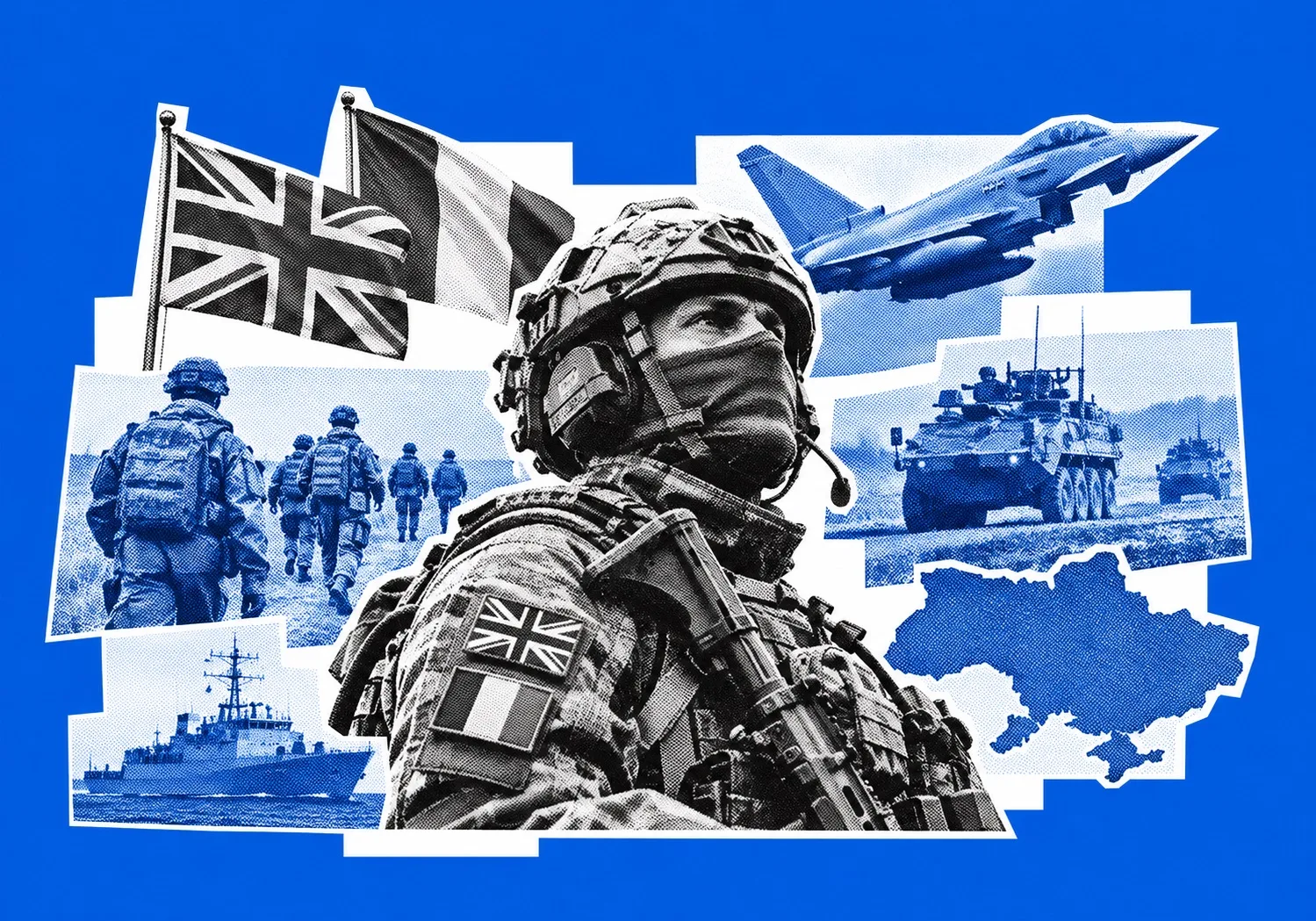
Britain and France are leading 2,800 European troops in Poland to test a post-war security force for Ukraine without relying on US combat forces. Exercise Koalicja, taking place at Nowa Dęba near the Ukrainian border, marks the first field test of the Multinational Force Ukraine (MNF-U) - a coalition designed to provide security guarantees once a ceasefire is reached.
The exercise comes before any agreed end to the war. That timing matters. European governments are building the military arrangements for a possible settlement while the political conditions for deploying them remain uncertain.
As the military component of the Coalition of the Willing - a grouping of approximately 36–40 countries supporting long-term security guarantees for Kyiv - the MNF-U's immediate task is not to enter Ukraine but to establish whether a multinational force could deploy, communicate, and sustain itself once authorised to do so.
That distinction may be straightforward on paper. Making it work is considerably harder.
A European force with a different mission
The proposed force would not be a conventional peacekeeping operation. It would neither patrol the front line nor monitor compliance with a ceasefire. Its mandate excludes offensive operations and direct involvement in combat.
Instead, the MNF-U is intended to help rebuild and train Ukraine's armed forces, support the reopening of Ukrainian airspace and maritime routes, and provide a continuing military presence intended to discourage renewed Russian aggression.
British Defence Secretary Wes Streeting has set out two conditions for deployment: a credible and verifiable cessation of hostilities, and an official request from the Ukrainian government.
Neither condition can be treated as a formality. A ceasefire may stop large-scale fighting without resolving the security risks facing foreign personnel. Nor would an invitation from Kyiv, by itself, remove the possibility of confrontation with Russian forces.
The proposed arrangement therefore occupies an unusual position. It is designed to strengthen Ukraine's military capabilities without assuming responsibility for enforcing the ceasefire that would permit its deployment.
For European planners, this narrows the mission and reduces the prospect of direct involvement in the war. For Ukraine, it offers a framework for rebuilding military strength rather than relying exclusively on outside forces to preserve a settlement.
It also leaves a difficult question unanswered: who would respond if hostilities resumed while coalition personnel were already operating inside the country?
Why the first test is in Poland
Nowa Dęba offers the coalition a place to confront practical deployment problems without sending troops into an active war zone.
The exercise will examine command arrangements, communications between national forces, cross-border movements and the protection of deployed personnel. These are basic requirements for any multinational operation, but they become particularly demanding when countries contribute different equipment, procedures and military capabilities.
France is providing the largest contingent, with 1,100 troops. Britain's contribution includes 300 personnel from 7 Brigade, known as the Desert Rats, together with RAF Typhoon fighters and a Voyager refuelling aircraft.
Belgium, Estonia, Germany, Lithuania, the Netherlands, Poland, Spain, Sweden and Türkiye are also participating.
The numbers are substantial enough to test coordination, though they do not establish how large a future deployment to Ukraine might be.
A force that cannot move supplies efficiently through Poland, maintain reliable communications or coordinate its command structure would struggle to fulfil a sustained mission farther east.
The exercise is intended to expose those weaknesses before they become operational problems.
It also provides a test of the coalition's ability to function outside NATO's established command arrangements. The participating countries are familiar with multinational military cooperation, but the MNF-U is being developed for a specific mission under a separate political framework.
That creates room for faster decisions among willing governments. It also places greater responsibility on those governments to agree how the force will be commanded, supported and protected.
London and Paris take the lead
The MNF-U is becoming a practical expression of British-French defence cooperation.
Its commander, Lieutenant General Tom Bateman, took over from a French officer in July 2026. The operational headquarters is moving from Paris to London, reinforcing the two countries' central roles in directing the initiative.
This arrangement gives Britain and France influence over a security mission that could shape Ukraine's post-war military position for years.
It also illustrates a broader change in European defence planning.
NATO remains the principal framework for collective defence among its members. The coalition, however, is preparing for a mission in a country outside the alliance, where a NATO-wide commitment cannot simply be assumed.
A smaller grouping of states can develop plans without requiring agreement from every NATO member. That flexibility is useful when governments differ over the political and military risks of deployment.
But a coalition of willing participants is not necessarily a coalition willing to accept identical risks.
Some countries may be prepared to provide troops, others aircraft, logistical assistance or specialist capabilities. The exercise can establish whether these contributions fit together militarily. It cannot settle every disagreement about what should happen if personnel come under attack.
The absence of American combat troops makes that question more consequential.
Washington provides political and consultative support, but the proposed force is being organised without a direct US ground combat contribution. European governments must therefore demonstrate that their own command structures, resources and political commitments are sufficient for the mission they are designing.
The challenge is not simply to assemble a force. It is to make its presence credible to both Kyiv and Moscow.
Securing the routes back to Ukraine
The exercise extends beyond ground operations in Poland.
RAF aircraft will rehearse tasks associated with the eventual reopening of Ukrainian airspace, including measures intended to reassure and regulate commercial aviation.
This is a different undertaking from conducting military air operations. Restoring civilian flights would require confidence that aircraft could operate safely and that the necessary security arrangements could be maintained.
The maritime component addresses a related problem in the Black Sea.
Under Turkish leadership, operations based in Istanbul will rehearse mine-clearance procedures intended to support the return of commercial shipping to Ukrainian ports.
Mine clearance would be an essential part of restoring maritime access, but the exercise does not mean shipping routes are already safe or that commercial traffic can resume immediately.
Both components reveal the economic dimension of the proposed security mission.
Rebuilding Ukraine's armed forces would help the country defend itself. Restoring access to its skies and ports would also support its ability to function economically after the war.
For European governments, the two objectives are closely connected. A Ukraine that remains militarily vulnerable and commercially constrained would be harder to stabilise, even after a formal cessation of hostilities.
The coalition is consequently preparing for more than the movement of foreign soldiers. It is testing elements of the infrastructure needed to sustain a post-war recovery.
Moscow's threat changes the calculation
Russia has rejected the proposed deployment outright.
Foreign Ministry spokesperson Maria Zakharova has described any foreign military contingent entering Ukraine as unacceptable intervention and warned that Russian forces would regard such personnel as legitimate military targets.
The statement directly challenges the premise on which the MNF-U is being built.
European governments intend to deploy only after hostilities have credibly ceased. Moscow's position indicates that it may reject the presence of foreign troops regardless of the mission's limited mandate.
This creates a deterrence problem for the coalition.
A foreign military presence is supposed to make renewed aggression more costly. Yet the same presence could become a point of confrontation if Russia threatens or attacks coalition personnel.
The MNF-U's restrictions on offensive operations and frontline peacekeeping may reduce its exposure, but they do not eliminate the need for force protection or clear political decisions about responding to threats.
Nor does Moscow's declaration settle the legal status of any future attack. It does, however, make Russian opposition an explicit factor in European military planning.
The coalition's purpose is partly to ensure that Ukraine does not emerge from the war isolated or unable to rebuild its defences. That objective conflicts with Moscow's preference for a weakened Ukrainian military.
The more effective the MNF-U becomes at supporting Ukrainian military regeneration, the more significant that disagreement could become.
The limits of European autonomy
Exercise Koalicja will provide an early measure of whether the coalition can turn political commitments into functioning military arrangements.
Its significance lies less in the number of troops assembled than in the structures being tested: a multinational headquarters, transport and supply networks, air operations and maritime security capabilities organised for a future mission in Ukraine.
The Coalition of the Willing has expanded through diplomatic meetings in Paris, including the declaration of 30 October. But participation in a political initiative does not automatically translate into readiness to deploy forces under potentially dangerous conditions.
Britain and France can provide leadership. Other governments must decide how much responsibility they are prepared to assume.
That is where European strategic autonomy becomes a practical issue rather than a diplomatic ambition.
The MNF-U is not replacing NATO, and it is not yet a force operating in Ukraine. It seeks to create a European-led mechanism for a security problem that existing institutions have not been tasked with resolving directly.
Its success will depend on capabilities, sustained political agreement and the conditions under which troops might eventually deploy.
The exercise can test whether European forces can work together. It cannot determine whether their governments would respond together to a Russian attack.
For Ukraine, that distinction may prove decisive. A foreign military presence designed to deter renewed aggression must be credible before the deterrent is tested. Moscow has already made clear that it intends to challenge the coalition's assumptions about what a cessation of hostilities would permit.
Sources: Press release from: Ministry of Defence and The Rt Hon Wes Streeting MP, France24, Independent, SKY, BBC, Le Monde