
Europe Protests: Italy Deploys Troops to Milan as Unrest Grips the Continent

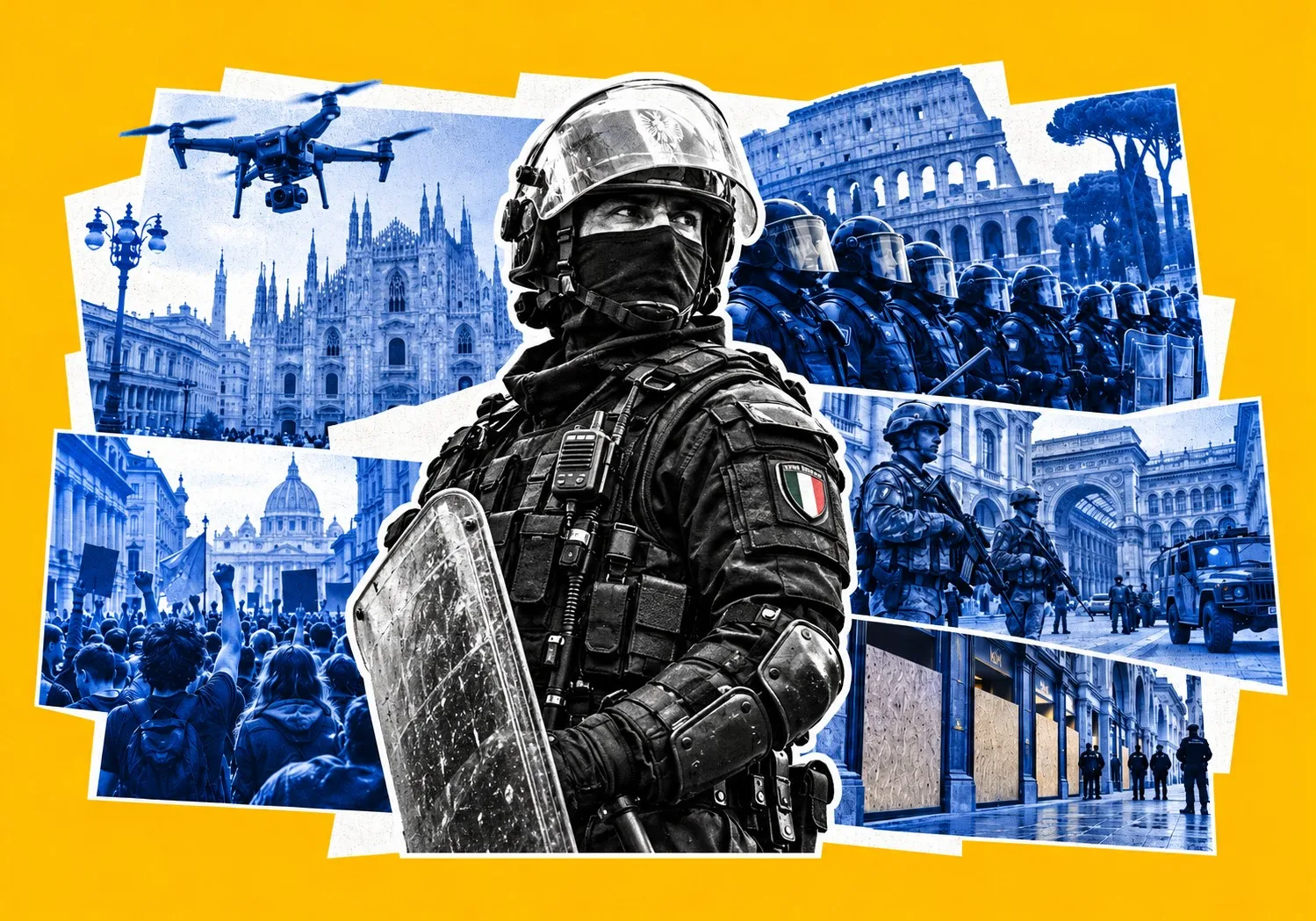
Premier Giorgia Meloni’s decision to deploy five hundred soldiers to Milan on Saturday, October 24, highlighted a dangerous escalation as a wave of protests over housing, cost of living, and economic inequality swept across Italy, France, Spain, Portugal, and Albania. Supporting roughly five thousand police officers in Italy’s financial capital following violent riots near the central Duomo square, the military presence underscores how localized urban grievances have rapidly hardened into a synchronized European security crisis.
The security mobilization occurred across major urban centers in Europe, involving domestic demonstrations concerning housing affordability, cost-of-living pressures, pension security, and political representation.

Soldiers on the Streets
In Italy, Premier Giorgia Meloni authorized the immediate deployment of five hundred additional soldiers to Milan.
Armed patrols joined approximately five thousand police officers and auxiliary security personnel. The deployment followed riots near the central Duomo square during the preceding weekend.
An estimated two thousand protesters had targeted retail stores selling athletic apparel, sneakers, and sporting goods.
Milan Mayor Giuseppe Sala’s municipal administration supported the military reinforcement.
Security authorities implemented a multi-layered containment strategy across Milan.
They utilized aerial drone surveillance over commercial corridors, identity checks at railway hubs, rapid-response tactical units, and digital monitoring. Security perimeters were expanded beyond the primary commercial center into outer neighborhoods.
National security officials addressed the operational and legal boundaries governing the use of armed forces in domestic crowd-control roles.
Defense Minister Guido Crosetto stated on social media that “soldiers were only recently allowed to use plastic restraint ties and only in areas around train stations, not throughout the city.”
Minister Crosetto confirmed that deployed infantry troops are not authorized to carry standard public-order tools, such as pepper spray or electroshock tasers, which are utilized by specialized civil police units.
Civilian police union representatives addressed the operational parameters of military deployments in urban centers.
Valter Mazzetti, secretary general of the Fsp police union, stated that “they cannot resolve police staffing shortages,” and added that “managing demonstrations requires specialized police training.”
Youth Alienation
Following the civil unrest in Milan, law enforcement agencies arrested forty-five individuals.
Thirty-four of them were classified as minors.
Officials from the Milan police department confirmed that a proportion of those detained were naturalized, second-generation Italian citizens or foreign nationals residing in the metropolitan area.
Lamberto Bertolé, Milan’s welfare councilor and a member of the center-left Democratic Party, said during official briefings that “many young people increasingly lack a sense of belonging and prospects for the future.”
“Part of our society feels excluded, amid social and economic inequalities,” Bertolé stated.
In Rome, municipal authorities executed security protocols.
They locked down luxury retail thoroughfares and established access controls around historic public spaces, including the Circus Maximus and Piazza del Popolo. Police units monitored an anti-war demonstration originating at Piazza della Repubblica alongside concurrent rallies organized by right-wing student groups.
Demonstration organizers instructed participants to maintain uncovered faces and keep their hands visible.
The weekend demonstrations in Italy were organized by the October 17 Movement in coordination with regional student federations, trade unions, and anti-war coalitions, with rallies planned across at least nine major Italian municipalities.
The French Crackdown
Concurrently in France, law enforcement agencies recorded one hundred and thirty-five arrests by 1 p.m. on Saturday as French authorities deployed personnel following property destruction the previous weekend.
In Lyon, riot police deployed tear gas to disperse a gathering of approximately one hundred and fifty protesters attempting to block a roadway near the city center, where municipal restrictions on demonstrations were in place.
"The police are really mobile. They come and disperse marches before they even form," a twenty-one-year-old student participant told Agence France-Presse at the Lyon protest site.
The French government implemented security measures following civil unrest the previous weekend, which involved clashes with police, burned vehicles, damaged buildings, and commercial looting in several cities.
Unrest had persisted in Paris through Sunday, marked by street barricades and police actions.
Ahead of Saturday's demonstrations, businesses across major French cities boarded up store windows or suspended operations for the day.
In Paris, a route alteration ordered by police regarding a planned demonstration drew criticism from leftist trade unions and political figures.
Authorities had initially approved a route between Bastille and Nation squares in the eastern sector of the capital but rescinded the authorization on Friday, redirecting the march along the southeastern periphery between Porte d’Italie and Porte de Vincennes.

To the south of the capital, state security forces established positions around Orléans, where the National Rally party convened its weekend congress featuring scheduled speeches by Marine Le Pen and Jordan Bardella.
The political event drew supporters and counterprotesters, prompting police deployments along transit arrival points and within the city center to conduct identity checks and intercept items that could be used in violent acts.
Police reported midday seizures of prohibited items in Orléans, Pau, Rennes, Marseille, and Tours.
Student Clashes in Tirana
Similar youth-led demonstrations took place in Tirana, Albania, where anti-government protests entered their second consecutive week. High school and university student groups threw rocks, flares, firebombs, and fireworks at police lines established around government buildings in the city center. Security forces deployed batons, water cannons, and tear gas canisters to disperse the crowds.

The student groups requested lower university tuition fees, increased state budgetary allocations for public education, and anti-corruption measures within educational institutions.
The student organizations aligned their actions with a political movement demanding the resignation of Socialist Prime Minister Edi Rama.
Pressure in Iberia
In Spain, street mobilizations centered on state pension security and residential housing availability ahead of the upcoming snap general election scheduled for next month.
Retiree organizations conducted rallies in central Madrid, demanding statutory legislative guarantees regarding public pension funds.
The pension framework became a point of debate between Prime Minister Pedro Sánchez’s governing Socialist Party and the conservative opposition Popular Party, with government officials commenting on opposition policy proposals regarding private pension market incentives.
Concurrently, civil demonstrations continued across Spanish urban areas regarding residential housing costs.
Demonstrators cited population growth, tourism expansion, short-term vacation rental proliferation, and immigration as drivers of housing supply shortages.
Public demonstrations occurred following the September eviction of an eighty-seven-year-old female tenant from her rented apartment in Madrid. A protest tent encampment established in Madrid’s central Puerta del Sol square remained occupied.
In Portugal, protest groups conducted marches through Lisbon opposing housing market legislative adjustments enacted by Prime Minister Luis Montenegro’s administration.
The legislation relaxed caps on annual rent increases and modified legal eviction procedures for tenants in rent default.
Prime Minister Montenegro defended the statutory changes in an official statement, maintaining that the policy “aims at reinforcing trust between tenants and landlords and boosting the rentals market.”
Demonstrators and tenant unions stated that the statutory adjustments alter tenant protections during a period of consumer price inflation.
Sources: Euronews