
Paris Counts the Cost of Violent Protests as Public Anger Deepens

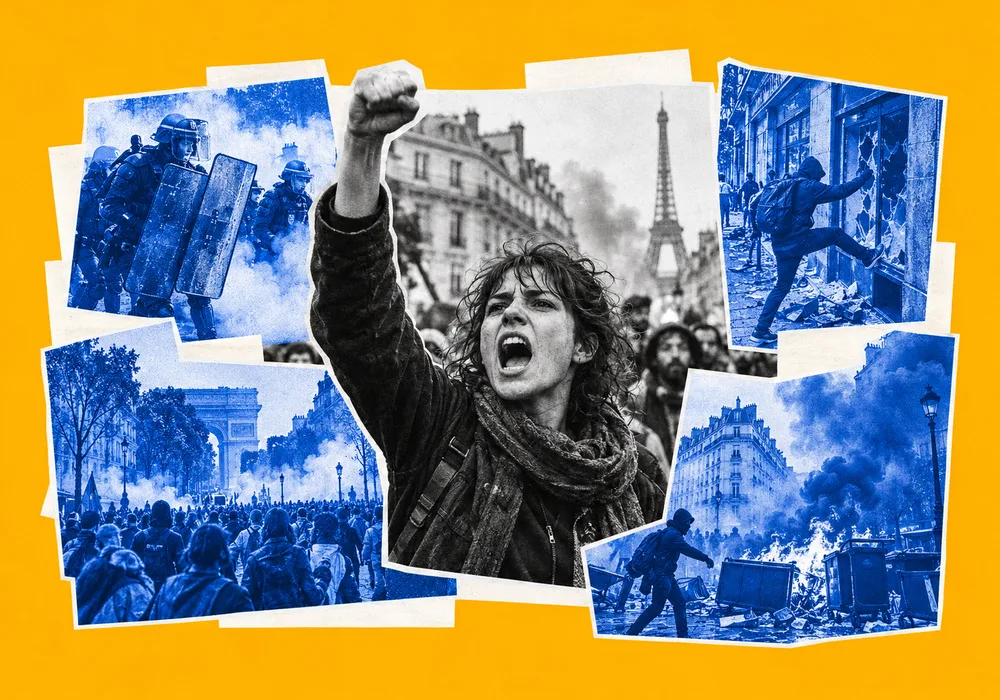
The destruction left by the October 17 demonstrations has exposed the economic cost of urban unrest, raised questions about France’s security response and intensified scrutiny of the social grievances driving public anger ahead of the 2027 presidential election.
Paris woke on October 18 to an unsettling contrast. Cafés reopened, tourists returned to the capital’s main attractions and residents resumed their weekend routines, yet streets across central districts remained marked by broken shop windows, burned bicycles and scooters, damaged street furniture and the aftermath of looting. Near Place de la République, where tensions had escalated during the previous day’s demonstrations, police maintained a visible presence as crowds gathered to observe the damage. In other parts of the city, commercial premises had been stripped of goods, while shopkeepers attempted to secure their entrances with temporary barriers. The apparent return to normality concealed a more fragile reality: residents remained uncertain whether the violence had ended, and the authorities continued to face sporadic confrontations.
The events of October 17 were particularly striking because the demonstrations had emerged from a broader mobilisation against the rising cost of living and deteriorating public services, with students and trade unions among those voicing their grievances. Hundreds of thousands of people took part in demonstrations across France, according to estimates reported by international media, although the precise figures differed between authorities and organisers. Most participants joined peaceful marches, but groups of rioters and looters targeted businesses, public buildings and police. The destruction in Paris became one of the most visible manifestations of a nationwide crisis, alongside serious incidents in other cities. By the following day, the debate had shifted from the protesters’ demands to the scale of the damage, the authorities’ preparedness and the question of how the unrest had been allowed to escalate.

Small Businesses Bear the Immediate Cost
For Parisian shopkeepers, the consequences were immediate. A broken storefront can mean more than the cost of replacing glass: it can leave a business exposed to further theft, force temporary closure and interrupt revenue at a time when operating expenses are already high. In the areas hardest hit by looting, retailers faced the additional task of assessing missing stock, repairing interiors and determining whether their premises could reopen safely. Independent businesses, including shops and service providers, may have fewer financial reserves to absorb unexpected losses than large commercial chains. Even where insurance covers some damage, the process of documenting losses and arranging repairs can take time, prolonging disruption.
The impact extends beyond the owners of the businesses directly targeted. Employees may lose working hours, suppliers face interrupted deliveries, and nearby establishments can experience reduced customer traffic as people avoid areas associated with violence. Damaged public infrastructure also requires municipal resources that could otherwise be directed towards everyday services. For a city whose economy relies heavily on tourism, retail and hospitality, images of looted stores and burning street furniture can undermine the sense of safety that visitors expect. The consequences should not be confused with evidence of lasting economic decline, but the immediate costs are real, and repeated episodes of disorder would make recovery more difficult for businesses already operating under pressure.
The scale of the destruction also raises a question about the relationship between public anger and private property. Demonstrations against government policy are a recognised part of French political life, and businesses are not responsible for every decision that fuels public frustration. Yet retailers and workers can become the immediate victims of violence carried out in the name of wider social grievances. The distinction matters because damage to local businesses can weaken the same communities whose economic difficulties helped bring people onto the streets. When shops close, jobs and local services are put at risk, potentially adding another source of insecurity to neighbourhoods already experiencing financial pressure.
Security Failures Under Renewed Scrutiny
The unrest has placed France’s security response under pressure. Authorities must manage large demonstrations across multiple cities, distinguish peaceful participants from those committing offences and prevent the rapid spread of looting once order begins to break down. The events in Paris raised questions about whether police resources were deployed effectively, whether potential flashpoints were anticipated and whether officers could protect commercial districts while responding to confrontations elsewhere. The return of riot police to Place de la République on October 18, followed by further clashes and the use of tear gas, demonstrated that restoring calm was not simply a matter of clearing the streets after the initial demonstrations.

The government’s response has to balance competing demands. Residents and business owners expect the state to protect public spaces, prevent attacks and hold offenders accountable. Peaceful demonstrators, meanwhile, have a legitimate interest in being able to protest without being subjected to indiscriminate restrictions or excessive force. A strategy centred exclusively on arrests and crowd control may restore order temporarily without resolving the conditions that sustain mobilisation. Conversely, failing to contain violence risks eroding confidence in the authorities’ ability to protect people and property. The challenge is therefore both operational and political: the government must demonstrate that it can maintain public safety while preserving the right to peaceful protest.
The distinction between peaceful demonstrators and those engaged in violence has become central to the political debate. French officials have blamed radical groups and criminals for exploiting the demonstrations, while opposition figures have criticised the authorities’ handling of the unrest. Establishing individual responsibility will require investigations rather than assumptions about the motives of everyone involved. At the same time, the government will face pressure to explain why businesses and public buildings were vulnerable to attacks and what measures will be taken to prevent similar incidents. The credibility of that response will depend on evidence of accountability and practical improvements, not simply stronger rhetoric.
Echoes of the Yellow Vest Movement
The protests have revived memories of the Yellow Vest movement that began in 2018, when opposition to fuel taxes developed into a wider challenge over purchasing power, inequality and the perceived distance between political decision-makers and ordinary citizens. The movements are not identical, but both reveal how economic grievances can become a broader expression of distrust when people feel that national policies fail to reflect their circumstances. In the current demonstrations, concerns about living costs and public services have provided a common focus for groups with different experiences and political priorities.
That diversity makes the mobilisation difficult to interpret as a single, unified movement. Students concerned about the quality of education, workers worried about household expenses and residents frustrated by declining public services do not necessarily share the same objectives or preferred solutions. Nor should the actions of violent groups be treated as representative of everyone who participated in the marches. Nevertheless, the convergence of different grievances suggests that dissatisfaction extends beyond a narrow dispute over one policy. When several groups see their prospects deteriorating at the same time, demonstrations can become a vehicle for broader opposition to the government, even when participants disagree about what should replace its policies.
For President Emmanuel Macron, the unrest presents a political problem at a particularly sensitive moment. France is approaching the 2027 presidential election, and the government’s handling of public anger is likely to influence the debate over security, economic policy and the condition of public services. The administration must show that it can respond to legitimate grievances without appearing either indifferent to the causes of unrest or unable to maintain order. The opposition, meanwhile, has an opportunity to portray the violence as evidence of governmental failure, although the destruction itself does not establish that any single political alternative would be better equipped to address the underlying problems.
Violence Risks Overshadowing the Protesters’ Demands
One of the most consequential effects of the unrest is the way violence can displace the original political message. When footage of looting, fires and confrontations dominates public attention, debates about education, living standards and public services risk being pushed aside. The actions of a minority can define how an entire mobilisation is perceived, making it harder for peaceful participants to secure support for their demands. This creates a strategic disadvantage for protest organisers, who must contend not only with the government’s response but also with public anger directed at the destruction.
The consequences can also extend to the political balance within France. Public anxiety over disorder can increase demand for tougher policing and strengthen arguments that social movements have become a threat to public safety. Parties that place law and order at the centre of their platforms may benefit from images of damaged streets and vulnerable businesses. At the same time, treating all protesters as responsible for the violence risks alienating people whose concerns are genuine and may deepen the sense that institutions are unwilling to listen. The government faces a narrow path between allowing disorder to continue and responding in a way that further intensifies distrust.
The damage in Paris therefore represents more than a clean-up operation. It exposes a tension between the right to collective protest and the public’s expectation that streets, businesses and essential services remain safe. The political response will influence whether the events are remembered primarily as an episode of criminal violence or as a turning point in a wider debate about the country’s social and economic direction. That distinction will depend partly on whether peaceful participants can maintain a voice in the debate and whether policymakers offer substantive answers to the grievances that brought demonstrators together.
A Test of France’s Capacity to Restore Confidence
The immediate priority is to secure affected areas, investigate offences, support businesses and ensure that public spaces can return to normal use. The longer-term task is more complicated. Rebuilding damaged storefronts will not resolve dissatisfaction over the cost of living or restore confidence in public services, just as addressing social grievances will not remove the need for effective policing. Both responses are necessary if the government is to avoid a cycle in which demonstrations produce disorder, disorder triggers a security crackdown and the resulting tensions fuel further mobilisation.
The coming days will provide a clearer indication of whether the violence was a concentrated episode or the beginning of a prolonged period of instability. The extent of further demonstrations, the authorities’ handling of gatherings and the practical support offered to affected businesses will all shape public perceptions. Equally important will be the government’s willingness to address the substantive concerns raised by peaceful demonstrators rather than allowing the destruction to become the only subject of national discussion.
Paris has begun repairing the visible damage, but the political consequences are less easily contained. The unrest has exposed vulnerabilities in public security, placed additional pressure on local businesses and highlighted the difficulty of governing amid accumulated social frustration. With the presidential election approaching, the government’s ability to restore confidence will depend on whether it can combine public order with credible responses to economic and social concerns. Without progress on both fronts, the calm returning to the capital’s streets may prove more fragile than it appears.
Sources: Paris Presse