
Italy’s School Ban: Meloni Targets Burqas and Foreign Pupil Numbers

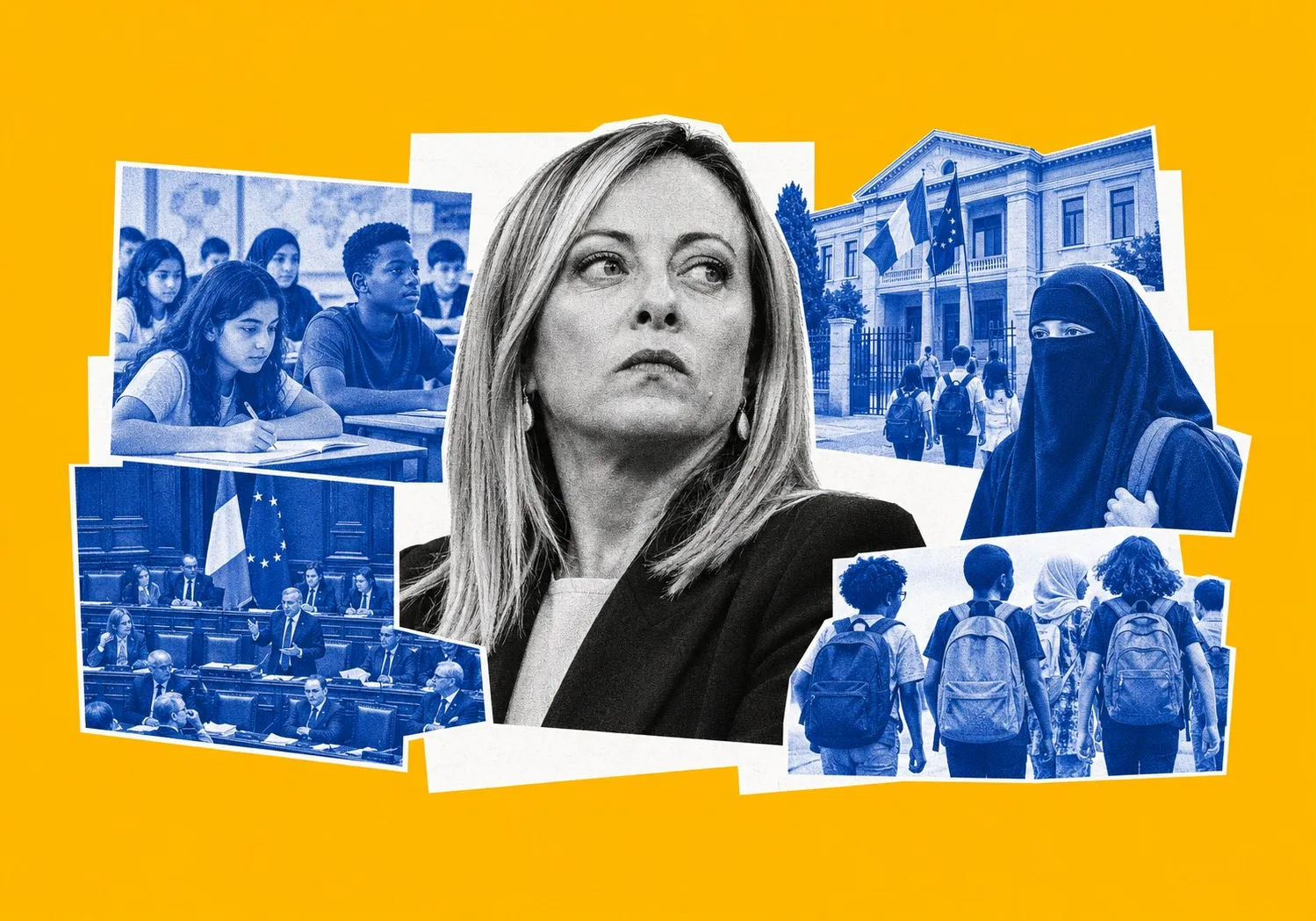
Giorgia Meloni has launched her most provocative cultural offensive yet. The Italian Prime Minister has unveiled sweeping legislation to ban full-face coverings in classrooms while capping foreign student numbers, setting Rome on a direct collision course with civil rights groups and EU integration norms. Italian Prime Minister said her government is preparing two legislative proposals.
The package is blunt. It introduces a nationwide ban on full-face coverings—specifically targeting the burqa and niqab—within all Italian educational facilities. Running parallel to this is a statutory cap on the percentage of foreign pupils permitted in any single schoolroom, backed by mandatory Italian language proficiency requirements for parents whose children enter the public system.

For a British political observer accustomed to the granular, fiercely litigated compromises of the UK’s pluralistic educational landscape, the raw, unsoftened mechanics of Rome’s decree are arresting. Yet to dismiss this as mere populist theatre is to miss the strategic machinery of contemporary Italian politics.
Meloni has steered her administration into its fourth year, defying the historical volatility that usually devours Italian governments. She has built her career on a triad of traditional anchors: God, homeland, and family. Today, she is fortifying that triad with the coercive power of the state apparatus, drawing a hard boundary around what it means to be culturally Italian in the twenty-first century.
The Veil and the Bench: Secularism Meets Identity
The proposed legislative text concerning face coverings is direct. It bars students from entering school grounds in garments that completely obscure facial identity. The government’s framing is meticulously constructed around the language of public transparency, gender emancipation, and civic integration.
"The school is a place of light, of shared identity, of open dialogue where faces must be seen," Meloni told supporters, framing the restriction not as an assault on personal faith, but as a defense of individual liberty against patriarchal structures.
In the view of the ruling coalition, allowing full facial veils inside a public school normalizes a symbol of segregation that runs counter to the fundamental tenets of the Italian constitution and European civic norms. To her base—millions of voters across the industrial north and the working-class peripheries of Rome and Naples—dies is the long-overdue assertion of a sovereign state reclaiming public spaces from cultural relativism.
The counter-arguments from the political left, civil liberties groups, and Islamic associations are equally trenchant. Critics argue that the ban is an exercise in political targeting that singles out a deeply marginalized minority.
Rather than liberating young Muslim girls, opponents warn it risks creating an impossible bind, forcing them to choose between familial expectations, personal religious conviction, and their right to an education.
In a country where religious freedom is constitutionally guaranteed, legal scholars are already preparing for a bruising constitutional challenge, pointing out that blanket bans risk violating core tenets of personal expression unless narrowly justified by absolute security imperatives.
The Classroom Calculus: Demographics and Disruption
If the face-covering ban fights a symbolic culture war, the second pillar of Meloni’s reform—the cap on foreign pupils—is an aggressive exercise in social engineering.
Data compiled by the Fondazione ISMU indicates that non-citizen children now account for roughly 11.6% of total enrollment across Italy's public schools. In urban epicentres like Milan, Turin, and Brescia, that proportion is significantly higher, driven by decades of Mediterranean migration and changing labor market demands.
Meloni’s argument rests on a pragmatic, if contested, premise: that high concentrations of non-native speakers in specific classrooms degrade educational outcomes for every child.
When an urban classroom fills with children who possess little to no command of the Italian language, teachers are forced to abandon standard curricula to act as language facilitators.
"When integration fails because the numbers are unmanageable, we are not building a society; we are building parallel worlds," a senior ministry official noted on condition of anonymity.
The government’s remedy is a statutory ceiling on foreign-born or non-Italian-speaking students per class, designed to force a more equitable dispersion across municipal districts.
Yet this policy runs straight into a wall of logistical reality. Headteachers and educational unions across Lombardy and Veneto have reacted with open dismay, questioning where surplus children will go if a neighbourhood school hits its quota and whether cash-strapped local councils will be expected to finance fleets of buses to ferry seven-year-olds across metropolitan areas.
Without massive infrastructural investment and hiring sprees for specialized teaching staff, educators warn the policy will collapse into a bureaucratic nightmare, shutting children out of the system rather than helping them assimilate.
The Economic Paradox: Fortress Versus Labour Market
Stepping back to view these reforms from a macroeconomic perspective reveals a profound contradiction at the heart of Meloni’s platform. Italy is trapped in a severe demographic winter. Birth rates hover near historic lows, and the population is ageing faster than almost any other in the G7.
The Italian pension system and its manufacturing-heavy export economy depend entirely on an infusion of working-age adults and growing families to sustain output.
By projecting an image of an impenetrable cultural fortress, and by implementing policies that signal to immigrant communities that they are unwelcome or permanently suspect, Rome risks repelling the very demographic lifeblood it requires.
Skilled professionals, healthcare workers, and technicians from North Africa, the Middle East, and Eastern Europe may look elsewhere—to Germany, Scandinavia, or the UK—rather than navigate an increasingly hostile bureaucratic environment.
Meloni calculates that the political dividends of projecting strength outweigh the hidden economic costs of a cooling labor pool. Her strategy relies on a core truth of modern European politics: anxiety over migration and cultural drift remains a potent, unifying force for conservative electorates who feel left behind by globalization.
The Parliamentary Battlefield Ahead
As the legislative drafts move from ministerial desks into parliamentary committees, Italy is bracing for a tumultuous autumn. The political battle will be fought on multiple fronts simultaneously. Left-of-centre parties are mobilizing legal challenges and planning nationwide demonstrations, while trade unions are threatening strikes over school funding and staffing shortages.
For Giorgia Meloni, this is home turf.
She thrives on confrontation, using friction with the opposition and international critics to solidify her domestic standing. Whether these sweeping reforms ultimately function as a masterclass in nationalist statecraft or fracture into an unworkable administrative mess will be decided in the trenches of Italy's municipal schools.
One reality remains undisputed: the Prime Minister has once again dictated the European political weather, forcing her continental peers to confront the raw, unresolved tensions of identity, integration, and state power.
Sources: Politico,Euronews, The Telegraph, AP