
Europe Cost-of-Living Protests: 1,800 Arrested in France as Unrest Sweeps Across Five Nations

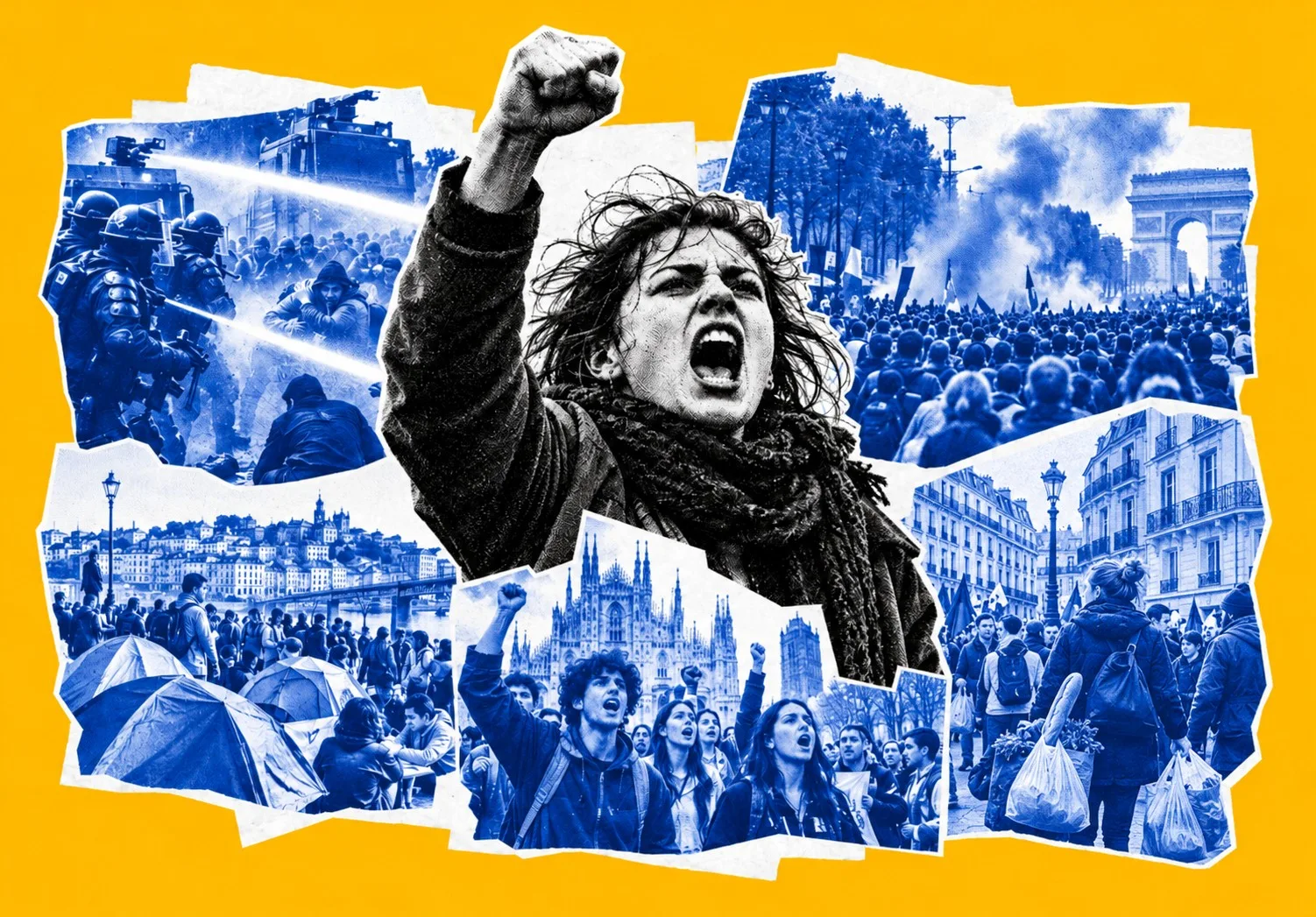
More than 1,800 people were arrested across France on Saturday. Student-led demonstrations regarding education funding shortages and rising living costs resulted in widespread urban damage and law enforcement clashes. The French events coincided with coordinated public protests across Italy, Belgium, Portugal, and Albania—movements driven by shared macroeconomic pressures including inflation rates, housing costs, and public expenditure allocations.
In Sunday morning the clean-up begins in Paris after clashes between police and protesters on Saturday, October 17.

Police arrested more than 1,800 during French protests, interior minister Laurent Nuñez says. 517 people were being held in police custody after a "record number" of arrests during Saturday's protests in Paris, the public prosecutor's office said. 346 were adults and 171 were minors, the prosecutor's office said, adding that the numbers were provisional and could change. Most of the arrests were for receiving stolen goods, association with intent to commit violence and vandalism, it said.Official reports confirm that over 150 police officers sustained injuries in France.

In Limoges, a structural fire damaged the 140-year-old town hall, causing a partial collapse of the building's roof, while municipal offices in Marseille and Lille were entered and vandalized by protest groups.
In Saint-Étienne, Mayor Régis Juanico confirmed on social media that a young demonstrator "had his hand blown off" after attempting to handle an explosive police stun grenade, adding: "Such a tragedy should never have happened."
Commercial properties, retail stores, and financial branches were damaged or looted in central Paris, Lyon, Marseille, Nice, Nantes, Bordeaux, Strasbourg, Grenoble, Lille, Toulouse, Angers, Avignon, Pau, Montpellier, and Valence.
Concurrently, public demonstrations addressing living expenses, educational resources, housing prices, and government policies were recorded across urban locations in Belgium, Italy, Portugal, and Albania.
School Walkouts and Urban Damage
The movement originated the previous month as localized secondary school walkouts in the northern working-class suburbs of Paris—specifically in Seine-Saint-Denis—where pupils protested against teacher shortages and deteriorating facilities in public lycées.
Over subsequent weeks, the scope of the demonstrations expanded to include organized labor confederations and members of the Yellow Vest (gilets jaunes) movement.
Primary grievances articulated by participating groups centered on inflation, fuel prices, public spending levels, and general living standards. In financial markets, French government borrowing costs reached their highest levels in over two decades as public debt reduction plans coincided with demands for expanded public sector budgets.
Data provided by official ministries and participating trade union confederations outline the geographic reach and operational impact of Saturday's events across France.
Nationwide turnout estimates ranged from 550,000 individuals according to Interior Minister Laurent Nunez to 800,000 according to the General Confederation of Labour (CGT).

In Paris, primary marches proceeded toward Place de Clichy, while separate clashes occurred in central locations including Place de la République, where demonstrators draped a Yellow Vest over the central statue bearing the slogan: "2026: the police maim school students."
Demonstrators interviewed in Paris expressed varying perspectives on the movement's objectives.
Lola, a 19-year-old protester, stated: "We are fighting because the cost of living is too harsh, because the price of fuel is too high, because high school pupils are being violently attacked and hurt all over the country just for trying to protest and ask for more teachers and decent learning conditions."
Meanwhile, Marjorie Keters, a Yellow Vest spokesperson for the political collective "For a Popular and Social Ecology," stated during the march: "This time we’re going to win and bring down this system."
Public authorities reported property damage to commercial retail branches in Paris, including an SFR mobile phone store, a Lacoste boutique, and an attempted forced entry into the Galeries Lafayette department store, alongside vehicle fires and deployed tear gas.
In Marseille, approximately two dozen individuals shouting "This is the Revolution" entered the town hall and damaged office furniture, leading Mayor Benoît Payan to criticize available riot police deployments, noting that "this morning, there was one company of riot police for Marseille," despite the city's size.
In Lyon, Mayor Grégory Doucet stated that the burning of the historic tourist office was "a tragedy" that "breaks our hearts because it's a very iconic, well-known historic building," adding: "Our public buildings are shared assets. Vandalising them means attacking the people of Lyon."
Forced entries and property damage were further recorded in Lille, where the mayor's office was vandalized and an Apple store emptied, and in Grenoble, where a tourist train was driven toward police lines.
Parallel Mobilizations in Rome, Brussels, Lisbon, and Tirana
In Italy, student organizations coordinated nationwide demonstrations designated as "No Meloni Day," recording participation figures exceeding 400,000 people across major urban centers including Rome, Turin, Padua, Bologna, Naples, Cagliari, and Milan.
Demonstrators protested public education budgets, military industry spending allocations, and administrative decrees limiting foreign student enrolment quotas in classrooms.
In central Milan, protests around Piazza del Duomo and the Galleria Vittorio Emanuele II commercial arcade resulted in damaged Carabinieri vehicles, burnt barricades, and 50 detentions, alongside two injured officers and the temporary closure of the central Duomo metro station. In Bologna, police deployed water cannons and made seven arrests, while approximately ten law enforcement officers sustained injuries across Turin and Rome.

In Belgium, demonstrations took place in Brussels and Liège, organized by student representative bodies protesting university registration fees, higher education access reforms, and study material costs.
Police forces deployed water cannons and tear gas following projectile throwing and an overturned vehicle in the Bourse district in Brussels.
Belgian Interior Minister Bernard Quintin stated on social media that "what is unfolding in Brussels is no longer mere protest" but "pure and simple violence, organised and repeated with the aim of destabilising our society."
"All necessary means will be used to restore order in the face of the rioters," wroted Interior Minister.
In Portugal, trade union confederations including the CGTP partnered with housing advocate movements to conduct marches across Lisbon, Porto, and Coimbra under the slogan: "Higher wages, better pensions, and public services. Against the rising cost of living. A new course for Portugal!"
Official economic data indicate that residential property prices in Portugal have doubled since 2017.
Addressing the demonstration in Coimbra, a CGTP spokesperson told SICN that "faced with the rising cost of living, housing and fuel, even a basic shopping basket has reached an exorbitant price."
In Porto, organizer Pedro Manuel stated: "People come from different groups, but we are not institutionally tied to any of them. This outcry is the result of abuse of authority and a way of saying 'enough of this crisis.'" José Manuel Pureza of the Left Bloc emphasized: "What people are demanding that we discuss is the right to housing for everyone. Those whose rent is getting ever more expensive, those whose mortgage is increasingly hard to fit into the family budget."
In Albania, student-led demonstrations in Tirana marked a fifth consecutive day of direct clashes following months of student boycotts. Participants gathered outside the Ministry of Education and the executive office of Prime Minister Edi Rama, demanding government resignations over education standards, economic conditions, and state corruption allegations.

Security forces utilized tear gas, water cannons, and rubber bullets to disperse crowds throwing stones and petrol bombs.
George, a 19-year-old medical student participating in the Tirana protests, stated: "We were peaceful for 135 days. Now we are trying to do like in France… we are trying to make a revolution. Our government doesn't want peace, so we are using violence."
Klea, a 17-year-old first-year university student, noted that "all the students are boycotting their university classes and left school to fight for our rights," while alleging that third-party provocateurs were present to discredit the movement.
Political analyst Lutfi Dervishi observed that Prime Minister Rama is "caught between a rock and a hard place" and has become "the victim of his own success" by concentrating power.
Official law enforcement figures confirm that over 80 individuals were formally charged with public order offenses in Tirana.
Debt Rules Limit Budgetary Responses
At the core of the demonstrations is the structural interaction between fiscal policy frameworks, public service delivery, and public order administration.
Across several European Union member states, national treasury departments operate under sovereign debt management rules and elevated borrowing interest rates. In France, government fiscal consolidation strategies aimed at managing public debt levels coincide with demands for increased operational budgets in primary and secondary education.
On October 8, French Education Minister Édouard Geffray announced an administrative allocation for 3,000 supplementary substitute teaching posts; however, student organizations and trade unions maintained planned mobilization schedules.
When formal policy adjustments do not alter public protest trajectories, state administration of civil gatherings relies primarily on law enforcement oversight.
Statistical data and union communications indicate operational strain among law enforcement bodies. Statement releases from the UNSA police union in France stated: "Today again, in every corner of France, our colleagues are being used as punching bags. Pelted with stones, injured, trapped in real ambushes."
The union added a direct warning to the government: "Let everyone take responsibility: this cannot go on indefinitely. The rope is stretched to its maximum."
Concurrently, civil rights monitoring bodies and police oversight agencies, such as the IGPN in France, have initiated at least two dozen formal investigations into police tactical maneuvers, crowd control equipment usage, and reported demonstrator injuries during public order maintenance operations.
Electoral Debates and Executive Statements
The developments of October 17 drew formal statements from elected officials, executive ministers, and party leaders across affected states, reflecting existing political alignments and upcoming electoral calendars.
In France, Prime Minister Sébastien Lecornu condemned the "extreme intensity" of the violence and attributed the acts to "ultra-left" political factions and criminal elements.

Addressing the upcoming presidential election next year, Lecornu posted on X: "To those who clearly want to use this violence as a 'warm-up' before the presidential election, I say clearly: We will not let ourselves be intimidated. No one will impose their political agenda through violence." Visiting deployment sites, he noted that "it’s a miracle the toll wasn’t higher."
President Emmanuel Macron stated on X: "We will all stand united against the sowers of chaos, who only seek to undermine our institutions and prevent those who peacefully express their demands from doing so," adding that those who looted town halls and attacked prefectures "will be prosecuted and punished."
Opposing viewpoints were articulated by parliamentary party leadership.
Jean-Luc Mélenchon, leader of La France Insoumise, accused police officers of "unleashing" on protesters while condemning instances of looting and arson, a stance Prime Minister Lecornu characterized as "dangerous and cynical."
Marine Le Pen, parliamentary leader of the National Rally, stated that "legitimate demands" voiced by protesters had been "held hostage by the far left," accusing Mélenchon of fueling the violence.
In Italy, Prime Minister Giorgia Meloni condemned the violent incidents via social media, stating: "Demonstrating is a right. Setting our cities ablaze is not," while criticizing "hooligans who exploit demonstrations to sow chaos, attack those responsible for ensuring security and hold entire cities hostage." Meloni also criticized opposition leaders for failing to condemn the violence.
Milan Mayor Giuseppe Sala stated that while "the reasons for the protests were understandable," the "violence against law enforcement and serious damage to the city are not justifiable."
In Albania, Prime Minister Edi Rama urged citizens on social media to "not forget that we have achieved extraordinary things," attributing the protest intensity to opposition Democratic Party mobilization and "the sinister agenda of foreign actors, intent on halting our progress" toward EU membership by 2030.
Concurrently, Albania's Special Prosecution Structure (SPAK), established under EU and US guidance in 2019, continues independent anti-corruption proceedings, including the recent arrest of secret service chief Vlora Hyseni regarding alleged assistance provided to businessman Ergys Agasi to evade justice.
Structural Parameters Facing European Governance
The events recorded across France, Italy, Belgium, Portugal, and Albania demonstrate the interconnected nature of contemporary socio-economic demonstrations in Europe. Shared macroeconomic pressures—including housing market price inflation, consumer energy costs, and public sector wage stagnation—continue to influence public assembly patterns across national borders.
Governmental bodies face structural parameters when formulating policy responses to public protests. Interventions involving increased public sector expenditure or expanded social subsidies remain subject to national fiscal deficit rules and international bond market pricing. Alternative strategies centered on administrative law enforcement continue to rely on policing agencies managing heightened operational deployments across urban centers.
As municipal authorities complete physical assessments of damaged public buildings and infrastructure in Limoges, Lyon, Marseille, Milan, and Tirana, national legislatures continue to debate budget allocations, public safety regulations, and public service funding models.
The administrative challenge for European governance structures remains balancing fiscal regulatory commitments against public expectations for state service delivery and economic stability.
Read also: In Europe property acts less like a universal utility and more like an increasingly scarce luxury. Nine of the 29 surveyed European countries recorded double-digit year-on-year price increases. The sharpest surges are concentrated in Southern and Eastern Europe, with Portugal leading the continent at 16.5 percent, closely followed by Bulgaria at 15.5 percent and Lithuania at 14.3 percent. Subsequent data for September 2026 demonstrates that the Portuguese market is only accelerating. National housing costs have hit a new all-time high, and median asking prices in Lisbon have reached an unprecedented €6,256 per square metre.
Sources: Reuters, Euronews, BBC, RFI, La Repubblica, Al Jazeera