
China’s Rare Earth Export Controls: Why Europe’s Defence Industry Faces Severe Material Shortages

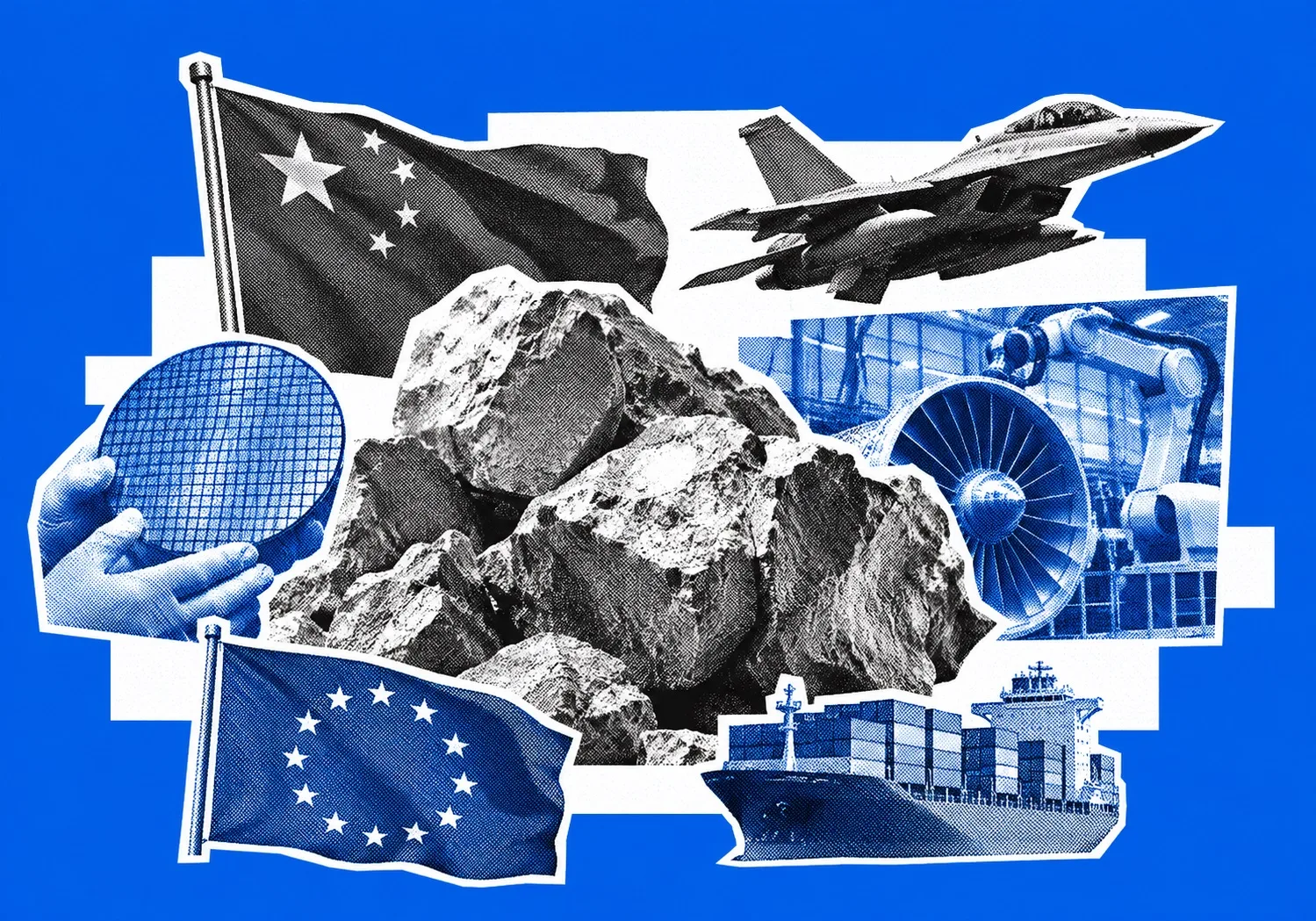
European aerospace and defence manufacturers are paying up to 125 times more for critical raw materials than their Chinese competitors. As Beijing tightens export restrictions on yttrium, dysprosium, and terbium, Europe’s heavy dependence on foreign processing is putting key industrial and military supply chains at risk.
According to reports from Argus Media and Bloomberg, yttrium - essential for semiconductor production and heat-resistant engine coatings - now reaches approximately $1.15 million per tonne on the European spot market, compared to just $9,144 in China.
Other strategically important materials have followed a similar pattern. Dysprosium can cost up to 20 times more outside China, while terbium carries an eightfold premium. Gallium, another important input for advanced electronics, has recorded a twelvefold price increase.
The disparity is particularly troubling for European manufacturers trying to expand defence production while maintaining their position in increasingly competitive civilian technology markets. Higher prices are one problem. Securing reliable deliveries of materials that have few readily available substitutes is another.
Beijing has extended a partial suspension of additional trade restrictions until 10 January 2027. Yet the export licensing requirements introduced in April 2025 for seven rare earth elements remain in place. European companies therefore face continued uncertainty over materials essential to aircraft engines, military electronics and high-performance electric motors.
Why Chinese export licences are reshaping prices
China's advantage extends well beyond its mineral deposits. It controls approximately 91% of global rare earth refining capacity, the result of decades of investment in processing infrastructure that Western economies were reluctant to replicate because of environmental costs and substantial capital requirements.
That concentration gives Beijing considerable influence over the availability of refined materials, even when the underlying minerals can be found elsewhere.
The April 2025 restrictions cover samarium, gadolinium, terbium, dysprosium, lutetium, scandium and yttrium, together with associated compounds, alloys and magnets.
Under the licensing system, exporters cannot assume that shipments will be authorised automatically. Chinese authorities retain discretion over approvals, introducing uncertainty into procurement schedules and making it harder for foreign buyers to plan production.
Beijing describes the measures as necessary for national security and controls on materials with both civilian and military applications. Western analysts have also interpreted their selective application, particularly amid tariff disputes, as a means of exerting economic pressure.
The distinction matters. Export controls do not necessarily require a complete prohibition to disrupt manufacturing. Delayed approvals, unpredictable delivery schedules and limited access to alternative suppliers can produce substantial market effects.
Trade figures indicate how sharply availability has deteriorated. Chinese yttrium oxide exports have fallen to approximately 40% of their 2023–2024 baseline. Shipments to the United States have declined by around 70%, while exports to Japan have approached zero.
Europe's extraordinary yttrium prices nevertheless require some caution in interpretation.
Rare earth oxides are often traded through relatively small, opaque markets rather than large commodity exchanges. When available supplies become scarce, a limited number of transactions can produce dramatic spot-price movements.
The 125-fold premium therefore does not establish that every European manufacturer is paying that amount for every shipment. Long-term contracts and individual purchasing arrangements may produce different costs.
What the price gap does reveal is the difficulty of obtaining additional material outside established Chinese supply channels when those channels become restricted.
The problem for Europe's defence industry
Yttrium illustrates how an apparently obscure industrial material can become important to military production.
It is used in thermal barrier coatings that protect components operating at extreme temperatures, including turbine blades in aircraft and gas engines. Disruption to its supply can complicate procurement for aerospace manufacturers and their specialist suppliers.
Other restricted elements are essential to high-performance permanent magnets used in military radar equipment, communications systems and drone propulsion motors.
Dysprosium and terbium are particularly valuable in magnet applications requiring reliable performance under demanding operating conditions.
The same materials support civilian industries, including electric vehicles, renewable energy equipment and advanced electronics.
European manufacturers consequently face competition for constrained supplies across several sectors simultaneously. Defence companies seeking to expand production cannot simply assume that commercial demand will diminish or that suppliers will prioritise military contracts.
The consequences depend on the material, component and manufacturer involved. Higher input costs may reduce margins, while shortages or uncertain delivery times can complicate production schedules. The available evidence does not establish a continent-wide halt in defence manufacturing.
It does, however, expose a weakness in European rearmament planning. Expanding assembly capacity is of limited value if specialist components depend on materials whose availability is determined outside Europe.
The challenge also extends to technological competitiveness. European semiconductor and automotive manufacturers must absorb additional costs while competing against companies operating closer to Chinese processing facilities and domestic supply chains.
Europe has the deposits, but not the mines
Europe's dependence on Chinese rare earths is not simply a consequence of geological scarcity.
Significant deposits have been identified at Per Geijer and Norra Kärr in Sweden, Sokli in Finland and the Fen Carbonatite Complex in Norway.
Yet Europe currently has no operational rare earth mine.
Turning these resources into commercially available materials requires more than identifying economically promising deposits. Mining projects need financing, environmental approvals, and extensive infrastructure. Refining capacity must also be developed before extracted minerals can become usable industrial inputs.
These requirements help explain why European supply diversification cannot happen quickly, even with stronger political support.
The European Union's Critical Raw Materials Act establishes targets for producing 10% of the bloc's strategic raw material consumption through domestic extraction and processing 40% within Europe by 2030.
Brussels is also advancing plans for a European Critical Raw Materials Centre in 2026, alongside joint procurement arrangements, strategic stockpiling and proposed restrictions on exports of magnet scrap.
The objective is to reduce exposure to external supply disruptions while strengthening Europe's ability to coordinate purchases and retain recyclable materials.
According to the South China Morning Post's analysis of European supply dependencies, China currently supplies approximately 98% of the permanent magnets imported by the EU.
That dependence cannot be eliminated through legislation alone.
Even successful mining projects would leave Europe needing facilities capable of separating, refining and manufacturing the specialised materials required by industry. Building those facilities involves substantial investment and technical development.
Recycling may provide another source of supply, particularly if more magnet scrap remains within Europe. But collection and processing systems must be sufficiently developed to turn that material into commercially useful products.
For manufacturers facing shortages today, the EU's 2030 targets offer a direction for industrial policy rather than an immediate alternative supplier.
Washington is taking a different route
The United States is responding to Chinese supply concentration through a more interventionist combination of defence procurement rules, industrial investment and long-term purchasing commitments.
From 1 January 2027, restrictions will prevent the US Department of Defense from procuring permanent magnets sourced from China, Russia, Iran or North Korea.
Washington is also supporting domestic rare earth processing and magnet production through investments and guaranteed purchasing arrangements, including projects associated with Mountain Pass in California and manufacturing facilities in Texas.
The approach aims to give domestic producers greater confidence that substantial demand will exist after new facilities begin operating.
Europe's strategy relies more heavily on regulatory targets, coordinated procurement and efforts to encourage investment across member states.
Neither approach guarantees rapid independence from Chinese refining. New facilities require time, technical expertise and commercially sustainable production.
The American procurement restrictions could also complicate transatlantic defence supply chains.
European contractors supplying equipment or components to US defence programmes may need to demonstrate that their magnets comply with American sourcing requirements. Manufacturers dependent on Chinese-origin materials could face additional pressure to qualify alternative suppliers.
The precise effects will depend on individual contracts, component origins and the availability of compliant production capacity.
There is also a diplomatic imbalance. Washington and Beijing are negotiating trade arrangements that could influence global access to critical minerals, while European companies remain exposed to decisions made between the two powers.
Brussels can pursue its own industrial and trade policies, but it cannot directly determine the terms of bilateral US-China negotiations.
For European manufacturers, that leaves an uncomfortable mismatch between the speed of geopolitical decisions and the much longer timetable required to establish alternative mining, refining and magnet production capacity.
China's partial relaxation of supplementary trade measures has not removed the licensing system governing the seven restricted rare earth elements. As long as those controls remain in force, European buyers must continue planning around approvals and supply conditions that can change independently of their own production requirements.
Sources: Bloomberg, SCMP, Politico