
EU-China Trade Deal: Brussels Limits Chinese Hybrid Imports in Exchange for Critical Minerals

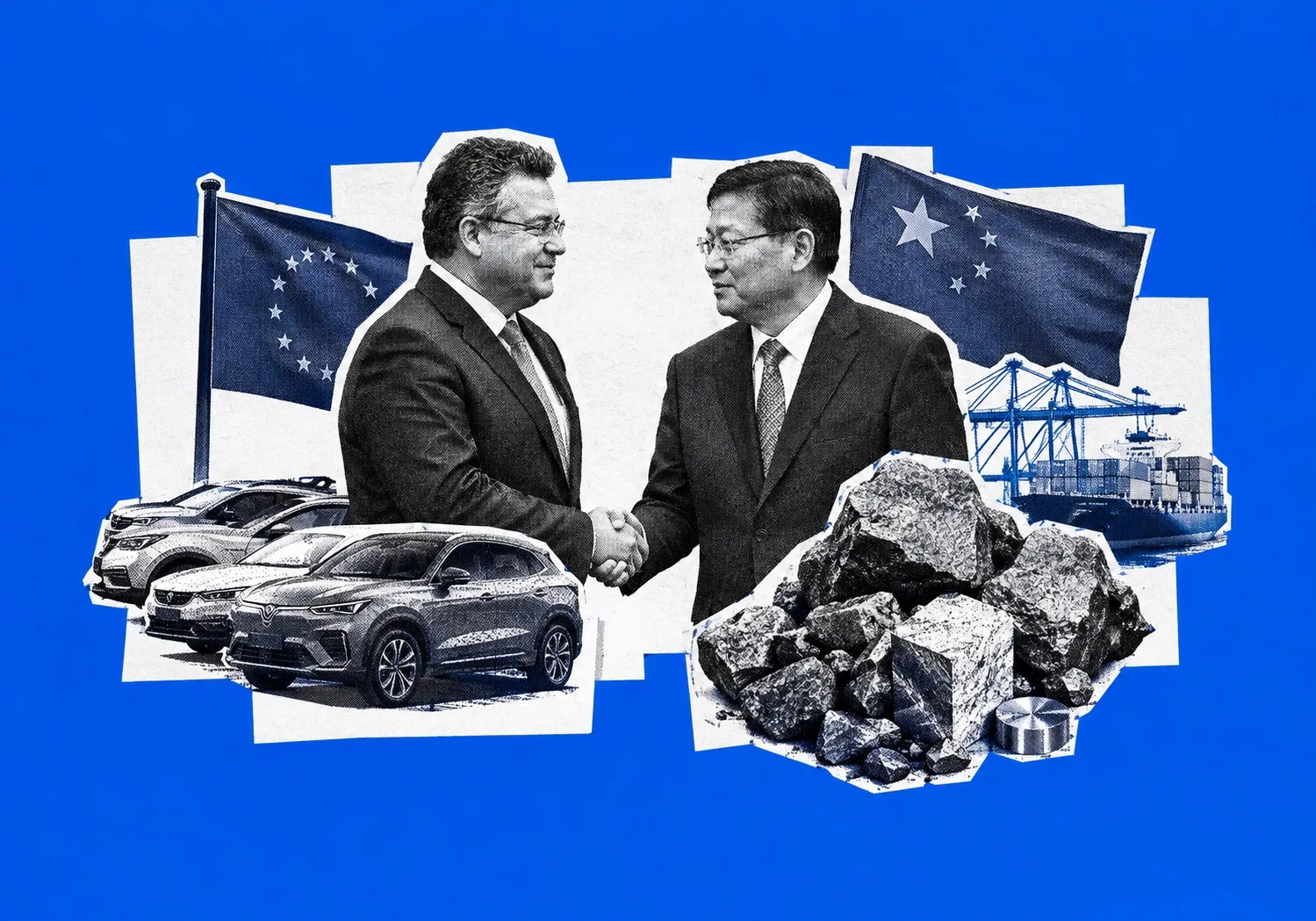
The European Union and China have reached a preliminary agreement to curb Chinese hybrid car exports to Europe. In exchange for limiting market access for its automakers, Beijing secured reduced risk of further tariffs and guaranteed Brussels better access to critical raw materials, including rare earths. Reached in Beijing on 9 October, the deal aims to protect Europe’s automotive industry while securing vital supply chains.
For European manufacturers, the political signal is nevertheless significant. After years of debating how to respond to China's industrial expansion, Brussels is testing whether negotiated limits can protect domestic production more effectively than tariffs alone.
The tariff wall has created a new problem
The immediate origins of the agreement lie in the EU's response to Chinese electric vehicles. Since October 2024, Brussels has imposed anti-subsidy duties of up to 35.3% on Chinese battery-electric vehicles, seeking to counter the effects of state support and protect European manufacturers from competition that it considers distorted.
The measures did not eliminate China's commercial incentive to expand in Europe. Instead, hybrid and plug-in hybrid vehicles became increasingly important routes into the market.
Chinese brands captured 14% of Europe's conventional hybrid market in the first half of 2026, up from 2% in 2024. Their share of the plug-in hybrid market reached 25%, compared with 2% two years earlier. These gains illustrate the limits of a trade defence policy organised around a particular vehicle technology: restrictions on one category can accelerate competition in another.
Extending the existing duties to hybrids would have risked widening the dispute without resolving the underlying industrial imbalance. It could also have raised the cost of vehicles for European consumers, who benefit from the availability of lower-priced imports.
Negotiated export restraint offers a different calculation. Rather than attempting to price Chinese competitors out of the market, the EU is seeking to limit the speed and scale of their expansion. Beijing, meanwhile, retains access to one of the world's most valuable consumer markets while avoiding a potentially broader confrontation over its automotive exports.
Neither side has abandoned its industrial strategy. They have agreed, provisionally, to manage the collision between them.
A four-year reprieve is not an industrial strategy
The immediate beneficiaries are likely to include established European carmakers such as Volkswagen, Stellantis and Renault, which have faced mounting pressure from Chinese competitors. Reduced import volumes could ease price competition and give manufacturers more room to defend market share.
But the value of that relief depends on what European companies do with it.
A four-year horizon is long enough to influence investment decisions, product development and the composition of vehicle portfolios. It is not, by itself, sufficient to restore competitiveness. If European manufacturers use the period principally to preserve existing business models, the agreement may postpone rather than solve the problem.
The challenge is particularly acute because the dispute concerns more than import volumes. Chinese manufacturers have expanded rapidly in technologies central to the transition away from conventional combustion engines. Protecting European production without improving the competitiveness of European vehicles would leave the industry vulnerable when the negotiated restraints expire or are revised.
The arrangement therefore creates a test for European industrial policy. Can temporary protection provide the space needed for adaptation, or will it become a substitute for it?
The distinction matters for workers as well as manufacturers. The negotiations have taken place against fears of factory closures and thousands of job losses across European industrial sectors. Governments face pressure to demonstrate that they can protect employment, while companies need to remain competitive in a market where technological change and pricing are reshaping demand.
There is also a cost on the other side of the bargain. Restricting lower-cost imports could reduce consumer choice and put upward pressure on prices. The benefits of shielding domestic production are concentrated among manufacturers and their employees; the costs may be distributed across millions of buyers. Brussels will need to justify that trade-off with more than the promise of temporary stability.
Rare earths turn a car dispute into a security negotiation
The more consequential element of the Beijing understanding may lie outside the automotive market.
China has committed to facilitating export approvals and establishing a green channel for rare earths and permanent magnets destined for the EU. These materials are essential to electric motors, industrial robotics, electronics and wind turbines. They also have direct defence applications.
That commitment links Europe's dependence on Chinese industrial inputs to the terms on which Chinese manufacturers compete in European markets. Brussels is no longer treating trade defence and supply-chain security as separate policy questions. It is attempting to negotiate them together.
The logic is straightforward. Europe wants to retain a manufacturing base while reducing the risks associated with dependence on strategically important materials. China wants to preserve access to European customers and avoid measures that could further constrain its exports. Each side possesses something the other needs.
Yet the promise of a green channel is not equivalent to a guarantee of uninterrupted supply.
The available details do not establish how quickly approvals will be issued, whether access will be protected during periods of political tension, or what remedies would apply if shipments were delayed. Nor has the framework publicly specified enforcement provisions that would turn the political commitment into a predictable operating arrangement for European industry.
For manufacturers, reliability matters as much as formal access. A supply chain that depends on discretionary approvals can remain vulnerable even when trade relations appear stable. The EU may have secured an opening, but the degree of protection it provides will depend on the rules beneath it.
The bargain also reveals an uncomfortable asymmetry. European market access gives Brussels leverage, but China's position in critical materials gives Beijing leverage of its own. The agreement is not a straightforward victory for either side. It is an attempt to make mutual dependence manageable.
The return of managed trade
The compromise forms part of a broader 16-point package intended to address a bilateral trade imbalance that the briefing puts at €1.18bn a day. China has also indicated a willingness to explore lower import tariffs on nearly €4bn of European exports across seven categories, including automotive components, olive oil and footwear.
Those concessions could create opportunities for European exporters and generate more than €225m in tariff savings if the proposed reductions are implemented as anticipated. But the distinction between willingness to negotiate and a binding commitment remains important. The details of the proposed tariff changes have yet to be settled.
The wider significance lies in the method. Instead of relying exclusively on formal investigations and litigation through the World Trade Organization, the EU and China are pursuing a negotiated framework in which export restraint, market access and strategic supplies are discussed as parts of the same transaction.
This is not a return to unrestricted free trade. Nor does it amount to a comprehensive replacement for multilateral rules. It is a pragmatic response to a situation in which both sides have substantial incentives to avoid escalation but disagree over what fair competition should look like.
For Brussels, the approach offers flexibility. The EU can use the attraction of its market to seek concessions in areas where its own vulnerabilities are pronounced. For Beijing, voluntary restraint may be preferable to unilateral European restrictions that could be harder to negotiate away.
The danger is that managed trade can become a permanent substitute for resolving structural disagreements. Once governments begin allocating market access through negotiated limits, businesses face a new set of uncertainties: not only competition and consumer demand, but also the durability of political agreements and the possibility that commercial conditions will change at the negotiating table.
The model also raises questions about consistency. If access to Europe's market becomes conditional on sector-specific bargains, companies may increasingly compete on their governments' negotiating power as well as their products' quality and price. The result could be a more politicised trading system, even where formal tariffs remain unchanged.
Brussels still has to make the compromise work
The understanding has not yet received final approval. Leaders across all 27 EU member states must review it, and Šefčovič is due to brief EU diplomats before an upcoming leaders' summit.
That process matters because the agreement distributes benefits and risks unevenly. Countries with significant automotive production have strong reasons to welcome relief from import competition. Others may be more concerned about consumer costs, the treatment of Chinese investment or the precedent set by negotiated restrictions. The preliminary framework does not establish how these competing priorities will be reconciled.
European automotive industry associations ACEA and VDA have responded cautiously positively, while waiting for concrete enforcement details. That caution captures the central weakness of the arrangement: its political ambition is clearer than its operational design.
The unresolved questions are substantial. What export baseline will determine whether China has delivered the promised reduction? How will the EU distinguish compliance from changes in demand or production patterns? What happens if the agreed limits are exceeded? And will the rare-earth channel offer enforceable protections or merely faster administrative processing?
The answers will determine whether the deal becomes a durable instrument of industrial policy or a temporary accommodation vulnerable to the next trade dispute.
The existing duties on pure battery-electric vehicles remain in place, and discussions on company-specific price undertakings for those cars are set to continue. The hybrid agreement therefore does not settle the wider dispute over Chinese automotive competition. It creates another negotiating track.
Europe has gained a potential reprieve for its carmakers and an opening to address a critical supply-chain vulnerability. China has preserved its access to the European market while offering concessions that stop short of a wholesale retreat from its industrial ambitions.
What remains uncertain is whether Brussels can turn that exchange into lasting industrial resilience. A negotiated ceiling on imports can change the conditions of competition. It cannot determine whether European manufacturers will emerge from four years of protection better equipped to compete, or whether their future will remain dependent on the next bargain with Beijing.
Sources: The Guardian, DW, RFI, Reuters