
EU Turns to Australia to Secure Critical Minerals Supply

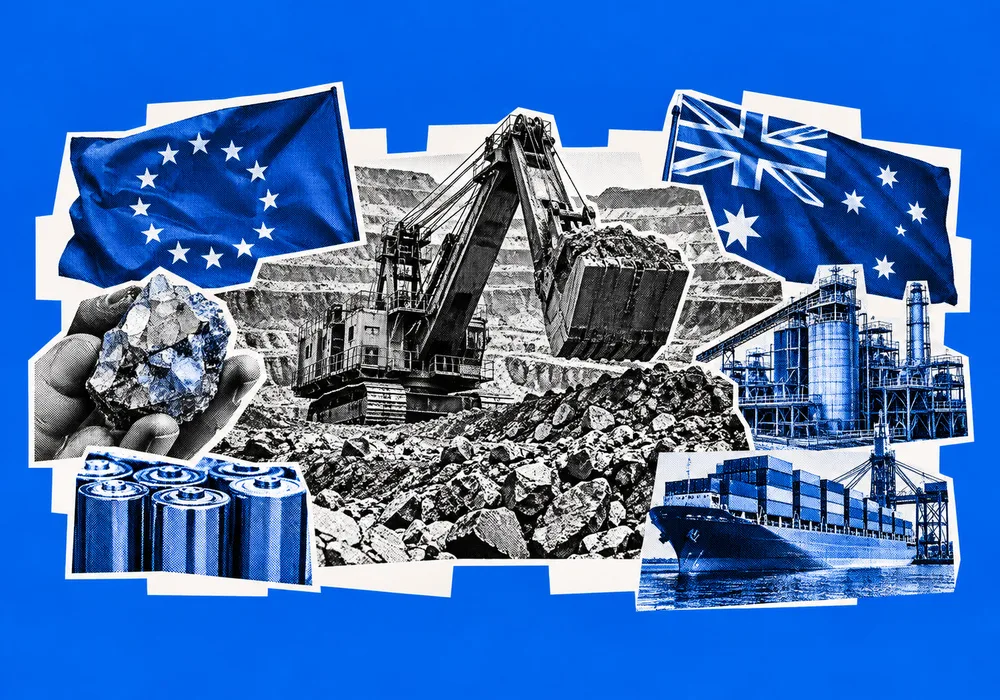
The European Union is preparing for substantial investment in Australia's critical minerals sector as it seeks to reduce dependence on China and strengthen supply chains essential to defence, advanced manufacturing and the energy transition. The initiative could deepen EU–Australian economic and security cooperation, with investment expected to extend beyond mining into processing and refining.
The European Union is preparing to increase investment in Australia's critical minerals industry as it seeks to diversify supply chains and reduce its exposure to China, which occupies a dominant position in several strategically important mineral markets. EU Ambassador to Australia Lawrence Meredith said on 27 October that Australia was among the most promising partners for this effort, given its resource base and the growing alignment between European and Australian economic and security priorities. The initiative reflects a broader European shift towards treating access to raw materials as a matter of industrial resilience and strategic autonomy rather than simply a question of purchasing commodities at the lowest price.
Critical minerals are essential to a wide range of industries, including renewable energy, electric vehicles, electronics, advanced manufacturing and defence. Rare earth elements, for example, are used in permanent magnets found in electric motors and wind turbines, as well as in various military and aerospace systems. Gallium and antimony also have important applications in electronics, specialist materials and defence-related technologies. Concentration of supply and processing capacity in a small number of countries leaves European manufacturers vulnerable to export restrictions, geopolitical disputes and sudden disruptions to international trade.
China's influence extends beyond the extraction of raw materials to the processing stages required to turn them into usable industrial inputs. Expanding access to Australian resources could therefore help the EU diversify its sources of supply, but the strategic value of the partnership will depend on whether it can establish reliable processing capacity and commercially viable supply arrangements alongside new mining projects.
Trade Agreement Creates a Route for Investment
The economic framework for deeper cooperation is already in place. The EU and Australia concluded negotiations on a free trade agreement in March 2026 after eight years of talks. Once signed and ratified, the agreement is expected to remove the EU's 5.5% tariff on critical minerals, improving the commercial conditions for Australian exports and European investment. Its entry into force depends on the completion of the necessary procedures by both sides.
The European Investment Bank could become an important part of this process. According to Meredith, negotiations on a memorandum of understanding between Australia and the bank were close to completion. Such an arrangement could help channel European financing towards strategic projects, although the precise structure and scale of future investments have not yet been confirmed. The EU's policy proposals include up to €10 billion for critical raw materials within a broader €409 billion competitiveness fund for the 2028–2034 budget period. This is a proposed funding allocation rather than a confirmed investment package for Australia alone.
Australia is competing for international capital with other resource-rich partners, including Brazil, South Africa and Canada. The EU's approach is therefore not based on replacing one dominant supplier with a single alternative, but on building a wider network of suppliers and industrial partnerships. Diversification across several countries could reduce the impact of disruptions in any one market, provided that alternative projects deliver sufficient volumes at competitive costs.
Processing Capacity Becomes a Strategic Priority
Mining alone will not resolve Europe's supply-chain vulnerabilities. Much of the strategic value of critical minerals lies in refining and processing, where raw materials are converted into products suitable for industrial use. China has established a strong position in several of these stages, making it difficult for competing producers to enter the market even when alternative mineral deposits are available.
Australia is seeking to capture a greater share of this value by placing more emphasis on processing and refining in its critical minerals strategy. The shift creates an opportunity for European investors to support projects that connect Australian resources with European industrial demand. Rather than relying exclusively on imports of unprocessed materials, the partners could develop a more integrated supply chain involving extraction, processing, technology and long-term purchasing agreements.
The challenge is financial as well as technical. Processing facilities require substantial upfront investment, reliable energy supplies, specialised expertise and predictable demand. Projects can also struggle when mineral prices fall or when established producers benefit from economies of scale. European public financing and long-term contracts could help reduce some of these risks, but investment decisions will ultimately depend on the commercial viability of individual projects and the ability to bring them into operation.
Critical Minerals Link Trade and Defence
The investment initiative is also connected to the expanding security relationship between the EU and Australia. Cooperation in defence increasingly depends on access to materials used in electronics, communications, advanced manufacturing and other dual-use technologies. Securing reliable supplies is therefore relevant not only to Europe's industrial competitiveness but also to its ability to expand defence production and sustain technological development.
The EU has broader ambitions to mobilise €800 billion for defence under its ReArm Europe initiative by 2030. This is a wider European defence-financing ambition, not a dedicated allocation for Australian mineral projects. Nevertheless, the relationship between raw-material security and defence industrial capacity provides a strategic rationale for closer cooperation with Australia, particularly where the same materials support civilian technologies and military systems.
Research cooperation could reinforce these links. Australia's expected association with Horizon Europe, the EU's flagship research and innovation programme, could create additional opportunities for collaboration in areas such as advanced materials, industrial technologies and clean energy, subject to the programme's applicable arrangements. Together, trade liberalisation, investment and research cooperation could give the relationship a broader industrial foundation.
From Political Commitments to Deliverable Projects
The immediate priority is to translate the expanding diplomatic framework into investments that produce measurable results. At the International Mining and Resources Conference in Sydney on 27 October, Australian officials also highlighted the need to move from policy agreements towards concrete projects. Australia's critical minerals prospectus identifies investment opportunities across the sector, while its proposed strategic reserve is initially focused on gallium, antimony and rare earths. These materials are among the areas where European demand and Australian supply ambitions could converge.
The scale of the opportunity remains conditional. Trade agreement ratification, financing arrangements, project approvals, infrastructure requirements and the development of processing capacity will determine how quickly investment can materialise. Competition from other international investors could also affect which projects receive funding and how much production is directed towards European markets.
For the EU, the Australian initiative is part of a longer-term effort to make its industrial base less vulnerable to concentrated supply chains and geopolitical pressure. For Australia, European capital offers an opportunity to expand its role beyond resource extraction and develop more sophisticated industrial capabilities. If both sides can align financing with reliable supply agreements and downstream production, the partnership could strengthen their economic relationship while reducing some of the strategic risks associated with dependence on a narrow group of suppliers.
Sources: Australian Government, Austrade