
Boris Nemtsov’s Convicted Killers Walk Free in Chechnya, Echoing the Politkovskaya Case

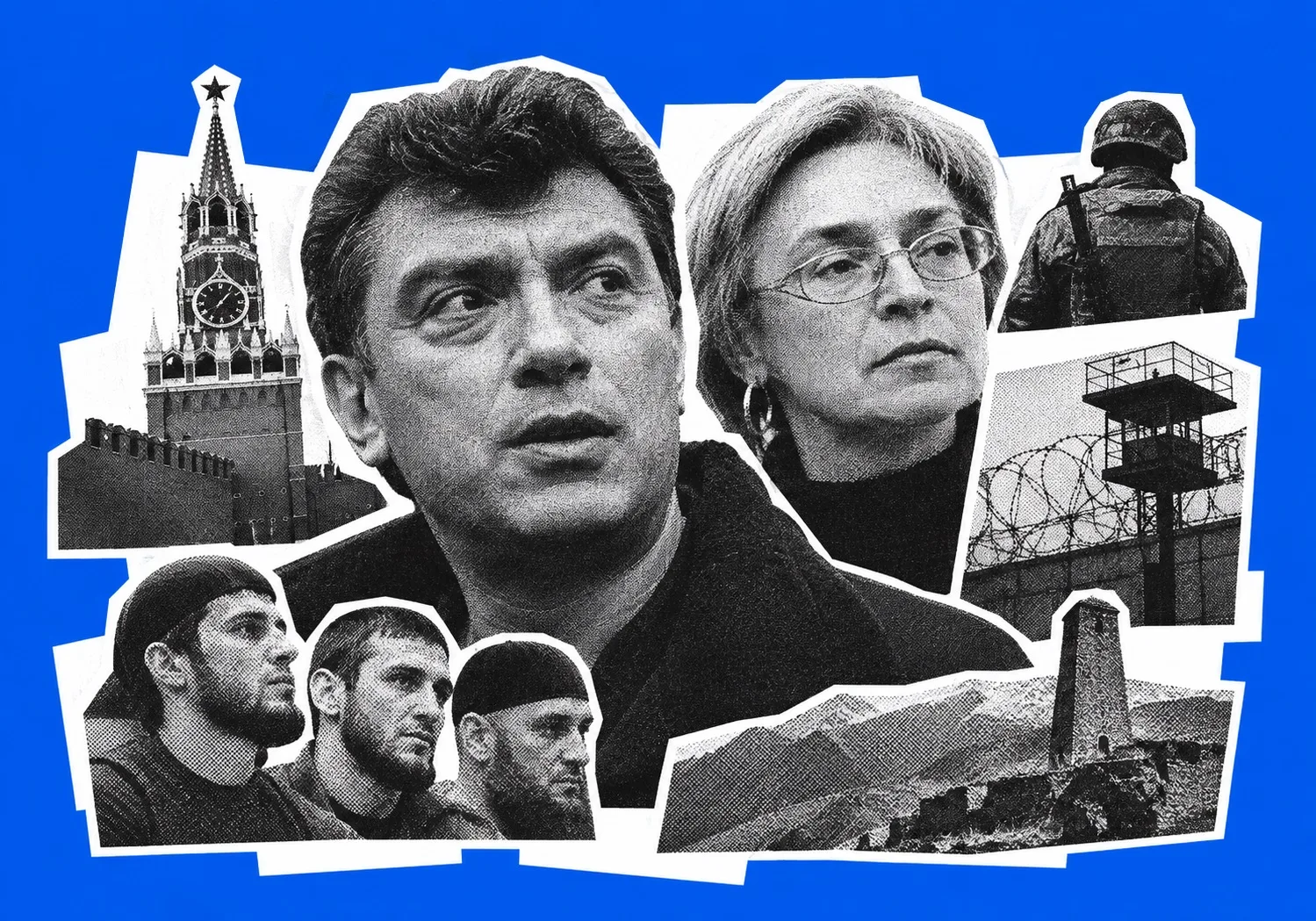
All five men convicted over the 2015 assassination of Russian opposition leader Boris Nemtsov have left prison years early, with three quietly returning to Chechnya via military contracts without serving on the front line in Ukraine, a new investigation reveals. The findings mirror the case of murdered journalist Anna Politkovskaya - prompting renewed European scrutiny over Moscow’s impunity for political assassinations.
The findings, published on November 16, 2026, by independent investigative outlet Proekt, suggest that four of the five men sentenced for Nemtsov’s murder secured early release through military contracts, while the fifth completed his sentence earlier this year.
The investigation draws on leaked government records, court documents and a confidential source familiar with the men’s circumstances. Russian prison authorities and Chechen officials had not responded to Proekt’s requests for information by the time of publication.
The revelations come just weeks after the European Union marked the 20th anniversary of Anna Politkovskaya’s murder with a renewed demand for accountability. Although Russian courts convicted six people in that case, investigators never established who commissioned the killing.
Nemtsov’s killers reportedly returned to Chechnya instead of the battlefield
Boris Nemtsov, a former Russian deputy prime minister and prominent critic of Vladimir Putin, was shot dead on February 27, 2015, while walking across a bridge near the Kremlin in Moscow.
Five men were convicted in 2017. Zaur Dadayev, a former officer in Chechnya’s Sever security battalion, received the longest sentence of 20 years. Anzor Gubashev was sentenced to 19 years, his brother Shadid to 16 years, Temirlan Eskerkhanov to 14 years and Khamzat Bakhayev to 11 years.
According to Proekt’s November 16 investigation, Dadayev and the Gubashev brothers signed contracts connected to Russia’s war against Ukraine but subsequently settled in Chechnya rather than serving on the front line.
The outlet’s confidential source said the men had been instructed to keep their release secret, with the threat of being returned to prison if their whereabouts became public.
Dadayev reportedly left a penal colony in Russia’s Irkutsk region in October 2024. Proekt found that his employment record at the colony had been closed on grounds of transfer, but it could not establish that he had been moved to another prison.
Leaked Russian records subsequently placed him in Yukarchoy, a remote settlement approximately 80 kilometres from Grozny. The investigation also found that he had married a woman employed by the Chechen administration and that the couple had a child in October 2024.
The Gubashev brothers are reportedly living in Grozny, where they have established families and intend to build homes.
Proekt said the documentary evidence supported its source’s account, although the men's releases have not been independently confirmed through official prison records.
Five convictions, five men outside prison
The other two men convicted in Nemtsov’s assassination are also no longer serving their original sentences.
Temirlan Eskerkhanov was released in 2024 after signing a contract with Russia’s Defence Ministry. Russian state media initially reported that he had been sent to the war in Ukraine.
However, Novaya Gazeta Europe subsequently reported that he had been assigned to guard industrial facilities in Russian-occupied Mariupol. That account does not establish whether he ever participated in combat operations.
Khamzat Bakhayev, meanwhile, completed his 11-year sentence in spring 2026. Unlike the other four men, his release was not connected to military recruitment.
The distinction matters. The five cases do not represent a single legal process: one man served his full sentence, while four reportedly benefited from military contracts, including three whose alleged return to civilian life raises questions about whether the contracts were ever intended to result in frontline deployment.
The new investigation has also renewed attention on the people suspected of organising the assassination.
Russia’s investigators identified Ruslan Mukhudinov, a former driver for Chechen security officer Ruslan Geremeyev, as an alleged organiser and commissioner of the killing. Mukhudinov has been wanted since 2015, but has never stood trial.
Proekt reported that he may still be living in Chechnya despite his wanted status. Journalists have also examined possible connections between the assassination and influential figures in the Chechen leadership. Those suspicions have not resulted in convictions, and the responsibility of any higher-level organisers remains legally unproven.
Politkovskaya’s murder: a presidential pardon and a case without a named mastermind
The killing of Anna Politkovskaya presents another example of how convictions in a politically sensitive murder case have failed to produce full accountability.
Politkovskaya, an investigative journalist at Novaya Gazeta known for reporting on human rights abuses in Chechnya and criticising the Russian authorities, was shot dead in the lift of her Moscow apartment building on October 7, 2006.
Six people were eventually convicted of involvement in her murder.
Rustam Makhmudov, identified by the court as the gunman, received a life sentence. Lom-Ali Gaitukayev, convicted of organising the killing, was also sentenced to life imprisonment but died in custody in 2017.
Former police officer Sergei Khadzhikurbanov received a 20-year sentence for his role in organising the murder. Yet in November 2023, it emerged that he had been pardoned after participating in Russia’s war against Ukraine.
His lawyer confirmed that Khadzhikurbanov had joined the military campaign and received a pardon. The decision drew criticism from Politkovskaya’s children and her former colleagues at Novaya Gazeta.
He was not the only convicted participant to leave prison before completing his original sentence.
Dzhabrail Makhmudov, one of the gunman’s brothers, was initially sentenced to 14 years. His sentence was subsequently reduced, and he was released on parole in February 2024.
Another convicted participant, former Moscow police officer Dmitry Pavlyuchenkov, received an 11-year sentence in 2012 after cooperating with investigators. His role included arranging surveillance of Politkovskaya before the murder.
Unlike Khadzhikurbanov, neither Makhmudov’s parole nor Pavlyuchenkov’s case has been established as involving a presidential pardon in exchange for military service.
The investigation into Politkovskaya’s murder ultimately produced convictions for the gunman and several accomplices, but not for the person who ordered the assassination.
The EU questions Russia’s commitment to accountability
On October 7, 2026, the European External Action Service issued a statement marking 20 years since Politkovskaya’s assassination.
The EU recalled her investigations into torture, corruption, extrajudicial punishment and abuses of power, and stressed that the Russian judicial proceedings had failed to identify the person who commissioned her murder.
Brussels also explicitly raised concerns about the presidential pardon granted to Khadzhikurbanov following his participation in the invasion of Ukraine.
The EU renewed its demand for an independent, transparent and effective investigation capable of bringing everyone responsible to justice.
Its statement placed the unresolved murder within a broader pattern of repression of independent journalism and civil society in Russia, arguing that restrictions on public scrutiny have deepened alongside the war against Ukraine.
The intervention was significant because it addressed more than the original failure to identify the mastermind. It also questioned what accountability means when a person convicted of involvement in a journalist’s murder can obtain a pardon through military service.
European courts identified failures in both murder investigations
The parallels between the two cases extend beyond the release of convicted participants.
The European Court of Human Rights has separately found that Russia failed to conduct effective investigations into the murders of both Nemtsov and Politkovskaya.
In July 2023, the court ruled in Nemtsova v. Russia that the authorities had failed to adequately investigate who had commissioned and organised the opposition politician’s assassination.
The judges acknowledged that Russian investigators had collected substantial evidence against the direct perpetrators. However, they found serious deficiencies in the separate investigation into the people behind the killing.
The court noted that allegations of a possible political motive and links to senior Chechen officials required thorough examination. It also identified failures to pursue potentially important witnesses and investigative leads.
In Politkovskaya’s case, the Strasbourg court reached a similar conclusion in July 2018. The investigation had resulted in convictions, but the authorities had not adequately established who commissioned the murder.
These judgments are important because they distinguish between prosecuting those who physically carried out an assassination and investigating the wider network of responsibility.
In neither case did the European court establish the identity of the ultimate mastermind. Instead, its findings concerned Russia’s failure to conduct sufficiently effective investigations into that question.
How Russia’s war became a route out of prison
Russia’s invasion of Ukraine introduced a new mechanism through which convicted criminals could leave prison before completing their sentences.
Military recruitment initially became associated with the Wagner mercenary organisation before the Russian state expanded its own recruitment arrangements for prisoners.
For some inmates, military service offered a route to release or a pardon that would otherwise have been unavailable.
The cases of Khadzhikurbanov and the men convicted in Nemtsov’s assassination demonstrate how that mechanism has intersected with some of Russia’s most prominent political murder cases.
There is, however, an important difference between them.
Khadzhikurbanov’s participation in the war and subsequent pardon were publicly confirmed by his lawyer. In the Nemtsov case, Proekt’s latest investigation suggests that three convicted men obtained their freedom through military contracts without actually being deployed to the front.
If confirmed, their circumstances would raise an additional question: whether military recruitment arrangements were used not simply to obtain soldiers, but also to facilitate the release of particular prisoners.
The available evidence does not establish who authorised the three men’s reported releases or why they were allegedly allowed to remain in Chechnya.
Nevertheless, the reported arrangements highlight the limited transparency surrounding decisions that can override lengthy prison sentences.
For the families of Nemtsov and Politkovskaya, the consequences are especially significant. In both cases, investigators secured convictions after years of investigation and legal proceedings. Yet the question of who ultimately ordered the murders remains unresolved.
The latest findings suggest that prison sentences imposed on some of those convicted may not have remained in force.
Russia’s use of military service as a path to freedom has therefore added another dimension to two long-running cases of unresolved accountability – at a time when European institutions continue to demand answers about the people who commissioned the killings.
Sources: Proekt, Novaya Gazeta Europe, European External Action Service (EEAS), European Court of Human Rights (ECHR), Anna Politkovskaya Investigation Archive