
Trump, Putin and Xi Gather in China: What to Expect From Their Talks

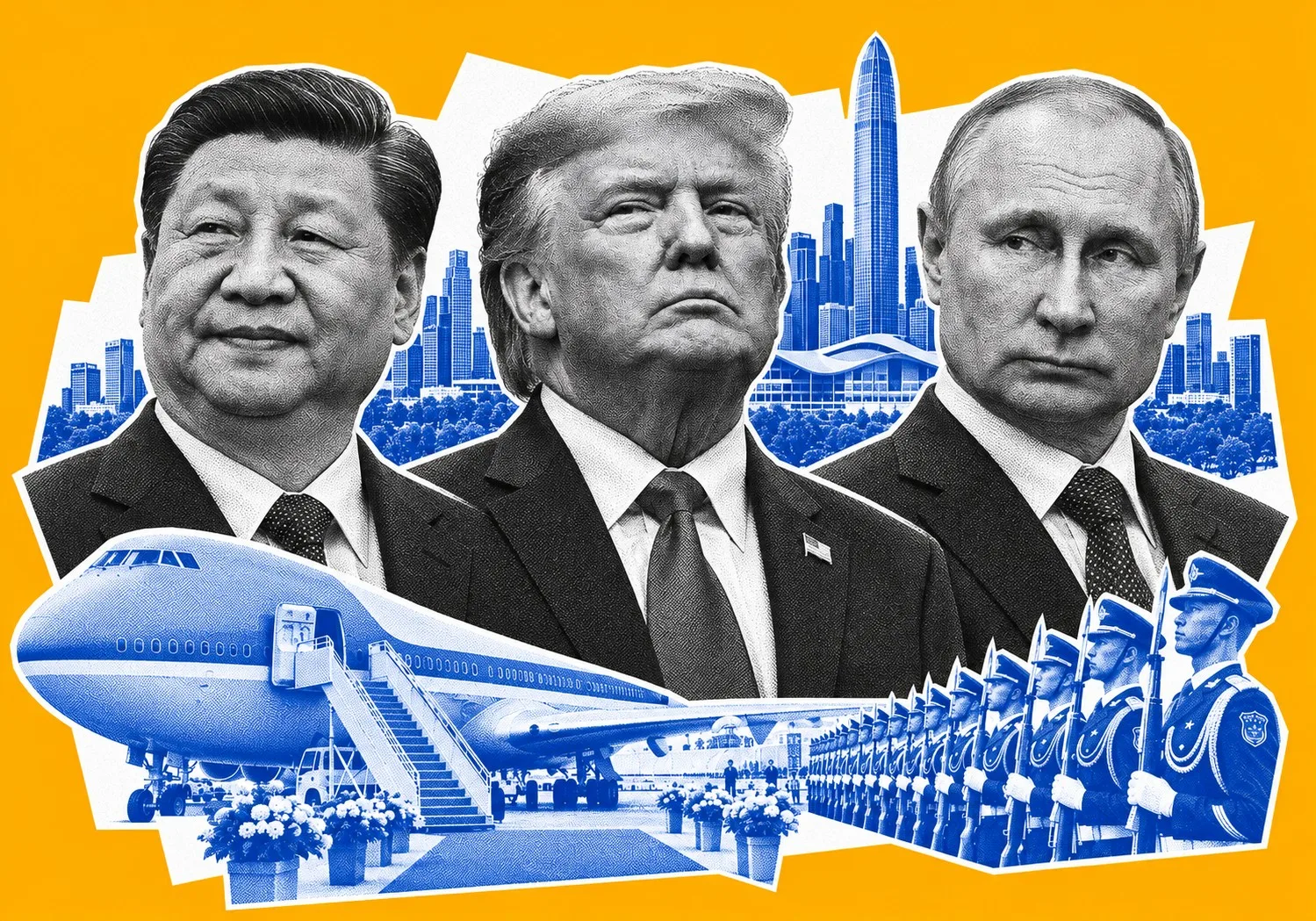
Donald Trump, Vladimir Putin and Xi Jinping have gathered in Shenzhen, China, with different priorities: Trump wants progress on nuclear arms control and an end to Russia’s war in Ukraine; Putin seeks to show that Western efforts to isolate him have failed; and Xi wants to showcase China’s technological strength and its role in global diplomacy. Their first three-way summit is scheduled for Thursday, 19 November.

Trump greeted Putin before Wednesday’s Asia-Pacific Economic Cooperation (APEC) welcome banquet, their first personal encounter since talks in Alaska in August 2025 failed to produce a breakthrough on the war. Xi and Putin had held talks earlier, while Trump arrived from the Philippines to a personal welcome from the Chinese president. Xi Jinping breaks protocol to greet and hug Trump at China airport. Separate Trump–Xi and Trump–Putin meetings are also planned for Thursday. Kyiv and European capitals fear that discussions without Ukrainian representatives could make the country’s future part of a wider bargain over security and influence.
Ukraine Without Kyiv
Xi and Putin met for approximately two hours before Trump’s arrival.
China’s Foreign Ministry said they discussed expanding cooperation in trade, energy, education and investment, alongside closer exchanges between their governments and armed forces. Both advocated a multipolar international order, challenging Washington’s influence and presenting their partnership as a source of stability.
The Kremlin said Ukraine was also discussed. Spokesman Dmitry Peskov said Putin briefed Xi on his recent Moscow talks with Trump’s envoys Steve Witkoff and Jared Kushner. Foreign policy aide Yuri Ushakov said the two presidents discussed the forthcoming meeting with Trump, but disclosed no details. Neither side announced new concessions or a common peace proposal.
The American position on discussing Ukraine has shifted during preparations. Last week, administration officials said the war belonged on a separate negotiating track because China was not involved in those talks. Trump subsequently said he intended to discuss ending the war with both leaders.
“I think it’s very close to getting it done,” he said on Tuesday, without disclosing terms that would explain his confidence.
An American official confirmed that Trump and Putin would also meet separately on Thursday. The Kremlin suggested that their encounter could involve brief, informal talks without large delegations, but the format and timing remained unclear. It adds another opportunity for direct negotiations after the Alaska meeting failed to secure an agreement.
Ukraine’s President Volodymyr Zelenskyy warned last month against a meeting resembling Yalta in 1945, when Stalin, Churchill and Roosevelt negotiated Europe’s postwar order.
“We really don’t want this to turn into ‘Yalta 2, 3, 4’ with a redistribution of influence,” he said.
The concern is that Moscow could press its demands in a room without Ukrainian or European representatives.
No settlement terms have been announced. A ceasefire, territorial negotiations and long-term security arrangements would involve different commitments, and Trump’s optimism offers no indication of which might be achievable. Any proposal would require decisions the three presidents cannot take on Kyiv’s behalf.
European governments would also retain control over their own sanctions, financial support and security commitments.
China’s role remains uncertain. Its public description of Thursday’s summit refers broadly to peace and strategic stability. Peskov’s account establishes that Putin discussed Ukraine with Xi, but gives no evidence that Beijing endorsed a specific Russian proposal or offered to pressure Moscow. That leaves a gap between Trump’s stated ambition to end the war and the positions disclosed by the other participants.

\## Putin’s Stage, Xi’s City
For Putin, the diplomatic benefit may precede any agreement. Rosenberg argues that the summit is already a coup for the Kremlin: a leader whom Western governments sought to isolate after the full-scale invasion is appearing alongside the presidents of China and the United States. It gives Putin an opportunity to claim that sanctions and diplomatic pressure have failed to exclude Russia from decisions about international security. Luke Coffey, a Hudson Institute senior fellow, offered a less favourable reading of the format for Washington. He told RFE/RL that the meeting could resemble the United States facing a coordinated Chinese–Russian position, with Moscow the junior partner. He questioned whether substantive results would follow, arguing that the encounter itself offered Beijing and Moscow diplomatic validation.
Xi’s reception for Trump also drew attention. The Chinese president greeted him at the airport, returning a courtesy Trump had extended during Xi’s September visit to Washington. Putin received no equivalent welcome. Sky News Asia correspondent Helen-Ann Smith highlighted both the contrasting receptions and Trump’s position beside Xi at the leaders’ gathering, interpreting the choreography as a deliberate display of hierarchy.
The setting carries a family connection.
Xi’s father, Xi Zhongxun, championed special economic zones while leading Guangdong at the start of China’s reform era. Shenzhen became one in 1980, opening it to foreign investment. Today, it is home to Huawei, Tencent and electric-car maker BYD, offering visiting leaders a demonstration of Chinese technological ambition at a time of friction with Washington over advanced technology.
Their public speeches addressed the economic disputes surrounding the summit.
Xi urged greater openness to trade and investment and promised improvements in market access, regulation and standards.
Putin attacked Western sanctions and export restrictions, arguing that attempts to isolate Russia had failed. The speeches set out positions for an audience of business leaders as well as governments: Beijing was promoting itself as a predictable trading partner, while Moscow was seeking recognition that it remained an important economic and diplomatic player. Those messages overlap without making the two countries’ interests identical. Russia wants to weaken the pressure imposed over its invasion of Ukraine; China is managing a much broader economic relationship with the United States. Their meeting gave them an opportunity to coordinate before facing Trump, although the published accounts reveal little about how closely their negotiating positions align.
Hosting both presidents allows Xi to present China as a power capable of convening its rivals. But Rosenberg distinguishes Putin’s diplomatic gains from his military position. Russian forces continue attacking Ukrainian towns and cities, and Moscow rejects an unconditional, comprehensive ceasefire. Ukraine’s strike on the bridge linking Russia to occupied Crimea on the eve of the summit underlined that distinction: access to a global stage has not ended Russia’s vulnerability on the battlefield.
Warheads, Chips and Trade
Nuclear arms reduction remains Trump’s stated priority for the trilateral meeting. New START, the last bilateral treaty limiting American and Russian strategic nuclear arsenals, expired in February, adding urgency to discussions about a replacement framework.
Washington wants China involved, but Beijing has long argued that the two larger nuclear powers should reduce their arsenals first. The imbalance is substantial. SIPRI’s 2026 assessment estimated that Russia and the United States held almost 86 per cent of the world’s nuclear warheads. Its January estimates put Russia’s total inventory at 5,420, America’s at 5,042 and China’s at about 620. The American and Russian figures include retired warheads awaiting dismantlement and should not be confused with deployed weapons.
There is no announced agreement on how three-way negotiations would proceed. Before the trip, a senior American official told Reuters: “We do not expect to get to any kind of agreement.”
The administration described the encounter as the beginning of a conversation. Even agreement to continue would leave negotiators to resolve which weapons to count, what limits to impose and how to verify compliance. Iran is also expected to feature. American officials said Trump would raise the US–Israeli war against Iran, bringing Washington’s demands into discussion with two governments that maintain close relations with Tehran.
Mark Katz, professor emeritus at George Mason University and an Atlantic Council fellow, told RFE/RL that Trump might seek Russian and Chinese pressure on Iran, but questioned whether either would cooperate. Washington has not disclosed a specific proposal for them to consider.
Trump’s separate meeting and working lunch with Xi are expected to focus on implementation of their trade arrangements, Chinese rare-earth exports and American technology restrictions. US officials have described the encounter as a review of existing commitments and said no tariff announcement was expected. They have complained that rare-earth supplies are arriving too slowly and in insufficient quantities, explaining that the Busan arrangement had been extended for two months rather than six. The dispute matters to manufacturers beyond the two countries. Uncertainty over export licences and deliveries affects businesses that depend on Chinese supplies, while US restrictions on advanced chips complicate Beijing’s technological ambitions.
Xi’s promises of greater openness sit alongside Washington’s insistence that its export controls are not negotiable.
Artificial intelligence is another expected topic.
Relations are also shadowed by the ousting of Nvidia chief executive Jensen Huang after an affair with a woman suspected of spying for China, an allegation Beijing rejects. Trump has sought warmer relations with Xi while maintaining restrictions on Chinese access to American technology. Taiwan could bring security directly into the bilateral talks. Trump said he did not plan to raise it himself but expected Xi to do so. Its importance in advanced semiconductor production gives any increase in tension implications for global supply chains. Before reaching China, Trump met the leaders of Japan, India and Australia in Manila and promised expanded defence cooperation with the Philippines, placing his engagement with Xi alongside relationships with countries concerned about Chinese power.

A separate meeting with North Korean leader Kim Jong Un remains unconfirmed. Secretary of State Marco Rubio said Trump was prepared for dialogue but acknowledged that an encounter might not materialise. Beyond Shenzhen, Trump and Xi are expected to meet again at next month’s G20 summit in the United States, providing another opportunity to address unresolved trade disputes.
Sources: The Washington Post, BBC News, Euronews, China’s Foreign Ministry, Ukrainska Pravda, ABC News, Sky News, Reuters, SIPRI Yearbook 2026, KBS, Associated Press