
Spain Builds Industrial Alliance to Protect Europe’s Undersea Infrastructure

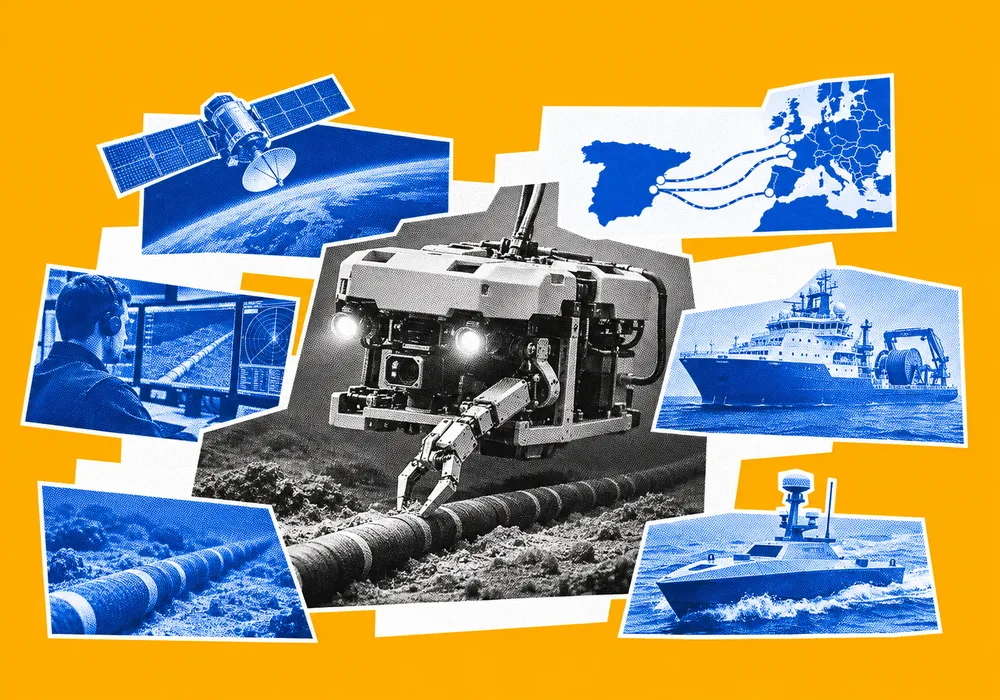
Spanish defence company Indra will coordinate a seven-company alliance developing an integrated system to monitor and protect critical underwater infrastructure. The SIPRIS initiative combines artificial intelligence, acoustic sensors, autonomous vehicles and satellite communications, reflecting Europe’s growing focus on the security of subsea cables and other strategic assets.
Spanish defence and technology company Indra will coordinate a new industrial alliance aimed at developing capabilities to monitor and protect critical underwater infrastructure. The initiative, named SIPRIS, brings together seven Spanish companies seeking to combine their technological expertise into a single surveillance and protection system covering the maritime environment from the surface to the seabed.
The companies signed a memorandum of understanding on 4 November 2026 during the Euronaval defence exhibition in Paris. Alongside Indra, the partnership includes SAES, UTEK, Aragon Photonics, Iqua Robotics, FYLA and Sateliot. The agreement establishes a framework for cooperation on technologies intended to improve the detection of suspicious underwater activity, inspect critical infrastructure and strengthen European technological autonomy.
Indra will act as the overall system integrator and coordinator, responsible for defining the architecture and ensuring that the different technologies operate as part of a common platform. The company will contribute its SEADEF naval mission systems and IndraMind artificial intelligence platform, as well as unmanned aerial vehicle capabilities and communications management systems.
Integrating Sensors, Drones and Autonomous Underwater Vehicles
The other partners will contribute specialised technologies covering different aspects of underwater surveillance. SAES will provide underwater acoustic sensors and advanced sonar processing capabilities designed to detect and classify potential threats. UTEK will develop autonomous surface vehicles, while Iqua Robotics will contribute autonomous underwater vehicles capable of inspecting submerged infrastructure and identifying potential anomalies.
Aragon Photonics will introduce distributed acoustic sensing technology based on fibre-optic networks. This technology can detect acoustic events along underwater communications cables, potentially allowing operators to identify unusual activity in their vicinity. FYLA will provide underwater optical communications technologies to facilitate information exchange between devices deployed beneath the surface, while Sateliot will contribute satellite communications and information services to extend coverage across geographically dispersed maritime areas.
The combination of these capabilities is intended to create a common operational picture of the underwater environment. Rather than relying on a single surveillance technology, SIPRIS is designed to integrate information from multiple sources, allowing operators to monitor infrastructure, identify irregularities and coordinate inspections.
Europe’s Growing Concern Over Subsea Infrastructure
The initiative comes amid growing European concern about the vulnerability of underwater infrastructure. Subsea telecommunications cables, electricity interconnectors and gas pipelines are essential to European economies, connecting national energy systems and carrying a substantial share of international data traffic. Their disruption can affect communications, energy supplies and the functioning of interconnected markets, extending the consequences well beyond the maritime area where an incident occurs.
Monitoring these assets presents significant technical challenges. Underwater infrastructure often extends across vast maritime areas, making continuous surveillance difficult and expensive. Damage or interference may not be immediately detected, while identifying the cause of an incident can require specialised equipment and underwater inspections. The security challenge also extends beyond deliberate interference to include accidents, technical failures and other forms of disruption.
The issue has become particularly prominent following incidents involving damage to subsea cables and energy infrastructure in the Baltic Sea. European governments have increasingly focused on improving maritime surveillance, information-sharing and the ability to respond to suspicious activity around critical infrastructure. These efforts have highlighted the need for technologies capable of monitoring the seabed rather than concentrating exclusively on surface and coastal security.
From Industrial Cooperation to Operational Deployment
SIPRIS reflects an approach in which civilian industrial technologies and defence capabilities are brought together to address these vulnerabilities. Acoustic monitoring, autonomous underwater vehicles, fibre-optic sensing and satellite communications could provide complementary layers of surveillance. Their integration could help reduce detection times and improve the ability to inspect damaged infrastructure, although the practical effectiveness of the system will depend on its testing and deployment.
For Spain, the partnership offers an opportunity to strengthen its position in the European defence technology sector while developing domestic expertise in an increasingly important area of maritime security. It also brings together companies specialising in different technological fields, creating a framework for cooperation that could be expanded to include additional industrial and research partners.
However, SIPRIS remains at an early stage of development. The memorandum signed in Paris establishes cooperation between the seven companies but does not mean that a fully operational surveillance network has already been deployed. The immediate objectives include coordinating demonstrations and joint activities to integrate and validate the participating technologies before the system can be introduced commercially.
The project is also intended to remain open to additional companies, technology centres and other industrial participants. This could allow the initiative to expand its technological base and incorporate further capabilities as operational requirements develop.
For Europe, the initiative represents another attempt to strengthen technological independence and improve the protection of infrastructure essential to economic and security interests. Its significance will ultimately depend on whether the industrial agreement can be translated into a tested and deployable system. Nevertheless, the partnership illustrates how the protection of the seabed is becoming an increasingly important component of European security planning.
Sources: Indra Group, Europa Press, Joint Forces