
Russia’s Regional Fiscal Crisis: How the Kremlin Is Shifting War Costs to the Provinces

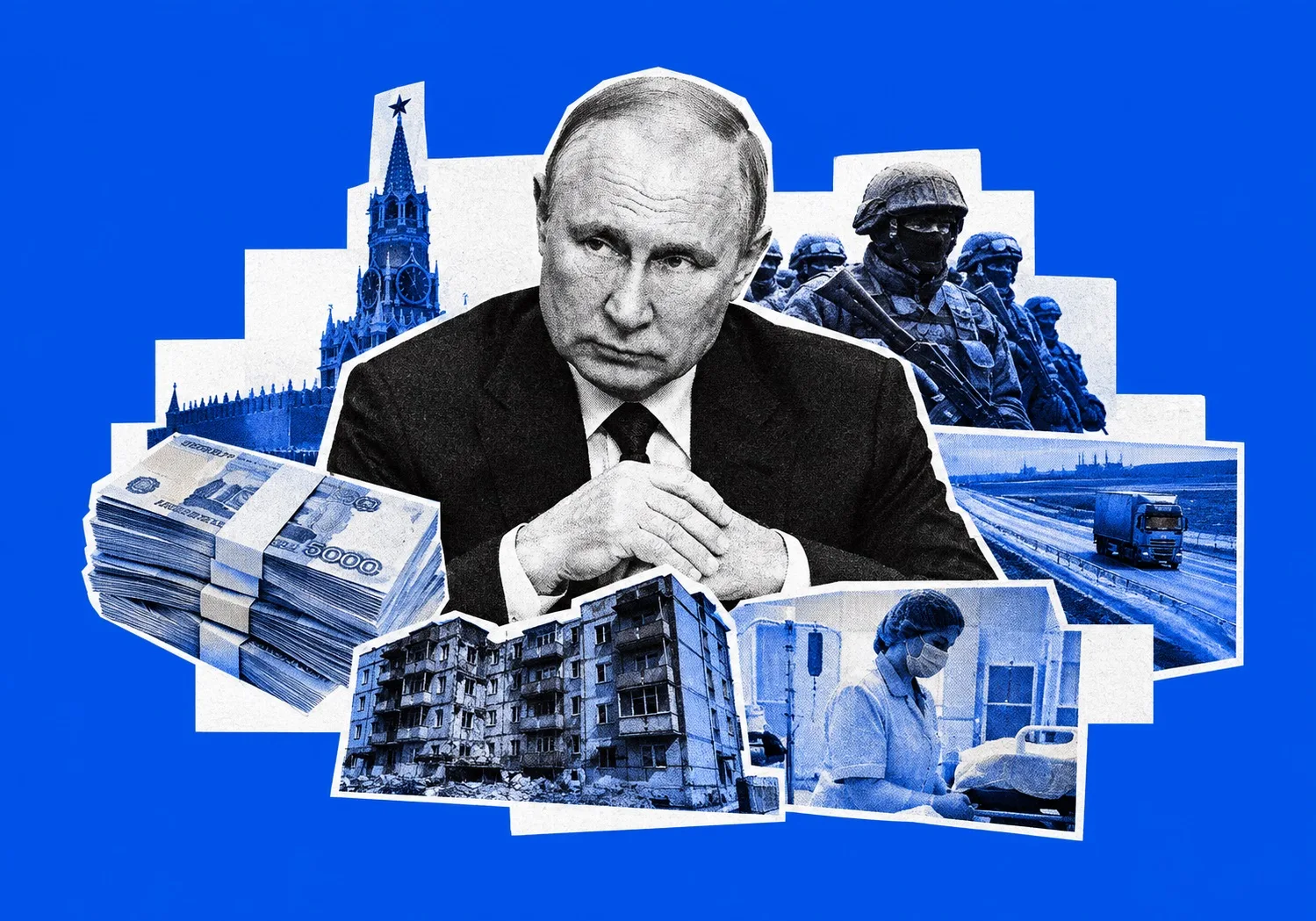
Russia’s regional governments entered 2026 under severe financial strain after the 2022 invasion, as Moscow forces them to co-finance the war. Consolidated regional deficits reached a record RUB 1.56tn ($20bn) in 2025 - five times official projections - with the shortfall expected to hit RUB 1.9tn in 2026, as 56 regions already struggle with deep budget gaps.
For much of the war, regional finances were cushioned by a combination of federal transfers, cheap budget loans and strong nominal economic growth. That arrangement is now under strain.
In 2025, federal tax policy increased the centre’s share of regional revenues to a record 57%. Corporate income tax was raised from 20% to 25%, while the federal share of the tax rose from 3% to 8%. For regional governments, this meant that a larger proportion of an already pressured tax base was being claimed by Moscow.
The timing matters. Regional spending increased by 8.9% in 2025, but inflation-adjusted own-source revenues contracted. Cumulative inflation between 2021 and 2025 reached almost 50%, meaning that the apparent growth in nominal expenditure substantially overstated the improvement in the services regions could actually provide.

By the end of 2025, between 70 and 74 of Russia’s 89 administrative subjects were spending more than they collected. In the first quarter of 2026, 56 regions were already in deficit, compared with 46 a year earlier.
The deterioration in corporate income tax has been particularly damaging. CIT receipts fell by 11.7% in the first quarter of 2026, with 55 regions recording declines. The sharpest falls came in economies heavily exposed to sanctions, exports and heavy industry. Kemerovo, for example, recorded a 70% fall in CIT receipts, while Vologda suffered a 49% decline.

The tax changes did not create all of these problems. Sanctions, weaker exports and corporate tax optimisation have also eroded regional revenues. But Moscow's decision to increase its own share of taxation has left governors with less room to absorb those shocks.
The war has become a regional expenditure programme
The Kremlin's centralisation of revenue has coincided with the decentralisation of many costs associated with the war.
Regional governments have been expected to finance recruitment incentives that help the federal authorities maintain military manpower without declaring a new general mobilisation. In 2024 and 2025, regions spent an estimated RUB 840bn–1tn a year on military bonuses, enlistment incentives and veteran compensation.
The sums paid to recruits vary dramatically. Regional signing bonuses ranged from RUB 300,000 in the Komi Republic to RUB 4.1mn in St Petersburg. Recruitment intermediaries received another RUB 7.7bn in 2024–25 and RUB 3.2bn during the first four months of 2026.

The pressure is becoming more direct. In March 2026, Ryazan oblast required private companies to provide between two and five recruits each for the armed forces.
Regional governments are also financing the reconstruction of occupied Ukrainian territories. By 2025, regional budgets had paid for the restoration of 10,000 infrastructure facilities in occupied Donetsk, Luhansk, Kherson and Zaporizhzhia. A further RUB 340bn was allocated to those four territories in 2026 - equivalent to 10% of the entire federal pool of intergovernmental transfers.
For governors, these are not optional expenditures. Yet they compete with healthcare, municipal infrastructure and other responsibilities that remain firmly at the regional level.

That is where Russia's fiscal structure becomes politically important. The federal centre controls the larger pool of resources and determines many of the priorities, while regional authorities remain visible to citizens when hospitals deteriorate, utilities fail, or public employees lose their jobs.
Debt is replacing the old federal safety net
The traditional solution to regional financial stress was to borrow cheaply from the federal government. That system has weakened.
As federal transfers stagnated in real terms and inexpensive budget loans became less available, regional administrations increasingly turned to commercial banks. Consolidated regional debt reached RUB 3.5tn by early 2026, while commercial borrowing nearly tripled.
The cost is substantial. Commercial loans carry interest rates ranging from 17% to almost 30%. Regional debt-servicing costs increased by 39% in 2025 alone.
Financial reserves are moving in the opposite direction. They fell from RUB 2.9tn to RUB 1.9tn.
This changes the character of the problem. A temporary wartime deficit can theoretically be absorbed through reserves or low-cost federal lending. Borrowing at commercial rates creates a longer-term claim on future regional budgets.
In effect, civilian regional spending is being squeezed twice: first because Moscow takes a larger share of tax revenue, and then because the remaining regional resources must service increasingly expensive debt.
There is no single Russian regional economy
The fiscal crisis does not affect every part of Russia equally.
Defence-industrial centres can still benefit from the war economy. Regions such as Tula, Udmurtia, Smolensk, Chuvashia and Nizhny Novgorod have experienced higher wages and stronger personal income tax receipts as state defence orders expand. Across such centres, PIT receipts increased by 106% between 2021 and 2025.
Some Far Eastern and logistics regions have also benefited from the redirection of trade towards China and the wider Asia-Pacific market, as well as from gold-mining revenues and infrastructure investment.
But these gains coexist with severe deterioration elsewhere.
Traditional resource-exporting and industrial regions such as Kemerovo, Vologda, Tyumen, Komi, Sakhalin and Yamalo-Nenets have been hit by sanctions, weaker export revenues and corporate tax optimisation. Their deficits reached roughly 20–23% of their budgets in some cases.
Border regions face a different burden altogether. Kursk oblast had suffered estimated losses of RUB 700bn by mid-2025, Belgorod RUB 160bn and Bryansk RUB 40bn. Together they have absorbed more than RUB 900bn in direct destruction, alongside civil defence and infrastructure costs.
Drone attacks affecting almost one-third of Russia's regions in early May 2026 also produced wider economic consequences, contributing to a national fuel-logistics crisis by July and repeated mobile internet disruptions.

The result is an increasingly fragmented wartime economy: some regions receive the benefits of defence production and state investment, while others finance destruction, lost exports or military recruitment without equivalent compensation.
The bill is arriving in hospitals and municipalities
The most consequential figures may not be those on regional balance sheets.
Eighty-one of the 85 regions analysed reduced the share of their budgets devoted to healthcare between 2021 and 2025. In real terms, healthcare expenditure fell by more than 20%. Nineteen regions planned further healthcare reductions of at least 10% in 2026.
Municipal services have been cut in 66 regions. Public-sector redundancies accelerated sharply in the final quarter of 2025, rising by almost 60%, with civil servants accounting for 40% of those laid off.
These are not merely accounting adjustments. Regional authorities are responsible for much of the infrastructure through which Russian citizens encounter the state in daily life. When money is redirected towards recruitment bonuses, occupied-territory reconstruction or war-related compensation, the trade-off eventually appears in staffing, maintenance and service provision.
The political logic is clear. The Kremlin can preserve federal spending priorities while pushing the visible consequences of austerity down to governors and municipalities.
A different kind of fiscal centralisation
Russia's federal system has been heavily centralised for decades. The new development is that centralisation is no longer simply about political control or redistribution. It is increasingly functioning as a mechanism for transferring wartime risk.
Only 26 of Russia's 89 regions were net contributors to the federal budget in 2025. Yet even regions that remain economically important have less control over the revenues generated within their territories.
The shift from federal budget loans to commercial borrowing is particularly revealing. It means that the centre can preserve its own fiscal capacity while regional administrations absorb the cost of maintaining services and meeting wartime obligations. Future regional budgets will carry the eventual burden through interest payments and reduced room for civilian spending.
That arrangement may remain workable for regions benefiting from defence orders or new trade routes. It is far less sustainable for regions facing industrial decline, export losses or direct war damage.
And it leaves governors with a narrowing set of choices: raise local revenues, borrow at punitive rates, cut civilian spending, or find ways to finance Moscow's priorities from increasingly depleted regional balance sheets.
The RUB 1.9tn regional deficit forecast for 2026 is therefore more than a large number on a budget document. It marks the point at which Russia's wartime fiscal model is beginning to consume the financial buffers of the state structures closest to its population - while the federal centre retains the greater share of the resources needed to decide what gets funded.
Read also:
- Leaked draft budget documents obtained by Reuters reveal that Russia plans to spend a record 17.1 trillion rubles (€178.8 billion) on defence in 2027. The figure - a 27 percent surge over previous projections - signals Moscow’s intent to sustain a long-term war in Ukraine. Over the full three-year planning window through 2027, the Kremlin’s military ledger is scheduled to absorb an extraordinary 50 trillion rubles (€522.6 billion). Yet behind the headline numbers lies a distinct structural challenge: Moscow is financing its military obligations by expanding domestic debt, drawing down state reserves, and increasing tax rates across the domestic economy.
- By raising Russia’s military establishment to 1.55 million active personnel for the fourth time this year, Vladimir Putin is avoiding the political shock of a second mass mobilization. Paired with a record 17.1 trillion rouble defence budget, Moscow is building the legal and financial infrastructure to sustain a long war of attrition as its new normal.