
Russia’s 2027 Defence Budget Leak: Kremlin to Spend €178bn as War Economy Strains

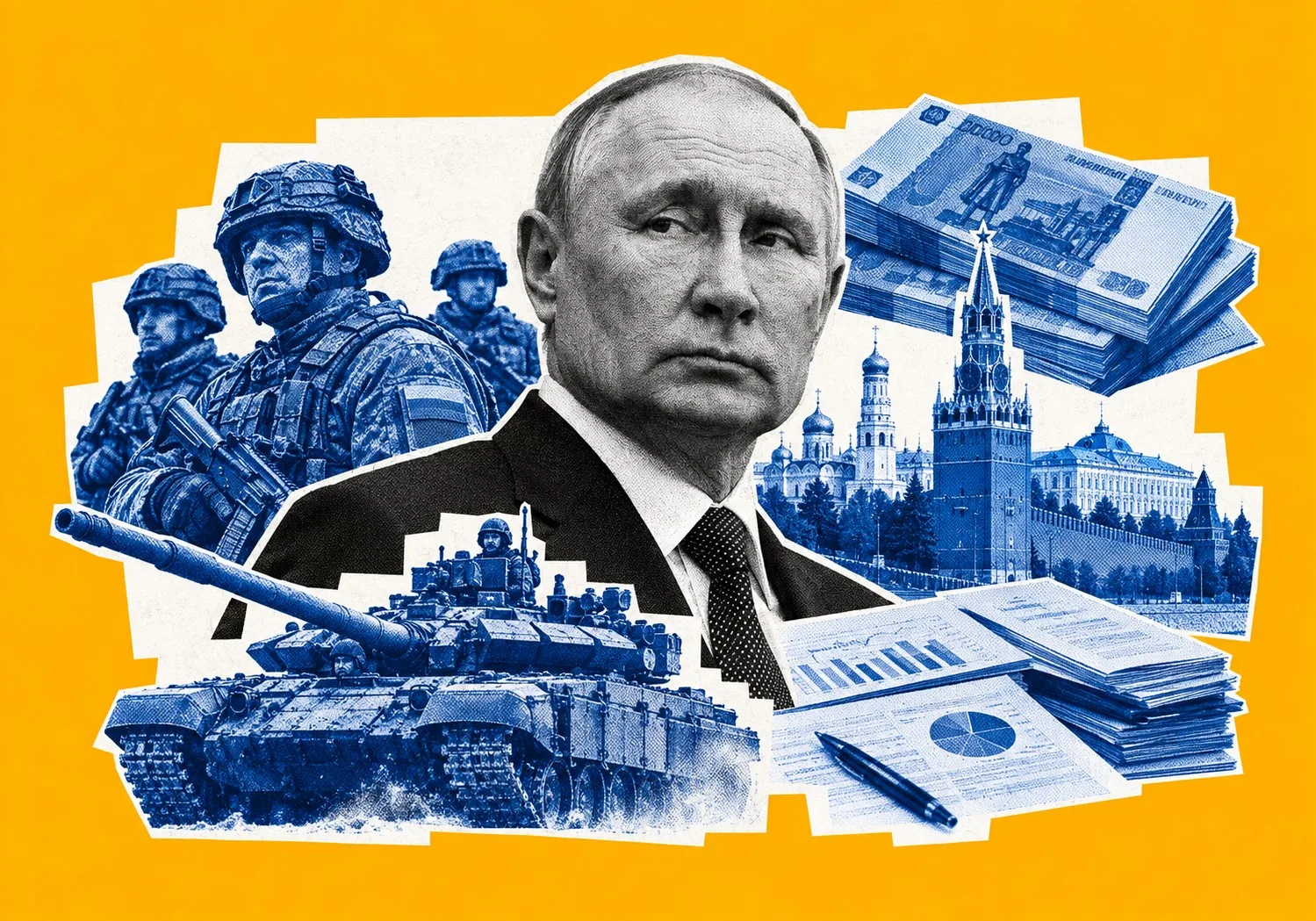
Leaked draft budget documents obtained by Reuters reveal that Russia plans to spend a record 17.1 trillion rubles (€178.8 billion) on defence in 2027. The figure—a 27 percent surge over previous projections—signals Moscow’s intent to sustain a long-term war in Ukraine. Over the full three-year planning window through 2027, the Kremlin’s military ledger is scheduled to absorb an extraordinary 50 trillion rubles (€522.6 billion). Yet behind the headline numbers lies a distinct structural challenge: Moscow is financing its military obligations by expanding domestic debt, drawing down state reserves, and increasing tax rates across the domestic economy.
The financial parameters set out in the draft framework illustrate a sharp escalation in state expenditure.
Total federal spending is projected to expand from 39.4 trillion rubles in 2025 to 44.2 trillion rubles in 2026, eventually reaching 48.6 trillion rubles in 2027.
Defence allocations will account for the single largest share of this growth, rising from 13.5 trillion rubles to 14.8 trillion rubles before reaching the 17.1 trillion ruble peak.
As a consequence, the projected budget deficit for 2026 has been doubled to 3.2 percent of gross domestic product. Bridging that shortfall will require substantial new borrowing and revenue measures.

The Mechanics of Domestic Sovereign Debt
Russian officials routinely cite the country’s low public debt ratio as proof of financial stability.
Standing at roughly 19 percent of GDP, Moscow’s total debt appears modest alongside Western balance sheets—Germany sits at 64 percent, Britain near 94 percent, and the United States exceeds 120 percent.
That comparison omits key structural constraints, however.
Cut off from international capital markets by sanctions, the Russian treasury relies almost entirely on a shallow domestic market dominated by state-owned lenders, primarily Sberbank and VTB. Because foreign portfolio investors are absent and market liquidity remains restricted, issuing large volumes of debt without directly driving up interest yields has become virtually impossible.
This environment alters borrowing costs significantly.
To place government bonds—known as OFZs (Obligatsii Federal’nogo Zayma)—with commercial banks, the Finance Ministry must pay market yields currently trading between 14 and 16 percent. These high rates reflect the Central Bank of Russia’s elevated key policy rate, maintained to offset war-related inflationary pressure and a weakening currency.
Equivalent ten-year government bond yields across G7 economies average roughly 4.3 percent.
Consequently, debt service costs represent a growing share of federal outlays despite the low overall debt-to-GDP ratio.
Annual interest payments on state debt will reach nearly 4 trillion rubles (€41.7 billion / $47.2 billion) this year, accounting for approximately ten percent of total federal spending. Germany spends roughly six percent of its federal budget servicing a national debt load three times larger relative to its economy. Federal outlays on debt interest now exceed combined spending on healthcare and education.
Borrowing requirements are scheduled to expand further over the coming cycle.
Net domestic borrowing targets stand at 5 trillion rubles for 2026—a 26 percent increase—and reach 7.7 trillion rubles in 2027, up an additional 43 percent.
Official estimates project total public debt will pass the Finance Ministry’s designated 20 percent threshold, reaching 21.7 percent of GDP by 2027.
The composition of this debt adds further fiscal risk.
To maintain demand among commercial banks, the Finance Ministry has shifted away from fixed-coupon paper (OFZ-PD) toward floating-rate bonds (OFZ-PK) tied directly to RUONIA, the overnight interbank benchmark rate.
While floating rates insulate institutional buyers against inflation, they create an immediate transmission mechanism. Every rate hike by the central bank directly inflates the government's own debt-servicing obligations.
Depletion of Sovereign Reserves and Tax Restructuring
In the initial years following the full-scale invasion of Ukraine, budget shortfalls were covered primarily by the liquid assets of the National Wealth Fund (NWF) and elevated energy export receipts.
That balance has shifted.
Hydrocarbon revenues face downward pressure from changing trade patterns, discounted export pricing, and European market decoupling.
The Finance Ministry revised its projected 2026 oil and gas revenues down to 7.6 trillion rubles, from an earlier 8.9 trillion rubles.
Simultaneously, the liquid portion of the NWF has decreased following successive drawdowns to cover deficit spending.
The government plans to use an additional 459 billion rubles from the fund in 2026, which represents roughly 11 percent of its remaining liquid assets.
As reserve drawdowns become more constrained, fiscal policy is shifting toward domestic revenue generation and direct taxation.
The draft budget details several broad tax adjustments targeting both corporate earnings and private income. A targeted windfall tax on metals and mining operations is projected to raise approximately 200 billion rubles annually.
Personal income tax rates on capital gains, including property sales and bank deposit interest, will reach up to 22 percent under an increasingly progressive tax scale.
At the retail level, a 22 percent Value Added Tax will apply to cross-border e-commerce transactions, accompanied by a 100-ruble customs handling fee on international parcels below €200 ($226).
In parallel, non-defence spending allocations will decline by roughly 2 trillion rubles (€20.8 billion / $23.6 billion). That reduction directly curtails funding for regional infrastructure, environmental projects, and housing subsidies.
Resource Allocation, Labour Shocks, and Private Sector Impact
These fiscal adjustments reflect a deeper shift in capital and resource allocation across the Russian economy, prioritizing defense output over civilian enterprise.
Higher borrowing costs, increased corporate tax rates, and rising labor expenses have slowed private sector investment. Fixed capital formation fell 9.9 percent year-on-year in the first half of 2026. Reduced retained earnings leave commercial firms with less available capital to replace capital goods, repair imported machinery, or expand civilian production lines.
Furthermore, the state-driven military expansion has created severe distortions in the labor market.
Offering state-subsidized wages and military draft deferments, defense plants actively pull skilled personnel away from agriculture, construction, transport, and commercial manufacturing. With unemployment at record lows, non-defense companies face acute labor shortages. They are forced to raise wages above productivity growth simply to retain workers, further feeding domestic wage-push inflation.
In contrast, state procurement contracts provide guaranteed cash flows to the defense industry.
Backed by the 50 trillion ruble multi-year commitment, defense manufacturers retain prioritized access to credit, raw materials, and energy supplies. State-owned banks similarly benefit from holding high-yield sovereign paper, earning consistent interest margins guaranteed by the federal treasury.
Diverting capital to military hardware changes the long-term economic trajectory, however.
While weapons manufacturing adds to short-term industrial production metrics, defense equipment generates limited ongoing economic value or productivity gains compared to civil infrastructure, commercial logistics, or technological research. High-yield government bonds also absorb domestic bank capital that might otherwise fund commercial loans, industrial equipment leasing, or private housing construction.
Policy Implications for Western Observers
For European policymakers and international financial institutions, the leaked 2027 figures illustrate Moscow’s multi-year budget planning and strategic priorities.
The expanded defence allocations confirm that military procurement remains the central priority of Russian fiscal policy over the medium term.
At the same time, the underlying budget mechanics demonstrate clear trade-offs.
Financing military outlays without access to foreign capital requires higher domestic taxation, reduced non-military outlays, and expanded bond issuances at elevated yields.
This structure limits policy flexibility.
Lowering interest rates risks accelerating inflation and weakening the exchange rate, whereas maintaining high policy rates increases the state's own debt-servicing obligations and dampens civilian economic activity.
The 2027 budget figures highlight how Russian fiscal policy is adapting to fund military spending through higher domestic borrowing costs, structural capital reallocations, and broader tax collection.
Sources: Reuters, The Moscow Times, RBC-Ukraine