
Russian Death Toll in Ukraine War Exceeds 700,000, Investigation Estimates

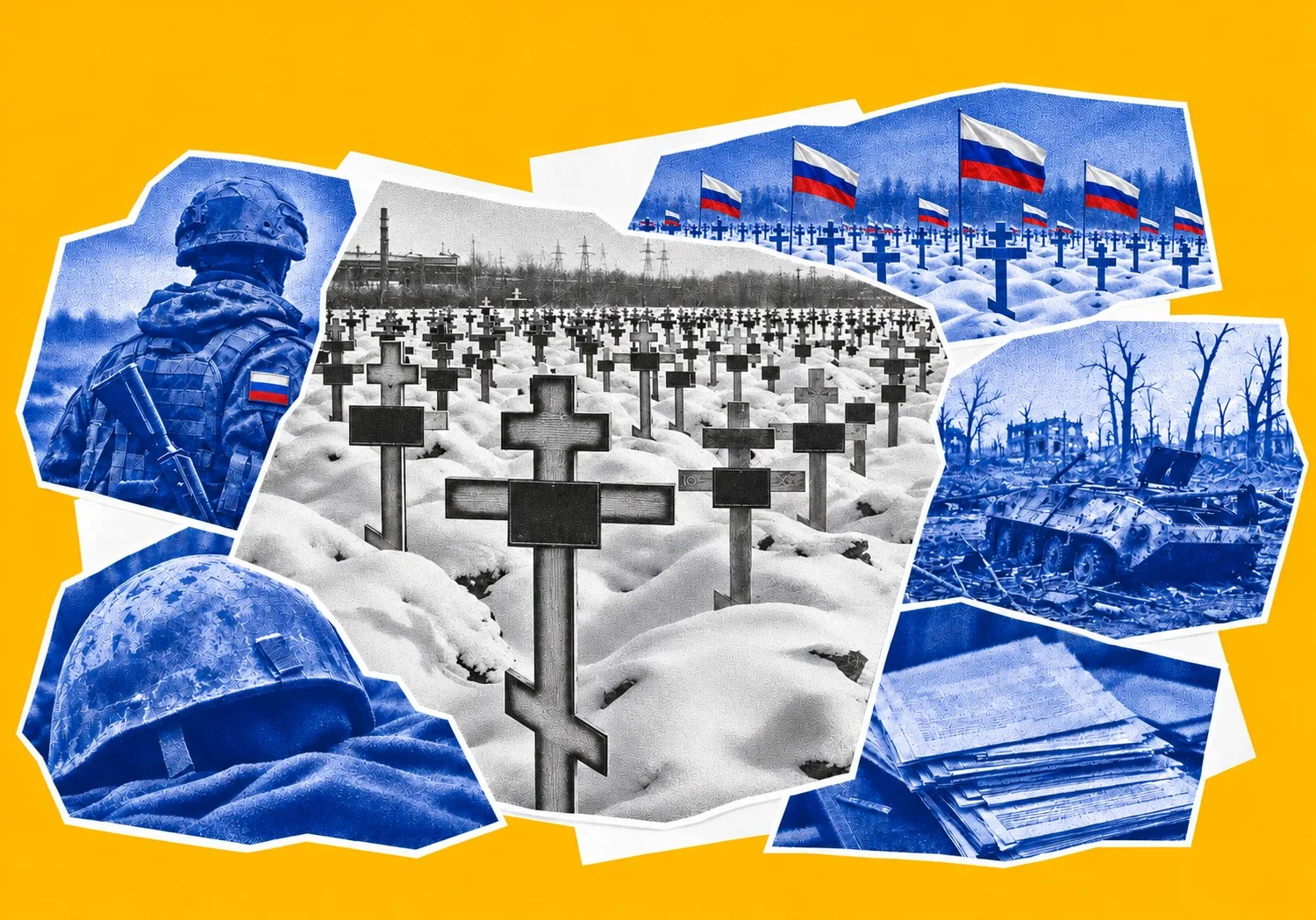
A leak of millions of Russian death certificates has allowed journalists to trace the mounting cost of the war in Ukraine, revealing a sharp rise in military deaths and the disproportionate losses borne by men from poorer regions. The investigations, published on 23 November, followed a breach of Rosstat, Russia’s state statistics agency. On 1 November, hackers replaced pages on its website with a message in Belarusian: “No one can escape responsibility.” They also claimed to have obtained internal data on Russian military losses. The Belarusian Cyber Partisans and Ukrainian collective Silent Crow subsequently released their own death counts and shared the database with journalists, including Meduza and Mediazona, which have spent years investigating Russian military losses. Rosstat acknowledged the cyberattack but initially denied that protected information had leaked.
The database contains more than 11 million death certificates from civil registration offices across Russia. Meduza identified roughly 490,000 registered military deaths and used information about missing soldiers and registration delays to estimate that more than 700,000 servicemen died between February 2022 and the end of September 2026.
This is a statistical estimate, with greater uncertainty for recent months, rather than a count of individually confirmed deaths.

A separate Guardian investigation identified more than 460,000 war-linked deaths in the database, without estimating the full number of unregistered fatalities.
Those delays are central to understanding the findings. A soldier who disappears during an assault may remain unaccounted for until his body is recovered or a court declares him dead. His death can enter the register months or years after the battle. The resulting gaps make recent fighting appear less deadly than it was and prevent a straightforward reading of the incomplete 2026 figures.
The Guardian used a different definition, including certificates that identified war as a cause of death or recorded military employment, while excluding people outside combat age. Some civilian deaths may be included. Its count and Meduza’s overlap and cannot be added together; neither should be confused with total casualties, which also include wounded personnel.
Russia’s defence ministry last publicly updated its own military death toll in September 2022, when it announced 5,937 dead.
The leaked records show how far the war has moved beyond that early official account, even before allowing for soldiers whose deaths remain unregistered.
The Cost of the Advance
The Guardian counted almost 20,000 deaths in 2022, about 50,000 in 2023 and more than 134,000 in 2024. The toll approached 200,000 in 2025, an average of approximately 548 a day.
During the week beginning 5 May that year, more than 5,000 Russian soldiers were killed — about 720 a day. At least a third died around Pokrovsk. Among them was Alexander Korepanov, 52, who enlisted in August 2023. Wounded twice and sent back to the front after each injury, he was killed in nearby Uspenovka on 11 May 2025, according to the Guardian.

From mid-2023, the certificates often record where soldiers died, sometimes naming individual villages.
Almost 116,000 deaths occurred in Pokrovsk district, which includes Avdiivka and Pokrovsk itself: more than a quarter of those with a known location. That district-wide toll exceeds the approximately 60,000 people who lived in Pokrovsk city before the invasion.
After Avdiivka fell in February 2024, Russian forces took 21 months to advance roughly 39 kilometres to Pokrovsk’s outskirts, according to the Institute for the Study of War.
Around 88,700 Russian deaths were recorded across the district during that period. The figures illustrate the cost of the campaign, although they cover a wider battlefield than the route between the two cities.
Across the front, Russia gained about 8,000 square kilometres from the beginning of 2023, according to DeepState, the Ukrainian monitoring group cited by the Guardian. That amounts to less than 1.5% of Ukraine’s territory.
Janis Kluge, a Russia specialist at the German Institute for International and Security Affairs, told the Guardian that the toll was putting pressure on recruitment. “If we compare the death data with Russia’s official recruitment rates, it becomes clear that Russia’s military has a manpower problem,” he said. In his assessment, heavy losses and slower recruitment appeared to have forced Russia to reduce its attacks during 2026.

Kluge also said the records suggested Russian deaths could exceed the number of soldiers severely wounded. That comparison concerns serious injuries, rather than all wounds, but challenges the usual expectation that substantially more soldiers survive injuries than are killed.
Who Bears the Losses
The average age of the dead rose from 34 in 2022 to nearly 40 in 2026.
Among soldiers whose ages were recorded, almost one in five killed this year was over 50, compared with 6% in the invasion’s first year. After the unpopular mobilisation of September 2022, the Kremlin relied heavily on enlistment bonuses, offering a financial incentive that carried particular weight in poorer areas.
The eight poorest regions recorded military death rates around four times those of the eight wealthiest: more than 10 deaths per 1,000 men aged 18 to 69, against fewer than three. Many heavily affected regions are far from Moscow and have substantial ethnic minority populations, although regional figures do not establish the ethnicity of individual soldiers.
Zabaykalsky Krai, near China, had the highest recorded rate, with 32 deaths per 1,000 men aged 18 to 69 born there.
Moscow and St Petersburg recorded about one per 1,000.
The comparisons use birthplace, which may differ from where soldiers lived before enlisting. In at least 19 regions, mostly in the far east, war accounted for more than half of deaths among men under 50 in 2025 where a cause was recorded. In the Jewish Autonomous Oblast, the proportion exceeded three-quarters, showing how heavily military deaths dominated mortality among younger men in some communities.
The recruitment effort also extended abroad.
The Guardian identified more than 7,300 probable foreign soldiers among the dead, excluding Ukrainians. Around 2,700 were born abroad but had no recorded citizenship, making this an estimate rather than a confirmed count of foreign nationals. More than three-quarters came from former Soviet republics; others came from 78 countries outside the former USSR. The records included about 440 people with African citizenship and roughly 200 from South America, mainly Colombia and Cuba. Some recruits had been promised civilian work, high pay or citizenship before finding themselves at the front.
The domestic consequences reach beyond recruitment. Among certificates with a recorded cause, war accounted for 29% of deaths of men under 65 in 2025, ahead of circulatory diseases at 26%.
Judyth Twigg, a professor of global health at Virginia Commonwealth University, told the Guardian that Russia’s demographic situation looked “qualitatively different” from earlier periods. She linked combat deaths to emigration, births that would not take place and pressure on healthcare spending.
Kyiv’s Figures, Moscow’s Claims
Ukraine’s General Staff estimated Russian personnel losses at approximately 1.64 million as of 23 November 2026, including 2,471 over the preceding day. Its bulletin does not separate deaths from other personnel losses, so the headline figure cannot be compared directly with Meduza’s estimate of fatalities.
In a Fox News interview published on 30 July 2026, President Volodymyr Zelenskyy separately put Russian deaths at around 700,000 and total losses at about 1.6 million. These were Ukrainian official estimates; the similarity to Meduza’s later death toll does not establish that the assessments used the same evidence.
Zelenskyy also said approximately 50,000 Ukrainian soldiers had been killed and 400,000 wounded, with many others missing. He said full figures were withheld for security reasons. Suspilne noted that he had previously reported 55,000 confirmed deaths in February 2026, without explaining why the later figure was lower.

Russia’s defence ministry, meanwhile, has claimed more than 1.5 million Ukrainian soldiers killed or wounded, according to TASS reporting cited by Focus. The outlet contrasted that claim with Kremlin adviser Anton Kobyakov’s September 2025 assertion that Ukrainian losses totalled 1.8 million. Neither claim has been independently verified, and the reports offer no consistent accounting that reconciles them.
Neither side publishes regular, comprehensive figures for its own military losses. Ukraine has occasionally disclosed headline death tolls, while Moscow has withheld updates throughout most of the invasion.
Sources: Meduza, The Guardian, Suspilne, Focus
-